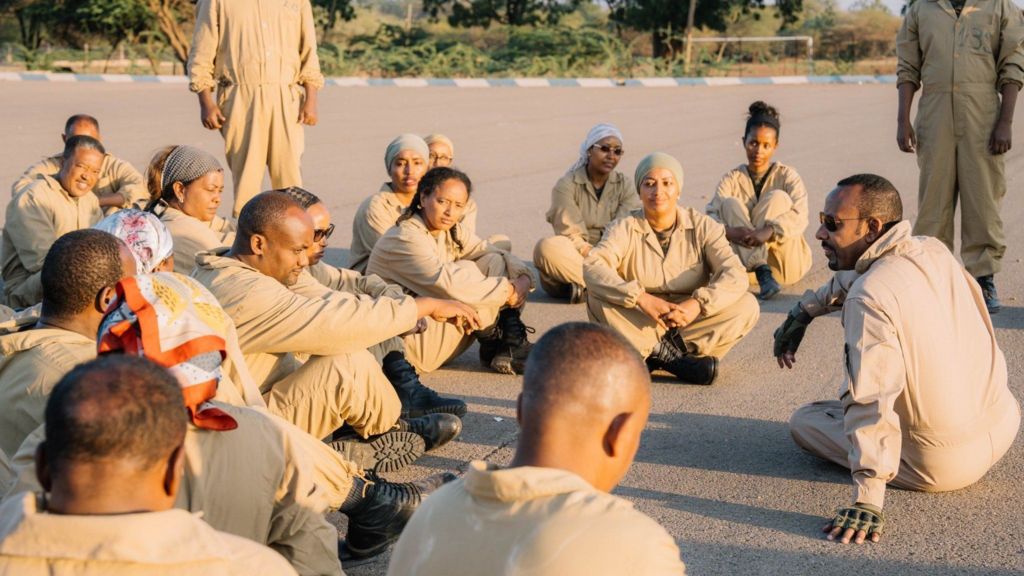
Ethiopia’s Prime Minister Abiy Ahmed has launched a landmark, unprecedented military training program for all senior civilian government leaders, including his full cabinet, deputy ministerial teams, heads of federal public institutions, and the speaker of the House of Federation, at the Hurso military training centre. The prime minister shared a series of firsthand photos on his official social media channels showing him participating in hands-on field drills alongside high-profile attendees such as Finance Minister Fitsum Assefa, Health Minister Mekdes Daba, and legislative speaker Muferiat Kamil, breaking with longstanding local norms where civilian political elites almost never undergo formal military induction. While the exact start date and scheduled duration of the specialized training have not been publicly disclosed, Abiy laid out a clear policy rationale for the unusual initiative in his accompanying social media statement. He framed the program as a deliberate investment in building a new cohort of national leadership that meets three non-negotiable benchmarks: peak physical fitness, unwavering moral integrity, and sharp intellectual competence, all of which he argues are prerequisites to deliver on Ethiopia’s national goal of inclusive, widespread shared prosperity. The Nobel Peace Prize-winning leader emphasized that formal military institutions are uniquely positioned to instill core values that civilian public administration training often overlooks: strict operational discipline, unflinching patriotic commitment, cross-unit collaborative teamwork, transparent personal accountability, and decisive, mission-driven leadership. In a notable framing, Abiy drew a direct parallel between military and civilian priorities, noting that while service members operate against clearly defined tactical targets and civilian leaders work toward long-term public goals, both groups share the ultimate objective of delivering collective victory for the Ethiopian people. The prime minister further argued that merging structured military discipline with civilian governance frameworks would cultivate a generation of public servants with a powerful sense of collective purpose, heightened personal responsibility, and proven ability to coordinate across silos to advance shared national priorities. The high-profile training rollout unfolds against a fraught backdrop of overlapping security crises across Ethiopia: intermittent armed clashes continue to flare in residual hotspots of the northern Tigray region two years after the formal cessation of the two-year Tigray war, widespread intercommunal and state security conflict persists across the Amhara region, and long-running localized insecurity remains pervasive in large swathes of Oromia. Compounding domestic strains, bilateral tensions with neighboring Eritrea have escalated sharply in recent months, with widespread regional and international diplomatic warnings of a potential return to open full-scale conflict between the two Horn of Africa nations. This new initiative is far from an outlier for Abiy’s administration, which has repeatedly positioned robust national military preparedness as a core pillar of its broader national development strategy over recent years.