A bitter political showdown has erupted in Warsaw over Poland’s highest constitutional judicial body, the Constitutional Tribunal, after the centrist administration led by Prime Minister Donald Tusk took the unprecedented step of suspending the court’s two most senior leaders and initiating proceedings to press criminal charges against them.
Poland’s sitting Justice Minister Waldemar Żurek formally submitted a request to lift the legal immunity that shields Tribunal President Bogdan Święczkowski and Vice-President Bartłomiej Sochański from prosecution, clearing the path for formal criminal allegations over their refusal to allow five newly elected parliamentary nominees to take seats on the court’s bench.
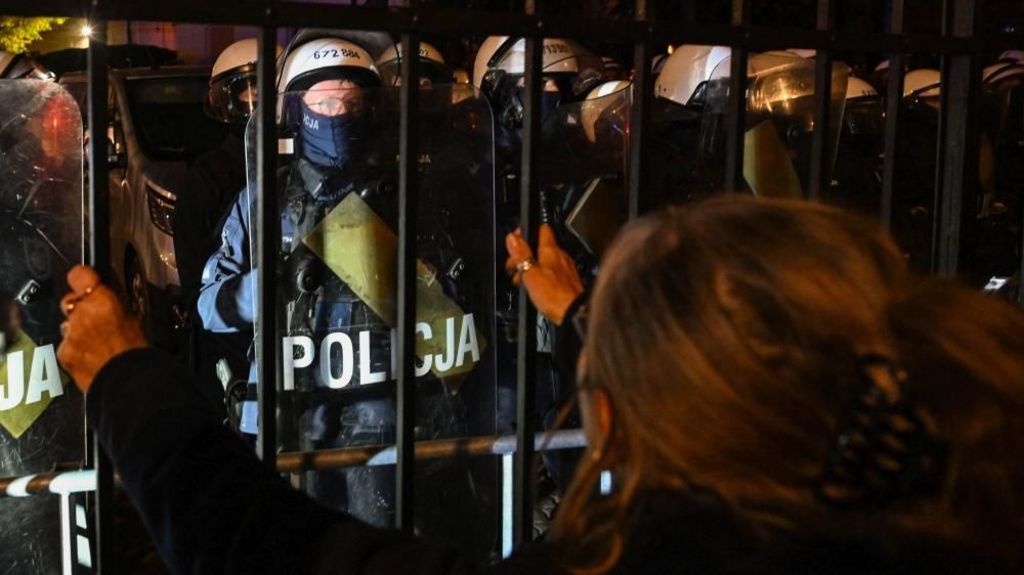
The move immediately galvanized supporters of the right-wing, formerly ruling Law and Justice (PiS) party, who gathered in large, vocal crowds outside the Tribunal’s Warsaw headquarters to denounce the government’s action as an illegal power grab. Riot police units were deployed around the perimeter of the building to block protesters from breaching the premises, as footage of the tense face-off between demonstrators and law enforcement circulated widely across Polish and European media.
In an official statement shared on its social media channels, the Constitutional Tribunal reaffirmed that Święczkowski and Sochański remained the legally appointed senior leadership of the court, and went as far as to label all parties involved in the government’s intervention as participants in a “coup d’etat.” Prime Minister Tusk pushed back forcefully against that characterization, framing his administration’s actions as a long-overdue corrective for years of institutional damage. “Restoring the rule of law is our non-negotiable duty. After nearly a decade of systemic lawlessness under the PiS government, this process is difficult, at times painful, and demands unflinching decisive action. There is no viable alternative path forward,” Tusk wrote in a public social media post.
PiS-aligned Polish President Karol Nawrocki, who was mid-flight en route to Senegal for the Summer Youth Olympic Games, immediately ordered his aircraft to turn back to Warsaw to address the unfolding crisis.
The standoff traces its roots back to 2015, when the newly elected PiS government launched a sweeping overhaul of the Constitutional Tribunal, a body with full authority to validate or strike down all national legislation. The PiS parliamentary majority fast-tracked appointments for a slate of loyalist judges to seize control of the court’s bench, a move that was later ruled unlawful by both the European Court of Human Rights and the Court of Justice of the European Union. The two top European judicial bodies concluded that three of the PiS-appointed judges had been installed to fill seats that had already been legitimately filled by the previous parliament, and formally declared that Poland’s Constitutional Tribunal no longer qualified as an independent, impartial judicial body. The Tusk administration, which took office in late 2023, has cited these European court rulings as its legal justification for refusing to publish the Tribunal’s formal decisions.
Tusk came to power on a public promise to fully depoliticize Poland’s judiciary, but his efforts to roll back PiS-era judicial reforms have been consistently stymied by presidential vetoes, first from PiS-backed former head of state Andrzej Duda, and now from Nawrocki. The current president has repeatedly refused to swear in five new Constitutional Tribunal judges elected by the national parliament since March, claiming procedural flaws marred their selection process. Anna Korwin-Piotrowska, one of those five blocked nominees, has now been installed as the temporary acting head of the court. The Council of Europe’s independent constitutional advisory body, the Venice Commission, publicly ruled earlier this month that Nawrocki had a clear legal obligation to swear in the five judges to fill the court’s vacant seats.
The dramatic intervention has sparked fierce debate across Poland’s legal and political spheres. Some of Tusk’s longstanding supporters have previously criticized him for moving too slowly to dismantle PiS’s judicial overhaul, with a number of political analysts suggesting the high-profile move is strategically timed to shore up his base ahead of next year’s scheduled parliamentary elections. But the action has also drawn sharp condemnation from even figures who have been vocal critics of PiS’s past judicial power grabs. Marcin Matczak, a prominent legal scholar who has repeatedly called Święczkowski the worst president in the Constitutional Tribunal’s history, argued that the justice minister’s suspension of the two top justices lacks any legitimate legal basis. “There are a million reasons this move has no legal standing. In my view, today’s action at the Constitutional Tribunal buries this institution and any progress on rule of law reform for the next two decades,” Professor Matczak posted to social media. “Images of armed police deployed at the highest constitutional court, paired with legal arguments that would allow a justice minister to unilaterally remove the Tribunal president by decree, will create a powerful anti-rule of law backlash that will echo for decades to come.”
Police deployed during stand-off over control of Poland’s top court