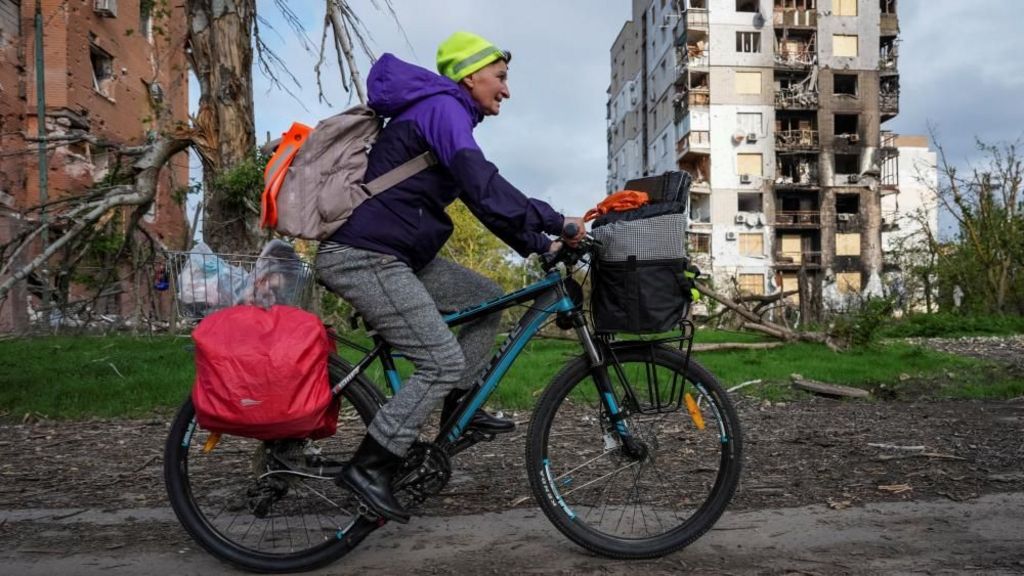
For the first stretch of unbroken quiet in nearly half a decade, the front-line Ukrainian city of Kherson has shed the constant din of Russian drone and artillery strikes, following a US-negotiated temporary ceasefire that took effect earlier this week. The pause in hostilities, set to expire on Sunday, was initially arranged to facilitate safe civilian evacuation from the Russian-occupied riverside city of Oleshky, located across the Dnipro River from Kherson, an initiative spearheaded by US First Lady Melania Trump. Ahead of the planned Friday evacuation of Oleshky’s remaining residents, Russian demining teams have worked for days to clear access routes for civilians to exit the occupied territory, with a contingent of American journalists invited to observe the formally announced humanitarian operation.
Across Kherson, the sudden absence of incoming attacks has unlocked small, long-forbidden acts of normalcy that once required constant vigilance for overhead threats. Social media footage captures residents meandering down streets still strung with anti-drone nets, gathering in public squares to soak in autumn sunshine, and running routine errands without the usual rush to seek shelter. For 42-year-old local resident Olga, the complete silence that settled over the city the moment the ceasefire was announced felt almost surreal. “We are all overjoyed,” she shared over a phone call, her elation audible even through the line. “It feels as if everything we have endured has finally come to an end.”
Ukraine’s Human Rights Ombudsman Dmytro Lubinets noted that Kherson has “literally come back to life” since Tuesday, with residents stepping outside unhurriedly to enjoy small pleasures that had been erased by years of active combat. Even the city’s long-restricted “red zone” – a heavily bombarded district so exposed to crossfire that it had been deemed unlivable for years – has seen dozens of residents venture back this week to retrieve personal belongings from their abandoned homes. Many returned to find their properties reduced to charred, looted shells, the scale of destruction described by Czech on-the-ground volunteer Denisa Bohackova as staggering. For some, the trips were not for material goods: Angela Dobrovolska traveled back from Kyiv for the first time in months to visit the grave of her husband Serhiy, who was killed two years prior by a grenade dropped from a Russian drone during one of the notorious “human safari” attacks that Kherson has become synonymous with.
But beneath the widespread relief runs a current of sharp, well-founded anxiety. Multiple local sources warn that Russian forces are exploiting the temporary truce to reinforce their positions across the Dnipro, rather than only facilitating the Oleshky evacuation. A local government official speaking anonymously to the BBC confirmed that Russian troops are using the lull to bring in fresh ammunition, drones, and military supplies, and to carry out widespread force redeployments ahead of a planned renewed offensive against Kherson as soon as the ceasefire ends. Petro Andriushchenko, head of Ukraine’s Center for Studying the Occupation, corroborated these reports, noting that local witnesses have observed a major Russian military build-up near Radensk, a settlement 12 miles from Oleshky. He warned that the situation after Sunday could be far worse than the pre-ceasefire status quo, as Russian units will enter the next phase of combat far better resourced and positioned.
The city’s residents, who have already adapted to nearly five years of near-constant attacks – navigating regular power blackouts, mines concealed under autumn leaves, and a city that typically shuts down entirely by mid-afternoon – are acutely aware the reprieve is fleeting. The city’s population has collapsed from 250,000 before Russia’s full-scale invasion to roughly 65,000 today, with schools, hospitals, and cultural venues moved entirely underground for safety. Even so, the two days of unbroken peace have given many a tangible taste of the normal life they have spent years dreaming of: Olga was able to drive to a neighboring town, ride a bus to visit her grandmother with her son, and navigate a small, unheard-of traffic jam as local cafes and shops filled with patrons. Longtime resident Dima noted that unlike dozens of previous short-lived ceasefires that were immediately violated, this week’s pause has held – but no one is taking it for granted. “These few days showed us exactly what life could be like if the war finally ended,” he said, as he prepared to visit his abandoned red zone apartment with his wife. “We know the strikes will resume on Monday, and they will be worse. But for now, we are breathing.”