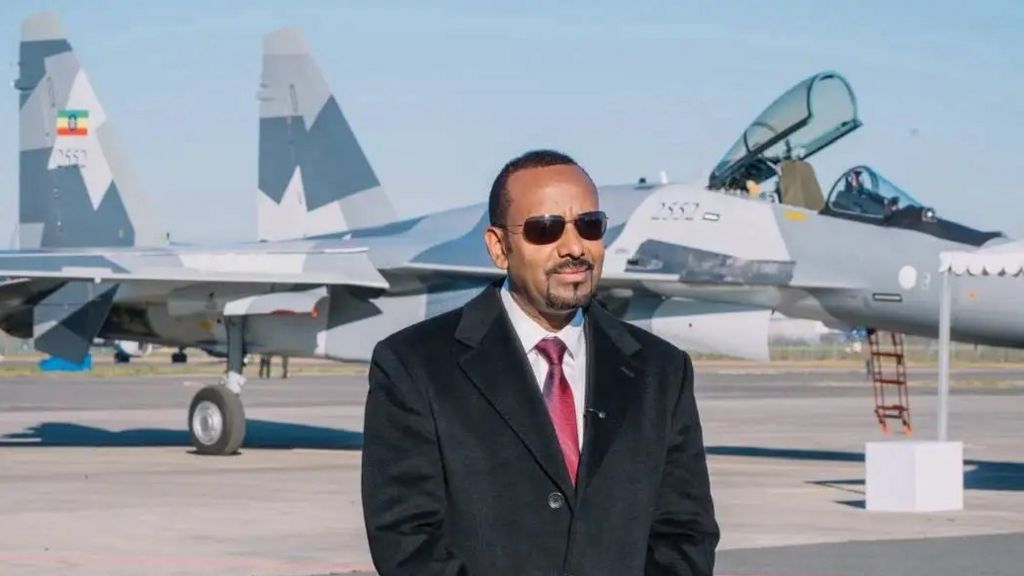
During his attendance at the 2024 Russia-Africa Summit in Moscow, Ethiopian Prime Minister Abiy Ahmed officially confirmed that his nation has received a full fleet of 12 advanced Su-35 fighter jets from Russia, delivered far earlier than the timeline outlined in a bilateral military procurement deal first struck several years prior. Abiy framed the acquisition as a landmark milestone in Ethiopia’s long-term national defense modernization agenda, noting that the country has also formalized plans to procure four S-400 long-range air defense systems from Moscow in the near future. The delivery of the high-performance combat aircraft arrives as hostilities re-escalate in Ethiopia’s northern Tigray region, where clashes between federal government forces and the Tigray People’s Liberation Front (TPLF) have reignited just weeks after the breakdown of a 2022 ceasefire agreement that ended a two-year brutal civil war. Both parties have publicly accused one another of violating the terms of that prior peace accord. Abiy went on to emphasize that Ethiopia has now become the first nation in sub-Saharan Africa to operate this tier of cutting-edge fourth-generation combat aviation technology, framing the hardware as a critical bulwark against external security threats. He specifically singled out long-simmering frictions with neighboring Eritrea, which gained formal independence from Ethiopia in 1993 after decades of armed conflict, leaving Ethiopia entirely landlocked. Abiy has previously described Ethiopia’s lack of direct maritime access as an “existential national priority,” a stance that Eritrea’s government has repeatedly denounced as a direct threat to its territorial sovereignty. Ethiopian federal authorities have also long accused Eritrea of providing military backing to the TPLF, a claim Eritrean officials have consistently rejected. Describing Russian President Vladimir Putin as a “close friend of Ethiopia,” Abiy noted that the Su-35 platforms are engineered for dual air-to-air and air-to-ground operational roles, with on-board systems capable of detecting and neutralizing incoming cruise missiles at ranges of up to 200 kilometers. He added that these new fighter jets will complement Ethiopia’s already extensive existing drone arsenal, which includes Turkish and Chinese unmanned aerial vehicles that have seen widespread deployment in recent domestic conflicts. “If we fail to build this layered, multi-domain defense capability, sustaining our sovereignty as a nation in our volatile region will become exponentially more difficult. States that invest in adequate defensive preparedness are far less likely to face unwarranted aggression,” Abiy stated. Local military intelligence analyst Qalaab Segatu, speaking to BBC Amharic, noted that the Su-35 delivery signals Ethiopia is preparing for potential cross-border conflicts beyond its ongoing internal security operations, pointing to the jets’ exceptional maneuverability, long-range coverage, and advanced radar systems that can secure full regional air superiority. When paired with the forthcoming S-400 air defense batteries, the combined system will create a robust defensive umbrella protecting major urban centers and critical national infrastructure, most notably the Grand Ethiopian Renaissance Dam, a massive hydroelectric project that has been a source of regional diplomatic friction for years. This latest procurement builds on a series of steadily expanding bilateral military cooperation pacts between Russia and Ethiopia, including a 2021 agreement focused on joint military training and defense technology sharing.
Ethiopia acquires Russian fighter jets and air defence systems amid war in Tigray