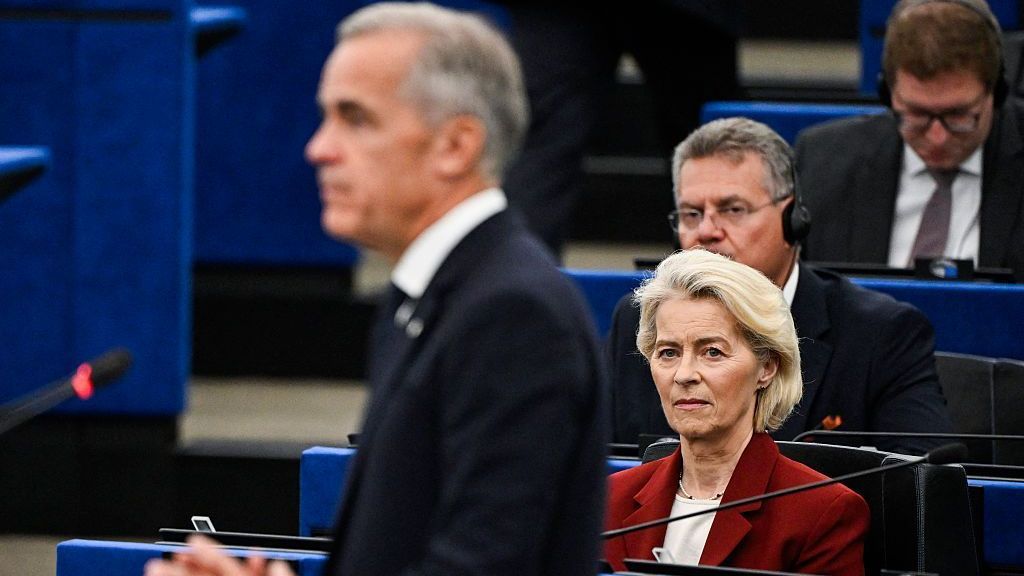
For decades, biennial summits between Canada and the 27-nation European Union proceeded as low-profile, procedural gatherings with minimal public fanfare. That long-standing pattern is set to shift entirely this week, as a high-stakes two-day bilateral summit kicks off in Montreal on Thursday, drawing unprecedented scrutiny from policymakers, industry stakeholders and geopolitical observers across the Atlantic. The gathering arrives on the heels of a landmark, unanticipated proposal last month from European Commission President Ursula von der Leyen, who floated the concept of granting Canada a formal, previously untested “associate membership” status to formalize far deeper integration between the North American nation and the EU bloc. Von der Leyen’s overture followed a high-profile address by Canadian Prime Minister Mark Carney to the European Parliament in Strasbourg, where he framed enhanced transatlantic alignment as a critical bulwark against escalating global geopolitical fragmentation and shared security risks. While Carney and a large contingent of EU member states have embraced the broader vision of tighter bilateral cooperation, a sharp diplomatic tussle has emerged over the proposed “associate membership” terminology. Leading the pushback is Germany, which has raised public and private objections that the label risks sidelining Ukraine and Moldova, two Eastern European nations that have spent years pursuing full EU accession, and for whom Berlin has long reserved the “associate membership” designation as a transitional framework for candidate countries. Multiple diplomatic and media outlets confirmed that Berlin and its allied member states successfully negotiated to strip all references to the “associate membership” title from the draft joint summit statement, replacing it with more ambiguous, softened language referencing a shared commitment to building an “ever closer association” between the two parties. Speaking to CTV News on Tuesday, Germany’s ambassador to Canada Matthias Lüttenberg acknowledged that many EU capitals were caught off guard by von der Leyen’s original announcement, noting that the proposed term had no established legal definition as it applied to a North American partner. He emphasized that neither side was entertaining the possibility of full Canadian EU membership, with the shared goal instead being to integrate Canada as closely as possible into EU policy and program frameworks without granting formal bloc membership. The summit’s opening day will feature a cross-continental business forum bringing together Carney, von der Leyen, and hundreds of senior industry leaders from both regions, while negotiators are set to hash out finalized bilateral agreements across four core priority areas: joint defence cooperation, critical minerals supply chain integration, cross-border academic and scientific research partnerships, and targeted trade expansion. Senior EU officials speaking on condition of anonymity earlier this week downplayed expectations for a sweeping, headline-making announcement on the formal new bilateral status at the close of the Montreal summit, noting that most of the structural details of the new partnership will be finalized through follow-up working group negotiations over the coming six to 12 months. Leaked preliminary outlines of the proposed partnership framework point to expanded cross-Atlantic student mobility programs, streamlined regulatory alignment for small and medium-sized enterprises, and targeted Canadian participation in select EU public programs, with no requirement for Ottawa to pay the large mandatory membership contributions levied on full EU member states. A senior Canadian official, granted anonymity to brief reporters ahead of the summit, noted that the ongoing dispute over naming conventions was purely symbolic, and did not undermine the shared high level of ambition for deeper bilateral alignment. The push for accelerated Canada-EU integration has gained significant momentum under Carney, who took office last year, as Ottawa navigates a protracted, volatile trade dispute with its southern neighbour and largest trading partner, the United States. Former U.S. President Donald Trump has publicly derided the concept of Canadian EU associate membership as “laughable”, and threatened to impose sweeping, severe new tariffs on European exports if he deems the arrangement to constitute a hostile act against U.S. economic interests. Canadian diplomatic representatives stressed on Wednesday that the ongoing transatlantic alignment initiative is not designed to antagonize Washington, and simply builds on years of pre-existing collaborative work between Ottawa and Brussels. The two sides have already locked in preliminary recent agreements, including a landmark deal granting Canadian defence contractors formal access to the EU’s Security and Defence Partnership procurement program, and a historic energy pact signed with Germany in May that will establish the first long-term cross-Atlantic liquefied natural gas export shipments from Canada to European markets to help reduce the bloc’s reliance on non-Western energy suppliers. Ahead of the summit, Carney told reporters that the naming debate over the new partnership status is ultimately irrelevant. “The nomenclature does not matter at all,” he stated. “What counts is the tangible, positive difference this arrangement will deliver to the daily lives of ordinary people across Canada and the European Union.”