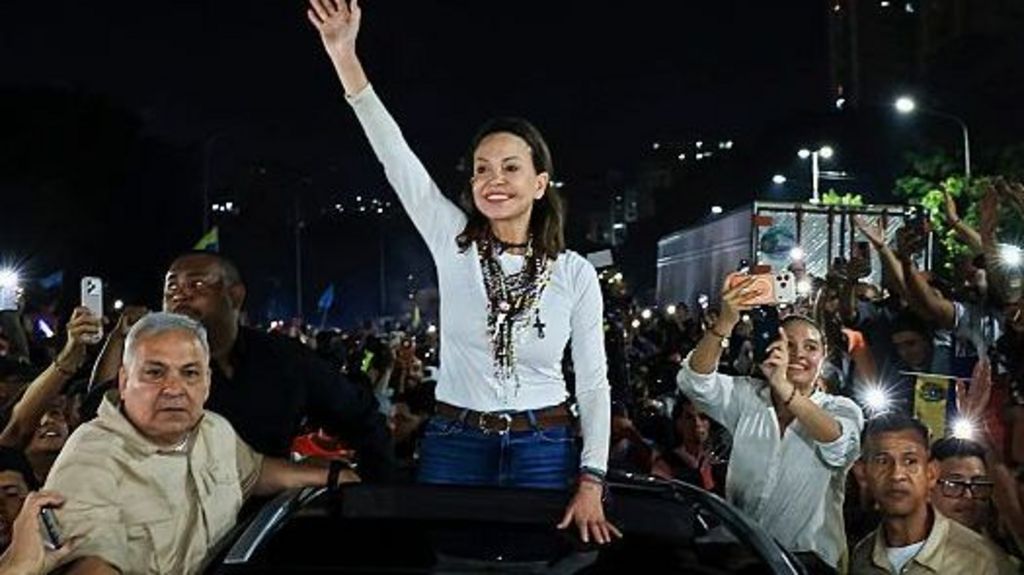
Venezuelan opposition figure Maria Corina Machado staged a dramatic, widely celebrated cross-country journey from the western state of Lara to the capital Caracas earlier this month, a homecoming that stands in stark contrast to her hasty, secret midnight exit from the country 10 months prior. Last December, Machado slipped across the border undetected to travel to Oslo and accept a Nobel Peace Prize, but for months afterward, repeated attempts to re-enter her homeland were blocked: first by the previous Venezuelan administration, then by the Trump White House, which repeatedly stated the timing for her return was not strategically favorable. The months-long standoff finally lifted, allowing Machado to travel openly through towns lined with cheering, flag-waving supporters, her procession broadcast live across social media to millions of Venezuelans who had waited for her return. “Maria Corina is the undisputed leader of Venezuela,” 20-year-old Gregory Noriega, a member of the grassroots opposition movement Vente Venezuela, said while waiting to catch a glimpse of Machado’s motorcade. “Her return is the first real spark of hope we have had in years.” 18-year-old Hilary, who joined crowds lining Caracas’ main avenues, echoed that sentiment: “This is a huge milestone for the electoral process we have been advocating for since last year.” Her companion Manuel added, “She came back right after the dual crises that shook our country, when we needed her most. Now the whole nation stands behind her, and no one is afraid to speak up anymore. The political reality in Venezuela has been completely reshaped in the time Machado spent abroad. On January 3, long-ruling president Nicolás Maduro was removed from power by U.S. military forces, extradited to New York, and formally charged with drug trafficking, weapons smuggling, and human rights abuses including systematic torture — charges he has pleaded not guilty to. Maduro’s former vice president Delcy Rodríguez assumed the interim presidency, and has overseen a rapid, unprecedented thaw in bilateral relations with the United States, ending nearly two decades of bitter animosity that defined the administrations of late socialist leader Hugo Chávez and his handpicked successor Maduro. This new diplomatic dynamic has created a set of unexpected, complex tradeoffs for all major political stakeholders. When Machado left Venezuela late last year, she was widely viewed as Washington’s preferred replacement for Maduro. Today, she returns to a political landscape where the Trump administration is fully satisfied with the Rodríguez government, at least for the time being. The U.S. recently signed a landmark energy deal with Caracas, granting a 100-year concession to 65 billion barrels of Venezuelan crude oil, in partnership with U.S.-based Venezuelan private firm North American Blue Energy Partners (NABEP), led by controversial businessman Alejandro Betancourt. Machado has publicly criticized the agreement, though she has carefully directed her critiques at the Rodríguez administration and Betancourt rather than President Trump, to whom she personally presented her Nobel Peace Prize, and whose political backing she still seeks to advance her own electoral ambitions. President Trump has repeatedly praised Rodríguez in public remarks, describing her as “wonderful” and “a terrific person” — a stark reversal from his previous characterization of Maduro’s entire government as a cabal of “narco-communists.” Leading Venezuelan political analyst Benigno Alarcon argues that Machado’s triumphant homecoming is the most consequential domestic political event since Maduro’s ouster in January. “It proves that her ability to mobilize grassroots support remains completely unbroken,” Alarcon explained. “For the first time in years, the Venezuelan opposition no longer has to operate entirely from exile. It now has a charismatic, widely recognized leader physically present on national soil.” Data from a joint research project by Venezuelan think tanks Polis and Nexo confirms that public political engagement has surged since January: the number of street protests across the country in the first nine months of this year was three times higher than the total number recorded for all of 2025, with demonstrations covering issues ranging from electoral reform and labor rights to public water access. Official data also shows that state repression of public demonstrations has fallen by more than 50% compared to last year. Analysts note that this more open public environment, paired with Machado’s return, is poised to galvanize a Venezuelan electorate that spent nearly a decade fearing retaliation for speaking out against government policies. Her arrival also aligns with U.S.-brokered reconciliation talks between the Rodríguez administration and opposition factions, a point U.S. Secretary of State Marco Rubio highlighted publicly, stating that Machado’s safe return was a direct outcome of the U.S.-backed negotiation framework. Machado still faces longstanding, unresolvable charges in Venezuela for treason and inciting insurrection, allegations she and her supporters have consistently dismissed as entirely politically motivated and baseless. She made at least eight separate failed attempts to re-enter Venezuela by air and sea before the Trump administration formally approved her return, a green light that the Rodríguez government has shown no willingness to challenge publicly. Rodríguez publicly dismissed Machado’s cross-country procession as a meaningless public “show,” and state-run television outlets entirely ignored the widespread public celebrations across the weekend. Even so, the interim president has signaled she is open to holding formal talks with Machado, as she knows maintaining good relations with the Trump administration is critical to avoiding Maduro’s fate. Multiple unconfirmed reports also suggest that most high-level decision-making in Venezuela’s oil-rich economy is now being directed by Secretary Rubio, who regularly holds late-night WhatsApp calls with Rodríguez to coordinate policy priorities. For the thousands of young Venezuelans who turned out to cheer Machado’s arrival in Caracas, her homecoming marks the start of an irreversible political transition, one that many said they could not have imagined even 12 months prior, when she left the country under cover of night.
Opposition leader María Machado returns from exile to a Venezuela reshaped by Trump