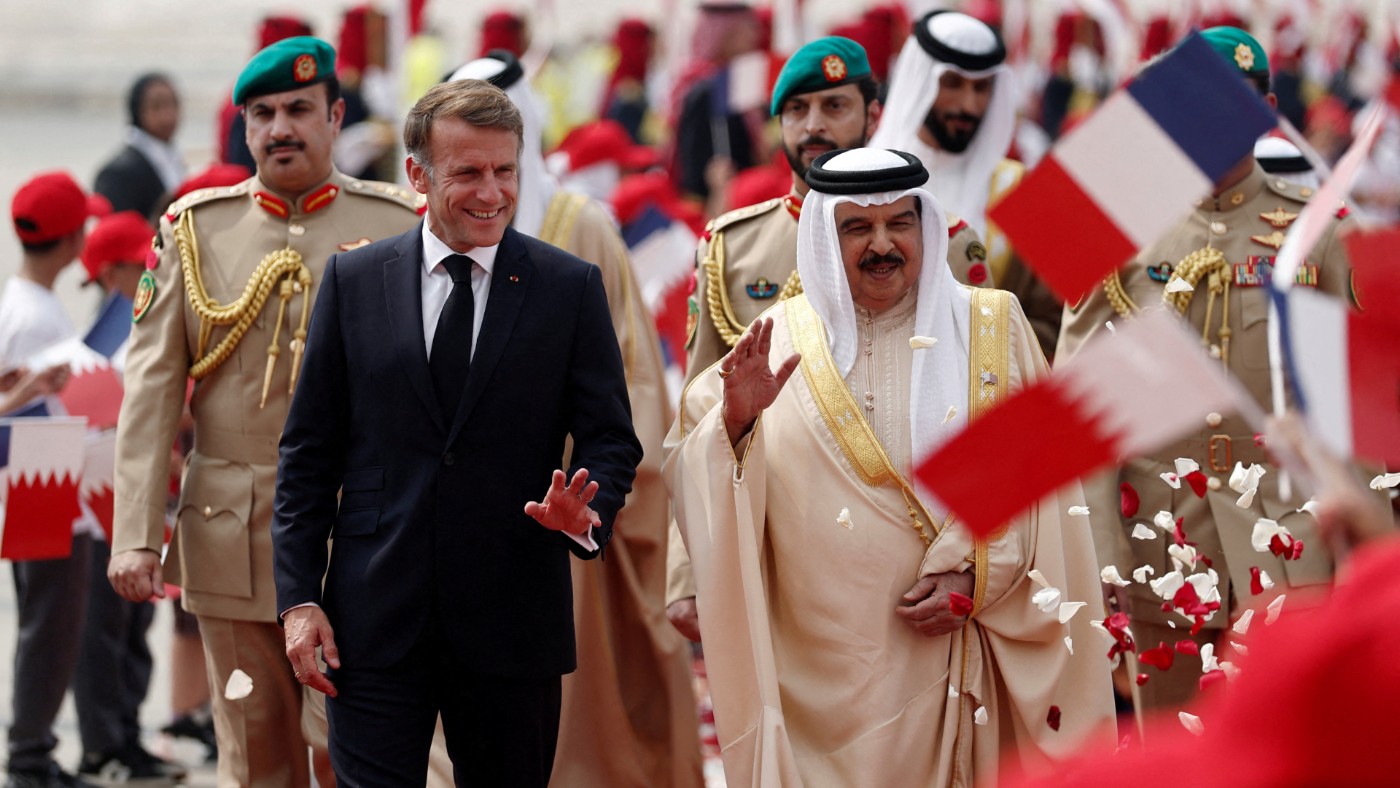
Emmanuel Macron, the French President, touched down in Bahrain on Tuesday for the third stop of his four-nation Gulf tour, facing immediate calls from 32 international and regional human rights organizations to confront Bahraini King Hamad bin Isa Al Khalifa over a sharp escalation of domestic repression in the kingdom. Macron’s visit comes at a moment of deep political turbulence at home, where hundreds of thousands of protestors have taken to the streets to decry rising living costs and what they see as a broken French social contract.
The coalition of rights groups, which includes the Bahrain Institute for Rights and Democracy (BIRD), Human Rights Watch, and the International Federation for Human Rights (FIDH), submitted an open letter to Macron ahead of his meeting with King Hamad. The letter details a rapid intensification of crackdowns on political dissent following the outbreak of the U.S.-Israeli war on Iran in late February, noting that the current wave of repression is the most severe Bahrain has seen since the 2011 Arab Spring uprisings. The groups warn that deepening political and security cooperation between France and Bahrain risks emboldening the Al Khalifa regime to continue its abusive practices.
Since the war began, Bahraini authorities have arrested more than 700 people accused of expressing sympathy for Iran, stripped citizenship from 69 citizens including 33 children – the youngest of which was only 19 days old at the time of the action. The letter also highlights the death in custody of 32-year-old Sayed Mohamed al-Mousawi, whose body showed clear signs of torture when returned to his family, and notes that 19 prisoners currently face the death penalty, 18 of whom have exhausted all legal appeals. Bahrain, a Sunni-ruled kingdom with a majority Shia population, has a long history of repressing democratic dissent dating back to the 2011 uprisings that were violently quelled by state security forces.
Among the most high-profile political prisoners still detained are two European citizens: Bahraini-Danish activist Abdulhadi al-Khawaja, who has now spent 15 years in prison, and Swedish-Bahraini cleric Mohamed Habib al-Muqdad. Al-Khawaja’s daughter, prominent Bahraini activist Maryam al-Khawaja, drew a direct parallel between unrest in France and continued repression in Bahrain, saying: “At a time when students are protesting for better conditions in France, President Macron is in Bahrain, where two EU prisoners of conscience are still imprisoned after 15 years.”
Abdulhadi al-Khawaja, a lifelong human rights defender, was arrested during the 2011 crackdown after masked security forces raided his family home in the middle of the night, beating him so severely he required four hours of reconstructive facial surgery. He was later sentenced to life in prison on charges of terrorism and attempting to overthrow the government, charges widely rejected by the international human rights community. “My father recently told me how it was a peaceful student protest that embarked him on his journey as a human rights defender. As an EU leader, I hope Macron calls for the release of my father and other prisoners of conscience,” Maryam al-Khawaja added.
Sayed Ahmed Alwadaei, advocacy director at BIRD, emphasized that France must not trade human rights commitments for economic and strategic gains. “France must not sacrifice human rights for lucrative Gulf deals under the guise of regional security. Bahrain must not be allowed to buy France’s silence. Those responsible for serious human rights abuses must face consequences, not rewards from France,” he said.
Antoine Madelin, FIDH’s advocacy director, echoed this sentiment, linking the current energy crisis to long-term political stability. “The current crisis should remind President Macron that lasting energy security depends on respect for human rights and peace. France must look beyond immediate supplies and support the open, democratic societies on which a stable future depends,” he said.
Despite the criticism, Macron’s visit proceeded with full ceremonial honors in the capital Manama on Tuesday, where crowds of school children lined the route waving French and Bahraini flags, and the French president walked a flower-strewn red carpet alongside King Hamad, his sons, and a military honor guard.
Macron’s Gulf tour, which runs from October 19 to 21 and includes stops in Kuwait, the United Arab Emirates, Bahrain, and Qatar, is directly tied to addressing the energy crisis sparked by the war on Iran, which has blocked the Strait of Hormuz and sent global crude oil and energy prices skyrocketing. As domestic inflation and energy costs have spiked in France, sparking mass weekend protests that drew an estimated 550,000 people across the country, Macron used his trip to issue a statement condemning violent protest action while acknowledging that protestors held “legitimate concerns.”
The Élysée Palace confirmed that Macron has already secured new energy commitments from Gulf producers, including 100,000 additional tons of diesel per month from the UAE and another 100,000 tons from Bahrain, with added supplies from Saudi Arabia bringing the total new monthly commitments to 295,000 tons – equal to just over 10 percent of France’s total monthly consumption. Beyond energy deals, Macron is also expected to discuss new defense cooperation agreements with Bahraini authorities. According to industry outlet Intelligence Online, following the full withdrawal of French forces from Iraq, Macron is preparing to announce the deployment of new French air defense troops to Gulf states to protect against frequent Iranian missile and drone strikes that have occurred since the outbreak of war in February. France charges millions of dollars annually for this type of air defense support, which also includes training for local armed forces, a model already in place in the UAE for many months.
With Macron’s second term set to end in 2027 and French presidential elections scheduled for April of that year, the trip is also a key part of his administration’s efforts to shore up energy security and stabilize domestic politics ahead of the election. However, rights groups argue that any short-term gains from energy and defense deals will come at the cost of France’s reputation as a defender of human rights in the region.