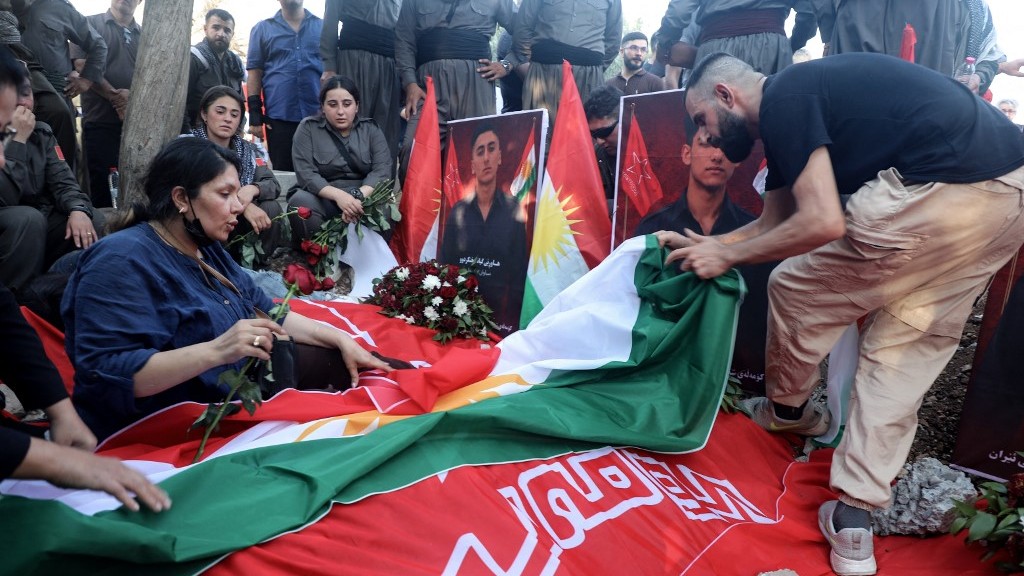
Against a backdrop of repeated cross-border drone and missile strikes that have left dozens dead and put Iraq’s autonomous Kurdistan Region on edge, a top Iraqi Kurdish political leader has publicly revealed ongoing negotiations with Tehran to broker a peace deal between Iran and exiled Iranian Kurdish opposition groups, a move that has caught the opposition off guard and drawn on a history of fraught, often deadly past talks.
Bafel Talabani, leader of the Patriotic Union of Kurdistan (PUK), one of the major political blocs in Iraq’s Kurdistan Region, announced the proposal Monday during the annual Middle East Research Institute (MERI) forum held in northern Iraq. Talabani drew a direct parallel between the proposed process and the landmark peace dialogue launched in October 2024 between the Turkish government and the Kurdistan Workers’ Party (PKK), a decades-long insurgent group. Under that existing Turkish framework, the PKK would disband in exchange for expanded constitutional rights and the release of its imprisoned long-time leader Abdullah Ocalan.
Talabani confirmed that the proposal had already been thoroughly discussed with senior Iranian officials during an official visit to Tehran last month, where he met with Foreign Minister Abbas Araghchi on September 16. Official readouts released by Iran’s foreign ministry following the meeting made no mention of a peace process, however; Araghchi only emphasized the need to deepen bilateral security cooperation to secure the shared Iran-Iraq border in line with existing bilateral agreements.
Reactions from Iranian Kurdish opposition groups, most of which have maintained a decades-long armed and political exile in Iraqi Kurdistan since the 1980s, have ranged from complete ignorance of the talks to outright skepticism. Multiple groups contacted by Middle East Eye either declined to comment or stated they had received no formal offer of dialogue from either Tehran or Iraqi Kurdish mediators. “At present, there is neither any groundwork for dialogue between the Kurdish nation and Iran nor any indication that such dialogue is forthcoming,” a senior source with the Kurdistan Freedom Party (PAK) told Middle East Eye, adding that the opposition would not fall for what he called Tehran’s deceptive political maneuvering and false promises.
Fariba Mohammadi, deputy secretary of the left-wing Komala Party, echoed that sentiment, confirming Komala had also received no outreach regarding a potential peace process. “Establishing the conditions for dialogue with a regime that has spent nearly half a century violating Kurdish rights, militarising Kurdistan, and executing thousands of young Kurds may not be easy,” Mohammadi said, though he stressed that the opposition has never rejected dialogue as a tool of political struggle.
The push for a negotiated settlement comes amid a rapidly shifting security landscape in northern Iraq. In late September, the U.S.-led anti-ISIS coalition withdrew its military presence from the region, leaving Iraqi Kurdish forces without dedicated air defense capabilities. Since that withdrawal, Iran has launched three separate drone strikes targeting Iranian Kurdish opposition positions in Iraqi Kurdistan, including one strike that coincided with the MERI forum itself. This escalation follows a long-standing pattern: Iran has repeatedly blamed exiled Iranian Kurdish opposition groups for inciting the 2022 “Woman, Life, Freedom” nationwide protests, and carried out widespread cross-border strikes targeting the groups throughout the recent period of heightened regional tension, which killed 32 people, 19 of them opposition members.
Back in March 2023, Baghdad and Tehran signed a bilateral security agreement requiring Iraq to push exiled opposition groups back from the shared border and disarm them. Multiple regional reports, including from Rudaw, confirm that senior officials from Iraq, the Kurdistan Regional Government (KRG), and Iran are scheduled to meet this coming Monday to discuss the future of the opposition presence in Iraqi Kurdistan.
KRG President Nechirvan Barzani also addressed the topic during the MERI forum, confirming that the status of Iranian Kurdish opposition has been a permanent fixture in all of the KRG’s diplomatic meetings with Tehran. Barzani, however, publicly criticized the opposition for what he called highly irresponsible actions during the recent period of regional conflict, saying their public statements and social media activity gave the impression an incursion into Iran was imminent, unnecessarily exposing the Kurdistan Region to devastating retaliatory attacks. He added that the PUK and the Kurdistan Democratic Party (KDP), the KRG’s two ruling parties, had prevented any such escalation by deploying military forces to seal the border from the first day of heightened tensions.
This is not the first time Iran has attempted to negotiate with exiled Kurdish opposition groups, and the history of these talks has been marked by violence and failure. In 1989, Abdul Rahman Ghassemlou, leader of the Democratic Party of Iranian Kurdistan (PDKI), was assassinated by Iranian agents during peace talks in Vienna. Three years later, PDKI’s subsequent leader Sadegh Sharafkandi was also assassinated by Iranian operatives in Berlin during a new round of negotiations. More recently, a 2011 ceasefire agreement was reached between the PKK-affiliated Kurdistan Free Life Party (PJAK) and Tehran: PJAK agreed to halt armed attacks in exchange for Iran ending the execution of Kurdish political prisoners. In 2019, a fourth round of talks facilitated by a Norwegian conflict resolution organization in Oslo between four major Iranian Kurdish opposition factions and Iran collapsed, with opposition sources blaming Iran for refusing to make meaningful concessions.
Shamal Bishir, a Stockholm-based Iranian Kurdish analyst and former head of external relations for PJAK, noted that Barzani previously served as a mediator between the opposition and Tehran back in 2011. Bishir added that the trajectory of any new talks will largely depend on the outcome of the ongoing peace process between Turkey and the PKK. Bishir said there are already indications that Ocalan has discussed the prospect of a similar process with Iran with delegates from Turkey’s Peoples’ Equality and Democracy Party (DEM Party), and has suggested Talabani and Barzani mediate talks between PJAK and Tehran. “If Ocalan gives his approval, I believe PJAK could take the lead in pursuing such a process,” Bishir said. DEM Party co-chair Tuncer Bakirhan echoed that logic during the MERI forum, saying Iran could resolve its long-running Kurdish conflict if it follows the same path Turkey has taken.
Still, analysts and opposition figures warn that any Iranian peace process will face far greater structural hurdles than the Turkish process. Jabar Yawar, former secretary general of the KRG’s Ministry of Peshmerga, pointed out that unlike Turkey, which only negotiates with a single main group (the PKK), Iran faces a fragmented opposition landscape with multiple distinct groups including PJAK, Komala, PDKI, PAK and others. While five of the largest groups formed the Coalition of Political Forces of Iranian Kurdistan earlier this year, Yawar noted that the groups hold deep ideological and strategic differences on the question of talks with Tehran, meaning there is no single unified negotiating partner for Iran. Even if PJAK enters talks independently, that could split the newly formed opposition coalition, Yawar added.
Mohammed A Salih, a Kurdistan expert and non-resident senior fellow at the U.S.-based Foreign Policy Research Institute, says the ball is now entirely in Tehran’s court to prove its good faith. “Kurdish political demands are neither new nor particularly ambiguous. They include recognition of Kurdish linguistic and cultural rights, the freedom to engage in political activity and peaceful assembly, and some degree of meaningful self-governance,” Salih explained. “If Tehran demonstrates a genuine willingness to accommodate these demands and creates credible conditions for political engagement, there would certainly be grounds for cautious optimism.”