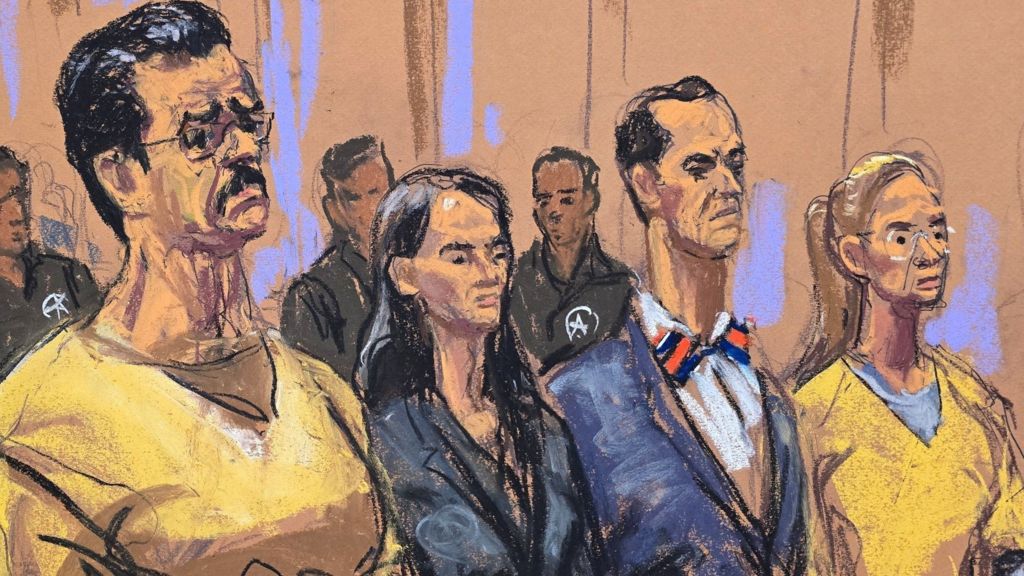
In a high-profile court hearing held in New York federal court on Thursday, ousted Venezuelan former president Nicolás Maduro and his wife Cilia Flores formally entered not guilty pleas to newly added charges of conspiracy to commit torture. The proceeding marks the latest development in a long-running legal confrontation between the U.S. government and the former Venezuelan leadership, which has sparked heated debates over international law and sovereign immunity.
The U.S. Department of Justice first brought charges against Maduro in connection with alleged narco-terrorism, large-scale drug trafficking, and weapons-related criminal activity. Last week, federal prosecutors expanded the indictment to include the new torture conspiracy charges against both Maduro and Flores, bringing the couple back into the courtroom for this latest hearing.
Maduro and Flores were detained back in January during a U.S. military operation, after which they were transferred to the Metropolitan Detention Center in Brooklyn, New York, where they have remained in custody ever since. During Thursday’s hearing, both defendants repeatedly rejected the allegations leveled against them. Speaking through a court translator, Maduro dismissed the charges as fabricated, telling the court “I deny the false accusations and false testimony behind me” before adding “I reject this document entirely.” When Maduro continued his remarks beyond standard plea procedure, presiding judge Alvin Hellerstein interrupted the former leader and formally entered a not guilty plea on his behalf. Flores also asserted her innocence through a translator, stating clearly “I am completely innocent. I am not guilty.”
Observers noted that both Maduro and Flores wore standard beige jail uniforms for the hearing, and appeared to have experienced noticeable weight loss during their months in detention at the Brooklyn facility. The new 10-count indictment outlines brutal, systematic abuses allegedly orchestrated by the pair, saying they built and sustained a violent repressive apparatus that targeted thousands of Venezuelan citizens. Prosecutors claim documented torture methods used in the system included electric shock, asphyxiation, sexual violence, forced nudity, prolonged solitary confinement, starvation, abusive placement in punishment cells, and systematic psychological torture. The indictment further alleges that Maduro personally authorized torture against specific targeted individuals, and that a number of U.S. citizens were victimized under this repressive system.
Long before the new torture charges were added, federal prosecutors had already accused Maduro, Flores, their son, and a network of alleged associates of running a large-scale cocaine trafficking conspiracy, and of forming criminal partnerships with drug cartels that the U.S. has designated as foreign terrorist organizations. Maduro has long framed all U.S. charges against him as a cynical political tool designed to advance what he calls “imperial” ambitions to seize control of Venezuela’s vast, untapped oil reserves.
A core legal argument from the defense centers on the question of sovereign immunity. Maduro’s legal team has insisted that he was the sitting head of a sovereign Venezuelan government at the time of his detention, making him immune from prosecution in U.S. courts. The defense has also repeatedly argued that the United States’ use of military force to capture Maduro on foreign territory violates fundamental international law, and has called for the entire case to be dismissed entirely.
Flores had previously filed a motion seeking to be released on bond ahead of the scheduled trial, citing preexisting heart conditions and other unaddressed health issues that she claims have worsened during her detention at the notoriously overcrowded and harsh Metropolitan Detention Center. That motion was ultimately rejected by the court. Currently, the trial for Maduro and Flores is scheduled to commence in June 2025, and legal analysts expect the case to involve months of complex pre-trial arguments over jurisdiction, immunity, and the admissibility of evidence before proceedings get underway.