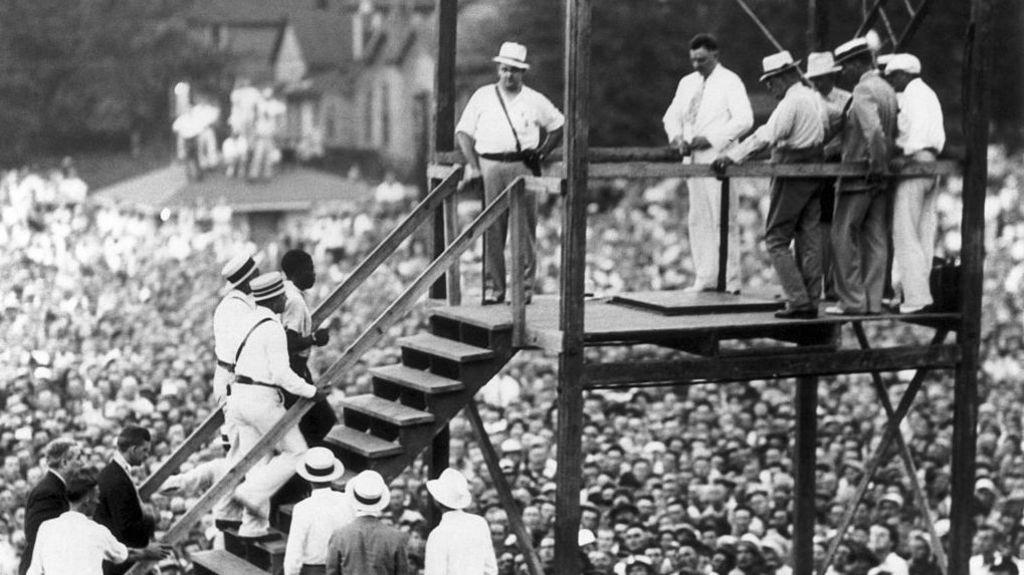
Nearly 90 years ago, a sweltering August morning in Owensboro, Kentucky drew a crowd of 20,000 spectators from across the region to witness the public hanging of Rainey Bethea, a 20-something Black orphan convicted of the robbery, rape and murder of 70-year-old white widow Lischia Edwards. That 1936 event would go down in history as the last high-profile public execution in United States history – a spectacle so sensationalized and dehumanizing that it pushed Kentucky’s governor to ban public executions just 18 months later, aligning the state with a national shift toward more private, humane capital punishment practices.
Accounts of that 1936 event paint a picture of public spectacle rather than solemn justice. Spectators camped out overnight near the gallows to claim prime viewing spots, while pre-execution “necktie parties” were held the night before, and child vendors sold popcorn and soda to the crowd that included men, women and children. A circus-like atmosphere surrounded the execution, amplified by rumors that the job would fall to a local widow – the deceased sheriff’s wife, who had inherited the role. She ultimately declined to pull the lever, leaving the task to a hired executioner. For decades after, many Kentuckians who witnessed or learned of the event remained haunted by its grotesquery, author Sonya Lea – whose own grandparents were in the crowd – has documented.
Now, that dark chapter of American history has been thrown into new relief by a shocking announcement from U.S. Secretary of Defense Pete Hegseth: the U.S. military plans to publicly execute Nidal Hasan, the Army major convicted of killing 13 unarmed fellow soldiers and wounding dozens more in the 2009 Fort Hood mass shooting in Texas. The execution, scheduled for December and set to be carried out by firing squad, will be livestreamed for global audiences to watch, Pentagon officials have confirmed.
“People need to understand that there’s serious consequences for these types of things,” Hegseth said in justifying the unprecedented modern decision. But the announcement has sparked fierce condemnation from scholars, activists and even some within the Trump administration, drawing sharp comparisons to the 1936 Owensboro spectacle that turned capital punishment into public entertainment.
Michael Radelet, professor emeritus at the University of Colorado and one of the nation’s leading scholars on capital punishment, said he never expected to see a return to public executions in the U.S. He noted that public support for the death penalty has fallen steeply over the past three decades, dropping from 80% in 1994 to just 52% today, as most Americans now prefer life without parole over execution as the ultimate punishment. “The justification for the death penalty becomes entertainment… bring your popcorn, invite your friends,” Radelet said, echoing the carnival atmosphere of the 1936 hanging.
Lea, who published a book detailing Bethea’s 1936 execution, said she felt “absolute horror” when she heard of the livestream plan. “What they called it in 1936 was a carnival of sadism,” she said. “That we now have the technology that can make it go wider than the 20,000 people who showed up… to witness in Owensboro, Kentucky, it just makes it even more horrific.” Lea, who discovered after her grandmother’s death that the elderly woman had been close enough to the gallows to hear Bethea’s neck snap, said she always believed the U.S. had left this level of grotesquery behind, reserved today only for a handful of authoritarian regimes including Iran, North Korea and Afghanistan. “Are we now, as the United States of America, considering ourselves to be part of that kind of government? It’s just horrific,” she added.
Experts say the announcement comes amid deep political polarization that has shifted popular discourse around punishment and justice. Kurt Gray, a social psychology professor at Ohio State University, noted that while some Americans crave harsh retribution, many others have become desensitized to the spectacle of state violence. “It’s not like they’re cheering a public execution – they’re just like, ‘Oh, yeah, I guess that’s where we’re at now,’” Gray said.
Public health and violence prevention experts echo critics, noting that national surveys show a steady declining appetite for public violence among Americans. “This morning, the chair of the US Conference of Catholic Bishops labelled this [livestream execution announcement] as barbaric, and I think he speaks for a lot of people,” said Garen Wintemute, director of the Violence Prevention Research Program at the University of California, Berkeley. “A public execution is not who we are. It’s not who we aspire to be as a country.”
The plan has already exposed rifts within the White House. Days after Hegseth’s announcement, Vice President JD Vance told reporters he was uncertain whether the execution would proceed as planned, and that he would not watch the livestream if it goes ahead. Hours later, President Donald Trump contradicted Vance, saying he “absolutely” approves of the livestream plan, though the Pentagon is still finalizing its decision. When asked if he would watch the execution himself, Trump declined to answer. “I really don’t care how he goes as long as he goes,” he said. “And I think that the death penalty is a very worthy way of going for him.”
It remains unclear how the American public will ultimately respond to the prospect of a widely accessible livestreamed execution, but experts estimate millions of people could tune in if the plan moves forward – a far larger audience than the 20,000 who gathered in Kentucky nearly a century ago to watch what was then thought to be America’s last public execution.