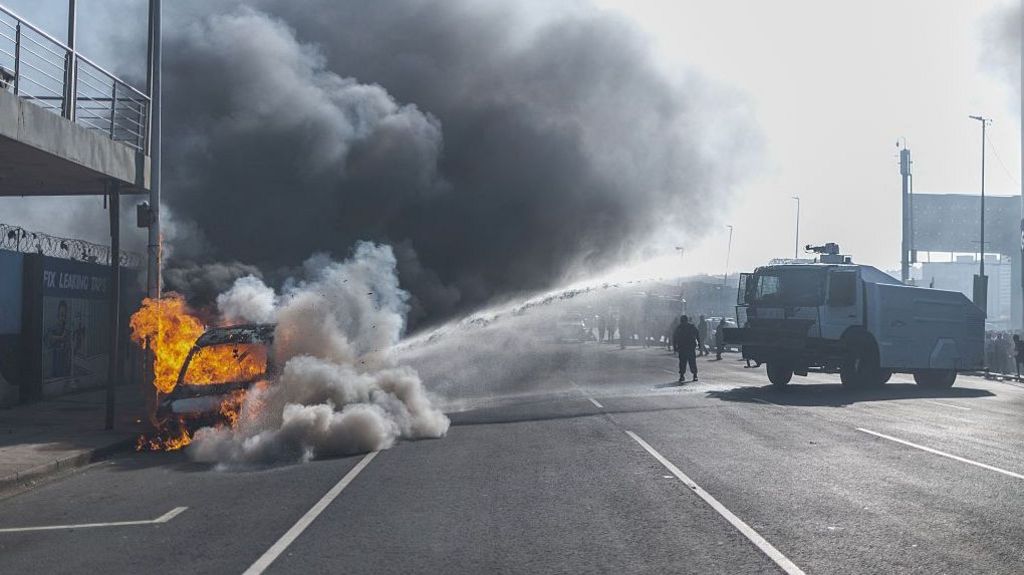
Widespread civil unrest has broken out in two of South Africa’s largest urban centers, turning peaceful anti-immigration demonstrations into violent rioting that has left dozens of vehicles burned, foreign-owned businesses looted, and security forces scrambling to regain control, national police confirmed this week.
The chaos first erupted on Thursday, spreading rapidly across Soweto — the sprawling historic township adjacent to Johannesburg, South Africa’s economic hub — and Durban, the country’s busiest Indian Ocean port that serves as a gateway for regional trade. The outbreak of violence comes on the heels of mounting public anger over a landmark Constitutional Court ruling that expanded access to asylum for certain migrants who entered the country without official documentation.
The court’s July judgment struck down long-standing restrictions that barred asylum applications from people who entered South Africa irregularly or missed strict immigration filing deadlines. Under the new ruling, any eligible migrant may submit an asylum claim regardless of how they entered the country, a change that triggered massive overcrowding at official immigration reception centers as hopeful applicants lined up for hours to file their paperwork. By Friday, the Department of Home Affairs announced it would revise its implementation protocol to comply with the ruling while addressing the sudden surge in demand, though it offered no specific details on the adjusted policy. The department noted that its existing framework had left frontline staff “overwhelmed” and that “serious threats to public safety and order had emerged” as a result of the overcrowding, stressing that any new policy would still adhere to the court’s requirements.
In Durban, the epicenter of the violence, Thursday’s demonstration shifted to rioting after unconfirmed allegations that a foreign national had assaulted a local protester. South African police confirmed three foreign nationals were taken into custody in connection with the alleged attack. Hundreds of protesters had initially gathered outside the city’s government-run refugee reception center, calling for an immediate end to all new asylum applications. As the unrest spread, business owners across the Durban city center shuttered their storefronts to avoid damage, and security forces deployed rubber bullets to break up agitated crowds. Senior local police official Xolani Fihla told public broadcaster SABC that clashes broke out between local residents and foreign nationals in the area, but as of initial assessments, no serious injuries or fatalities have been recorded.
Police tallied 14 vehicles burned in Durban alone, with another 10 set alight in Soweto. In the Soweto neighborhood of Orlando West, protesters originally gathered to demand the permanent closure of spaza shops — small, neighborhood convenience stores that are commonly owned and operated by foreign migrants. Demonstrators forced foreign traders to abandon their businesses in parts of the township, with multiple shops attacked and one entire building set on fire, according to local media reports. Gunshots were also reported during confrontations between local residents and foreign shop owners in the area.
Acting national police commissioner Lieutenant General Puleng Dimpane issued a formal statement condemning the deliberate destruction of private property, saying law enforcement has deployed additional reinforcements to both unrest zones to prevent further escalation of violence. South African authorities have also vowed to track down and prosecute every individual responsible for the rioting and looting.
Government spokespersons have pushed back against misinformation surrounding the Constitutional Court ruling that sparked the unrest. Spokesperson William Baloyi told Reuters that bad actors deliberately spread false claims that the judgment would automatically grant permanent legal status to all undocumented migrants already in the country. Baloyi clarified that the ruling only allows migrants to submit asylum applications — each claim will still be reviewed individually on its merits, and all applicants remain subject to standard immigration background checks. No migrant is guaranteed refugee status or the right to permanent residency under the new framework, he emphasized.
This week’s unrest is the latest in a years-long wave of anti-immigration mobilization in South Africa. Earlier this year, anti-immigration groups organized weeks of nationwide demonstrations demanding all undocumented foreign nationals leave the country by the June 30 deadline. Those protests forced tens of thousands of migrants to flee their homes and communities, with many repatriated to their home countries through government-organized programs.
Xenophobic violence has been a recurring crisis in South Africa for nearly 20 years. The worst recorded outbreak occurred in 2008, when widespread targeted attacks on foreign nationals left more than 60 people dead and displaced more than 30,000 migrants across the country.
The current unrest unfolds against a backdrop of deep-seated socioeconomic strain in South Africa, where systemic poverty, stark racial and economic inequality, and an unemployment rate that affects roughly one-third of the entire workforce have fueled public frustration. Migrants, most of whom come from poorer neighboring Southern African countries, are often scapegoated for high unemployment, rising crime, and strained public services, even though academic researchers have repeatedly found no empirical evidence to support these broad, generalized claims.
Despite its ongoing economic challenges, South Africa remains one of the most popular destinations on the African continent for migrants seeking formal employment, physical safety from conflict or repression, and improved economic opportunities for their families.