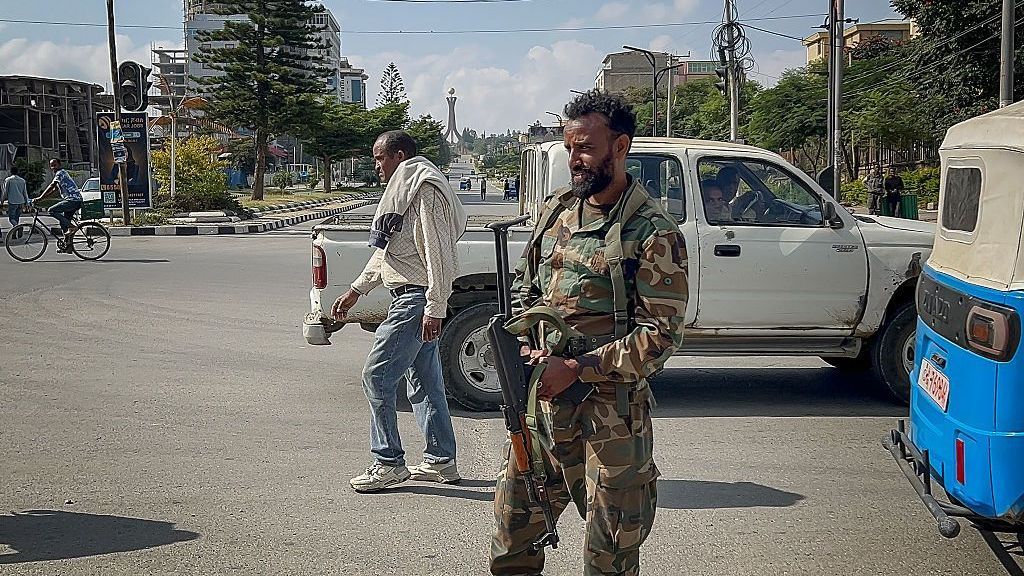
After nearly two years of fragile peace following a brutal civil war, Ethiopia’s northern Tigray region has once again become the center of escalating armed conflict, with a recent development marking a dramatic turning point in tensions between federal authorities and the Tigray People’s Liberation Front (TPLF).
The TPLF, the rebel group that governed Tigray prior to the 2020 civil war and retained de facto regional control after the 2022 peace deal, announced that it has ordered a tactical temporary withdrawal of its forces from Mekelle, Tigray’s capital, as pro-government troops advance on the city. Spokespeople for the group emphasized that the decision was driven primarily by humanitarian priorities, to avoid mass civilian casualties that would come from intense urban combat within Mekelle’s populated neighborhoods.
Two local residents confirmed the shift in control to the BBC, stating that pro-government forces now hold full authority over the city, and TPLF fighters have fully withdrawn from key infrastructure and population centers. One resident also reported a limited restoration of mobile communications services in several districts of Mekelle, a small sign of returning normalcy after weeks of disrupted connectivity.
Renewed hostilities broke out across northern Ethiopia in recent weeks, with clashes spreading beyond Tigray into the neighboring Afar and Amhara regions, pitting TPLF fighters against Ethiopia’s national army and its allied local militias. The collapse of the 2022 African Union-brokered Pretoria Agreement, which had been celebrated as a landmark step toward ending one of the deadliest conflicts of the 21st century, has been underway for six months, with both the federal government and the TPLF repeatedly trading accusations of violating the terms of the peace deal.
Tensions escalated dramatically last month, when the TPLF announced it had formed a unified armed alliance with six other opposition militant groups across Ethiopia, including the Amhara-based Fano militia. The coalition openly declared its core goal to be the removal of Prime Minister Abiy Ahmed’s sitting government from power.
The original 2020-2022 Tigray conflict left a legacy of catastrophic harm: the African Union’s lead mediator for the peace talks estimated that roughly 600,000 people died from combat, famine, and preventable disease, pushing the entire region to the brink of mass starvation. Even after the peace deal was signed, Tigray residents have struggled to rebuild their lives and communities amid lingering political and economic instability.
The TPLF’s withdrawal from Mekelle has shifted the trajectory of the conflict dramatically, and regional and global observers have sounded alarms over the risk of wider destabilization across the entire Horn of Africa. Many analysts warn that escalating conflict could draw neighboring states into open confrontation, worsening an already volatile security landscape.
Diplomatic tensions have already spiked between Ethiopia and its border neighbors. On Friday, Ethiopia and Eritrea formally severed diplomatic ties after Addis Ababa accused Asmara of providing military and logistical support to the new rebel alliance — a claim Eritrean authorities have outright denied. Ethiopia has also levied similar accusations against Egypt, a longstanding regional rival of Addis Ababa over the Grand Ethiopian Renaissance Dam dispute. The tit-for-tat escalations led Ethiopia to expel a senior Egyptian diplomat, which Egypt reciprocated by ordering an Ethiopian embassy official to leave the country within the same timeframe.
A diplomatic meeting focused on the Ethiopian conflict is scheduled to take place on Sunday in Egypt, bringing together leaders from several of Ethiopia’s neighboring countries. Ahead of the talks, the U.S. Department of State issued a statement calling for all warring parties to exercise maximum restraint and return to negotiations to resolve disputes through dialogue rather than force.
The United Nations has also issued urgent warnings about the humanitarian impact of the renewed fighting, noting that the deteriorating security situation has severely disrupted life-saving aid operations across northern Ethiopia. The UN has called on all factions to guarantee safe, unimpeded access for humanitarian organizations to deliver food, medicine, and other critical supplies to vulnerable civilian populations trapped in conflict zones.