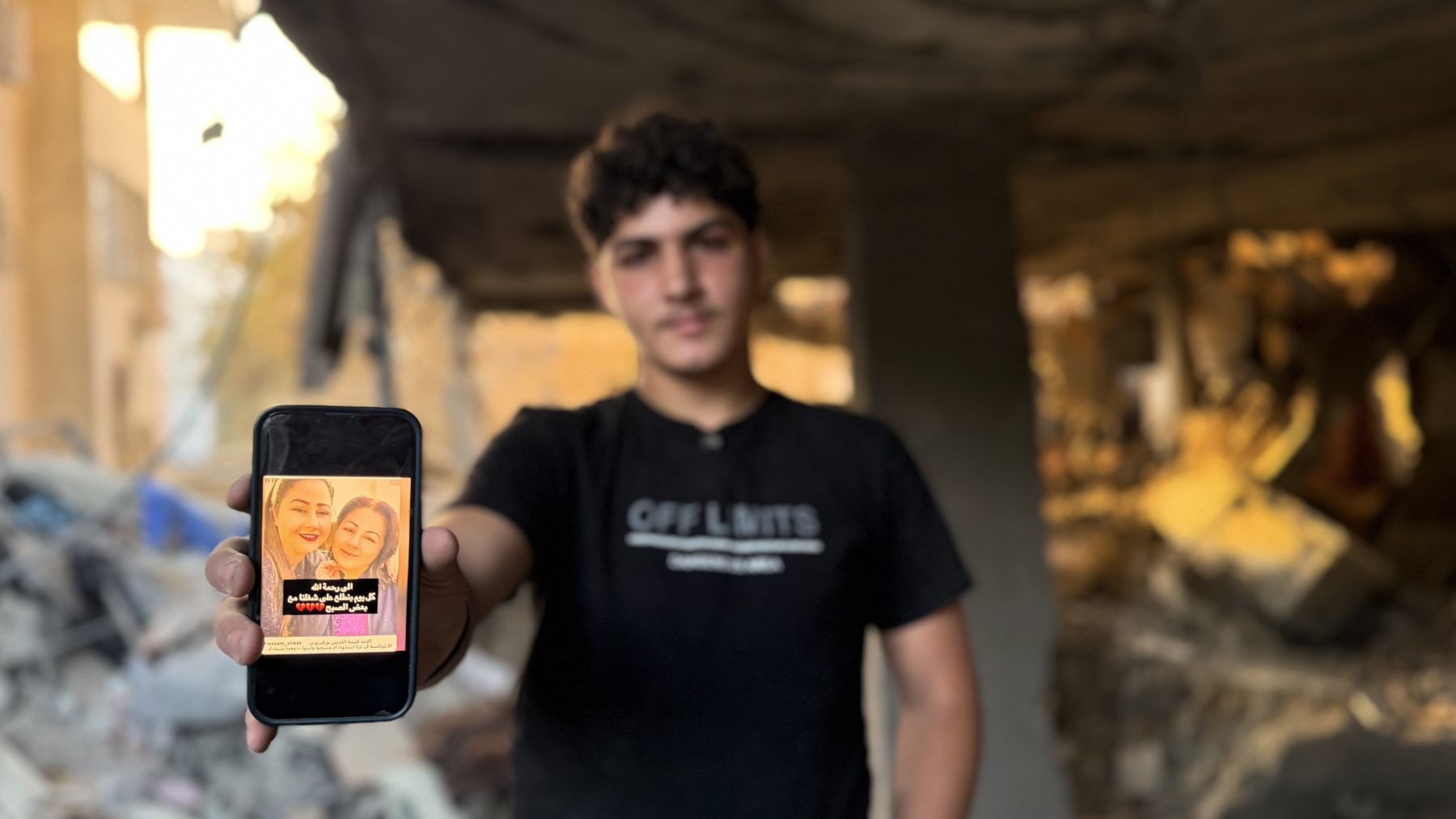
It was just after 5 a.m. on Saturday when 14-year-old Fuad opened his eyes at his father’s home, his mind already set on the routine of a school day. But the routine Fuad expected would never come—instead, he learned that the two women who raised him were already gone, killed in an Israeli airstrike that reduced their western Gaza City apartment to rubble overnight.
Mary Abu Dawud, 40-something, and her mother Maysaa, 72, were two of the five Palestinian civilians killed when three missiles slammed into the al-Asala residential building shortly after 1:30 a.m. that same day, Palestinian authorities and local church leaders confirmed. Recounting the destruction described to him by first responders, Fuad shared the harrowing details of the blast that took his family: “My mother was thrown violently against the wall by the force of the explosion, and my grandmother was swallowed by flames when the missile hit our home.” His voice breaking, the teen added, “Today I lost the most precious people in my life. There are no words that can ever describe what I feel right now.”
Fuad had been living with his father following his parents’ divorce. When he woke that morning, his father was already waiting by his bedside, struggling to deliver the devastating news. The pair rushed straight to the hospital, but by the time they arrived, there was nothing to do but mourn. “When we got there, he told me they had been killed and that I needed to pray for them,” Fuad recalled. “We went to see their bodies, but they were already wrapped in burial shrouds.”
After the identification process, the remains of Mary and Maysaa were transported to St Porphyrius Church in central Gaza City, where relatives, local Christian community leaders, and Muslim neighbors gathered to hold funeral prayers. Photographs from the service show rows of mourners standing somberly around the covered bodies of the two women, heads bowed in grief. According to church records, the pair had spent much of the ongoing war taking shelter at the Holy Family Catholic Church before recently moving into the al-Asala apartment for what they thought would be greater safety.
Other survivors of the airstrike shared chilling accounts of the sudden chaos that unfolded as they slept. Emad Kullab, a 30-year-old resident who was on the building’s fourth floor with his family when the missiles hit, described the moment the attack began as “the whole world turning upside down around me.” “It was pure horror,” Kullab said. “Dust and flying rubble blinded all of us. I ran downstairs as soon as I heard people screaming for help, and what I saw will never leave me: neighbors torn apart by the blast, women and children bleeding, fires spreading across every floor.”
Kullab confirmed that Mary and Maysaa died instantly in the strike. He remembered Mary as a caring local doctor and Maysaa as a warm, kind neighbor who was friendly to everyone in the building, regardless of faith. “This was a residential building full of completely innocent people,” he said. “It was one of the calmest, most peaceful buildings in all of Gaza, but the Israeli occupation is determined to destroy everything here, no matter what.”
Yasser Abu Juba, a 19-year-old who lives in a nearby building and was one of the first first responders to reach the al-Asala site, helped pull survivors from the rubble and worked to extinguish spreading fires. He shared unflinching details of the carnage he witnessed that morning: “The building doorman was decapitated by a piece of missile shrapnel. His phone was still open, right where he dropped it—he had been playing PUBG when the blast hit.” Abu Juba added, “One of our Christian neighbors was also decapitated, another woman’s body was so badly disfigured it was almost unrecognizable. An elderly woman in the building next door was also killed, her body shattered. Dozens more were hurt. I will never be able to forget the things I saw with my own eyes that day.”
Gaza’s Christian community is one of the smallest in the region, numbering fewer than 1,000 people, most of whom identify as Orthodox Christians. This airstrike marks the latest in a years-long string of attacks on Palestinian Christian communities and their places of worship during the ongoing conflict. The Latin Patriarchate of Jerusalem released a statement following the latest deaths, expressing “deep sorrow and unshakable grief” over the killing of the two women and extending condolences to their surviving family and the entire Gaza Christian community.
George Anton, the Latin Patriarchate’s director of operations in Gaza, explained that the deaths have left a lasting wound across the Strip’s tight-knit Christian community: “This killing has left deep sorrow among all Christian families in the Gaza Strip.” At the funeral, held October 3 at St Porphyrius in Gaza City’s al-Zaytoun neighborhood, Muslim neighbors and friends joined the Christian community to mourn Mary and Maysaa, a demonstration of shared grief across Gaza’s faith communities.
Previous attacks have already left dozens of Christian Palestinians dead: In October 2023, an airstrike on the St Porphyrius Church compound killed at least 18 people who had taken shelter there. Two months later, in December 2023, the Patriarchate confirmed a mother and daughter were killed inside the Holy Family parish compound. Most recently, in July 2025, an Israeli strike on the Holy Family Catholic Church compound left three people dead and multiple others injured, including the parish priest, Father Gabriel Romanelli.
For Fuad, the grief is a deeply personal, unending pain. When he returned to the wreckage of his mother’s apartment after the funeral, one small, mundane object stuck with him: her favorite ceramic mug, left half-buried in the rubble. “I came back to see the house where they lived, and I saw the mug my mother loved so much,” he said. The teen ended with a blunt, devastating observation that reflects the shared fear of all Gazans, regardless of their faith: “The Israeli occupation does not distinguish between Christians and Muslims. We are all at risk of being killed here in Gaza. I don’t even know if I will still be alive after this interview ends.”