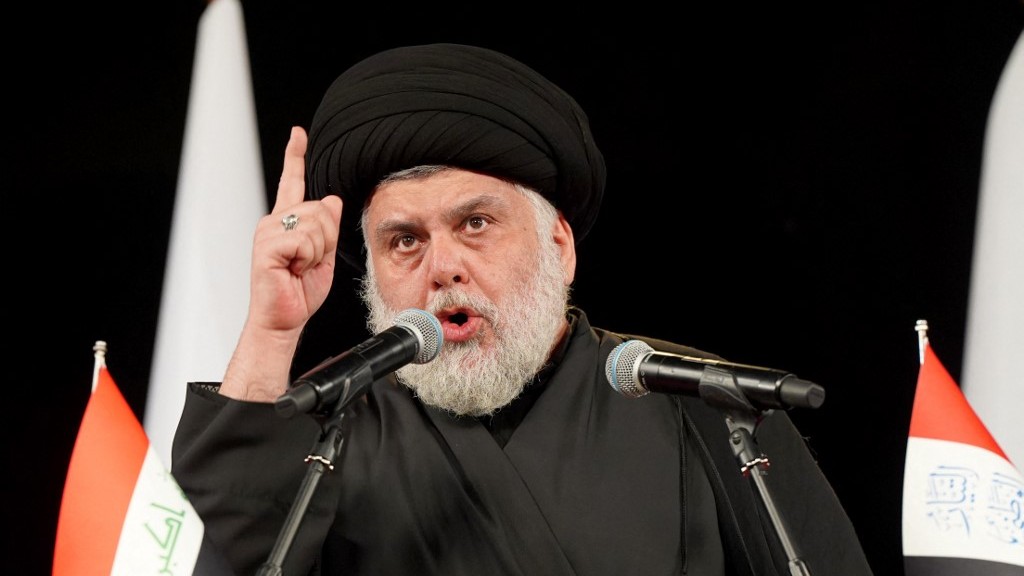
As the final contingent of U.S. troops wraps up their 12-year military presence in Iraq and departs the country, influential Iraqi Shia cleric Muqtada al-Sadr has issued a bold demand: the United States must pay compensation to the Iraqi people for decades of destruction and harm caused by its military occupation.
Sadr released his official statement on Wednesday, the exact deadline set for the full withdrawal of American forces. In the remarks, he celebrated what he called Iraq’s newfound full independence and paid tribute to all factions that had taken up arms against the U.S. deployment. “We demand compensation from the American army for all the damages that occurred as a result of its occupation of Iraqi lands,” Sadr stated, adding a call for all affected parties to pursue formal legal claims to secure reparations.
The timeline of U.S. military involvement in Iraq stretches back more than two decades. The U.S. first launched a full-scale invasion and occupation of the country in 2003, which resulted in the overthrow of longtime leader Saddam Hussein. U.S. forces initially withdrew in 2011, but they returned three years later in 2014 at the invitation of the Iraqi government to combat the rapid expansion of the Islamic State group, which had seized roughly one-third of Iraq’s territory at the height of its advance.
The 2003 U.S.-led invasion remains widely condemned by the international community as an illegal act of aggression. Throughout the years of occupation, American forces faced repeated accusations of systematic war crimes and widespread human rights abuses against Iraqi civilians. Estimates of the total death toll stemming from the invasion vary widely, with most credible counts placing the number of excess violent deaths between hundreds of thousands and more than one million.
Beyond his demand for compensation, Sadr called on both the United States and Iraq’s neighboring countries to end all forms of external interference in Iraq’s domestic affairs. He warned that continued meddling would risk severing diplomatic ties, trigger reciprocal policy actions, and drag Iraq into devastating regional conflicts, particularly in the spheres of political and ideological rivalry. “We hope that the United States will reciprocate diplomatically and not act arrogantly towards Iraq, its government, and its people,” he added.
Sadr has long occupied a central role in Iraqi political and military life. During the initial U.S. occupation, he led the Mahdi Army, an armed faction that fought against coalition forces, and later reorganized the group as Saraya al-Salam, or the Peace Brigades. He and his political bloc have positioned themselves as leading Iraqi nationalist voices, opposing both U.S. influence in the country and interference from neighboring Iran, a regional power with extensive sway over Iraqi Shia politics.
In Wednesday’s statement, Sadr announced a major restructuring of his armed movement: remaining elements of the former Mahdi Army will be reorganized into a new entity called the Supporters of Imam al-Mahdi Foundation, named for a revered figure in Shia Islam who believers believe remains in hiding and will return at the end of days alongside Jesus to establish justice. He also called for all sitting Iraqi politicians to resign from their posts to make way for new leadership, a step he says is necessary to root out systemic corruption and push through long-delayed political reform. He additionally reaffirmed his longstanding position that all weapons in Iraq must be placed exclusively under the control of the Iraqi state.
The question of integrating powerful non-state armed factions into Iraq’s official security forces has become inextricably linked to the U.S. troop withdrawal. While the process of disarmament and integration was originally scheduled to be completed by the September 30 withdrawal deadline, Iraqi Prime Minister Ali al-Zaidi announced last week that he was extending the deadline to June 2027.
Several of Iraq’s most powerful Iran-backed armed factions, including Kataeb Hezbollah, Harakat al-Nujaba and Kataeb Sayyid al-Shuhada, have already publicly stated they will not give up their weapons. Current regional tensions, fueled by the ongoing U.S.-Israel military campaign against Iran-linked forces across the Middle East, make it extremely unlikely that Iran will pressure these allied factions to disarm, analysts say.
Hayder al-Shakeri, a research fellow in the Middle East and North Africa programme at London-based think tank Chatham House, explained the complexities of the disarmament process in an interview with Middle East Eye. “Disarmament needs a political agreement inside Iraq, a credible way of integrating fighters and command structures into the state, and some answer to the political, economic and ideological power these factions have built up over years,” he said. “For the groups closest to Iran, it will also be extremely difficult without Iranian agreement or a broader regional de-escalation. Otherwise, you risk simply moving the weapons into another institution while leaving the same networks and chains of command intact.”