In a converted classroom-turned-emergency shelter at a public school in Sidon, a 72-hour-old newborn rests on a frayed, thin mattress pulled directly onto the concrete floor. The infant’s first days of life unfold surrounded by the quiet chaos of displacement, just a few feet from where an elderly man stirs a pot of lunch, separated from the new mother and child only by a rickety shelf stacked with donated canned goods and bundled clothing. Three separate families now crowd into this single classroom, all their worldly possessions tucked into dusty corners, as they wait for a chance to return to their homes in southern Lebanon’s Nabatieh district.
This newborn’s mother, 29-year-old Hala Loubany, had only just recovered enough from an emergency cesarean section to sit up and watch over her son, one hand still pressed instinctively to the throbbing surgical wound on her abdomen. Her labor began unexpectedly right here in the school shelter, and she was rushed to a local hospital at the last minute for the life-saving procedure. When Hala fled Nabatieh six months into her pregnancy alongside her husband, their two young sons, and her father, this Sidon school was already the second makeshift refuge the family had been forced to occupy.
Hala’s 54-year-old father, Ali Mahmoud Loubany, shared the family’s story with Middle East Eye, describing the terror of the initial Israeli bombardment that pushed thousands from their border communities. “Israel just started bombing everywhere and everyone at random, people who I know very well are not affiliated with Hezbollah. I kept thinking, ‘Where do we go? Or do we stay and try and fight back?’ I was scared as the Israelis were also targeting the cars as people were fleeing. It was terrible,” he recalled.
Ali first learned his childhood home in Zawtar, a village perched on a hillside overlooking the Litani River, had been completely destroyed when he checked satellite imagery on Google Maps. “On the map, you don’t know which pile of rubble is your house. All the land, all the trees… the whole village has been flattened. We have gone back 100 years,” he said. When the bombing began, he admitted, he had wished “for the ground to just open up and swallow me.” Just a day before speaking with reporters, Ali had attempted to travel back to Zawtar to survey what remained of his property, only to be fired on by Israeli occupying forces with a grenade, forcing him to flee back to the shelter.
This is not the first time Ali has lost everything to conflict with Israel. After the 2006 war, he rebuilt his home brick by brick and replanted his small farm, where he grew tobacco and fresh vegetables. He even joined local demining teams to clear the area of dangerous cluster munitions that contaminated the region following that earlier conflict. Now, after decades of slow, painstaking reconstruction, he faces the same catastrophic ruin. For the first time in his life, Ali is considering leaving Lebanon for good, though he has no idea where he might build a new life.
Poor living conditions add to the family’s constant stress. The shelter’s only women’s bathroom sits directly across the hall from their classroom, with just three laminate shower stalls that families must sign up to use by a shared schedule. Residents wash clothing in shallow, cramped sinks. For Hala, still recovering from major surgery, inadequate sanitation creates a constant, crippling worry that her surgical scar will develop a dangerous infection.
Rents for temporary housing near former border communities are far out of reach for most displaced families, Ali explained. “I know many people are somehow affording to rent houses near their homes… but it is really expensive. If I had the money, I would spend it on medicine that the family needs but we cannot afford. We are stuck here but at least we are alive and safe. There are mattresses to sleep on and NGOs bring us food,” he said. Still, Ali sees no long-term future for his family in Lebanon, adding: “There is no one by our side, the Lebanese government does not care about us. Lebanon is a country of war.”
Mina Jardali, a field worker with the humanitarian organization Action for Humanity, which provides funding for ambulance services, medical care, and community bakeries across the region, says Ali’s despair is shared by thousands of other internally displaced people (IDPs) across Lebanon. She has watched families arrive at shelters with nothing but a single bag of clothing, only to leave weeks later hoping to get closer to their homes, only to be displaced again. “Ali is not alone in looking elsewhere, like Europe, for an escape,” she noted.
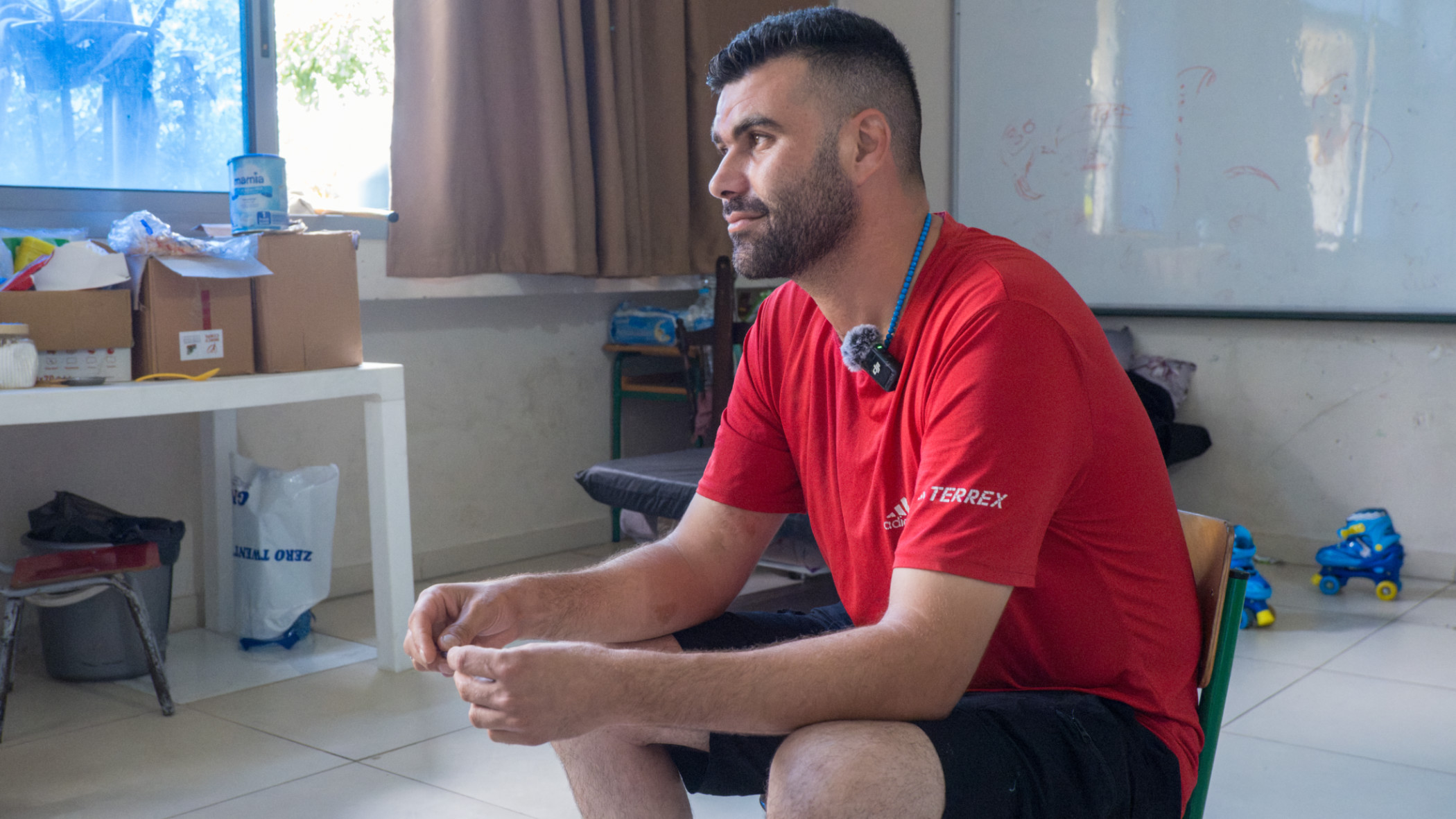
In the same classroom, Hala’s husband Hassan Bisher, a 33-year-old former taxi driver from Nabatieh’s Kfar Tebnit, plays with his two young sons, six-year-old Jaffar and one-year-old Haydar. The boys take turns racing a plastic toy bicycle around the room, weaving between mattresses and folding chairs. Growing up in a crowded shelter is not the future Hassan imagined for his children, especially not with the arrival of their new baby brother. His own family home in Kfar Tebnit was destroyed in an Israeli air strike, just as it was first destroyed in the 2006 war. It took the family a full decade to rebuild it the first time.
“Their childhood memories are all gone,” Hassan said. “What is even harder is that I depended on my job to look after my children, but now I am unable to provide for their needs. Every parent strives to provide for their children to see them as happy as possible, to help them excel in life. And I cannot do that now.” Unlike his father-in-law, however, Hassan holds onto hope. His only wish is to return to Kfar Tebnit once the bombardments stop and start rebuilding again, even if he has to live in a tent pitched on the rubble of his old home in the meantime. “I just want to pitch a tent on my land and smell the fresh air of the town once again… I prefer that than being anywhere else,” he said.
Further down the dark school corridor, another displaced family tells a story marked by even greater loss. The Darwish family, originally from Nabatieh, saw their four-story family home flattened by an Israeli bomb during the 66-day 2024 war. Their relatives are now scattered across dozens of different shelters, and one of their sons, Samih, was killed in an Israeli strike on his motorbike in the Beqaa Valley two months after a 2024 ceasefire took hold. His 71-year-old mother Sobheya cries as she pulls out a photo of her son, saying simply: “Samih was driving on the motorway and was martyred, just like that. He left three children behind and we have no idea what is going to happen to them as he was the only provider.”
Sobheya and her 72-year-old husband Mahmoud spent 18 years building their home, creating an apartment for each of their three sons while the couple lived on the ground floor. Their 42-year-old son Hussein says what he misses most is gathering the whole family for dinner every night. Losing his brother and watching his parents’ life work turned to rubble has left him numb with grief and anger. “I have no feelings, I am numb. Losing his brother has caused him unbearable pain he cannot put into words, as has seeing his destroyed home, the result of 18 years of his and his family’s hard work,” Hussein said, his voice shaking as tears filled his eyes. “We did not know the house was targeted until we went back. Other houses around it were still standing… So why us? We don’t do politics, we don’t know anyone from Hezbollah.” The family still hopes to return to Nabatieh one day, but Hussein worries constantly about his elderly parents’ health, as they sleep on the floor with nothing but thin sheets and a flattened mattress between them and the cold concrete.
As of September 1, the International Organisation for Migration estimates roughly 856,000 internally displaced people have returned to their home communities across Lebanon, but the widespread humanitarian crisis remains far from over. Since the Loubany and Darwish families were interviewed for this report, the Sidon school shelter was shut down in late September, and all residents were transferred to other aid facilities, a forced new displacement that has only deepened the hardship for more than 329,000 IDPs still living in uncertainty across the country. For Hala’s newborn son, displacement has become the default of life before he is even old enough to remember having a home of his own. For his grandfather Ali, it is a fate that he fears will define the rest of his life.