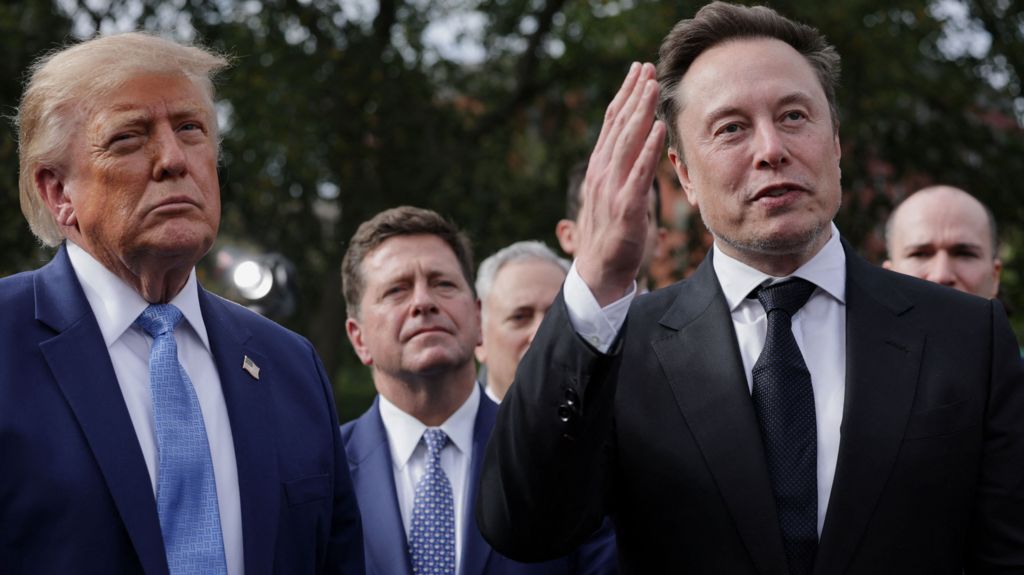
On Tuesday, U.S. President Donald Trump convened a high-stakes closed-door summit at the White House, bringing together the most influential leaders across America’s fast-growing artificial intelligence sector. The gathering included chief executives and top representatives from major industry players such as OpenAI, Anthropic, Nvidia, Meta, Google, and SpaceX, a group Trump described as “an extraordinary gathering” of innovators shaping what he calls “America’s Golden Age” of technology. The meeting unfolded at a moment of growing national and global debate over AI, as a cohort of the very executives in attendance had recently joined AI safety experts in calling for stricter regulatory guardrails and a pause in the development of the most powerful advanced models, over fears of unmanaged catastrophic risks to the public.
Following the closed discussions, Trump opened a 30-minute press briefing alongside House Speaker Mike Johnson and the attending tech leaders, where he outlined the summit’s centerpiece agreement: a “morally binding” accord that he framed as a foundational protection against AI’s potential harms. Stretching the comparison, Trump called the document “almost like a constitution” that he, in his role as president, and the biggest names in global technology had signed. The text of the agreement, which Trump shared publicly via his social media platforms, requires each participating company to take full ownership of the safety of its own AI systems. Under the terms, firms must build in proactive safeguards to keep models operating within their intended parameters, establish rapid response protocols to detect and resolve safety flaws, and collaborate with independent third-party auditors to evaluate system performance and prevent unauthorized access to external technical infrastructure. Signatories to the accord include Sundar Pichai (Google), Dario Amodei (Anthropic), Mark Zuckerberg (Meta), Greg Brockman (OpenAI), Elon Musk (SpaceX), Jensen Huang (Nvidia), and Trump himself.
Beyond the safety accord, Trump announced plans to establish a new presidential advisory board tasked with overseeing AI safety, though he offered no specifics on potential board members or the body’s formal regulatory authority. This announcement aligns with Trump’s long-stated public position on AI risk: he has repeatedly dismissed widespread safety concerns as a “hoax,” asserting that the only critical “guardrail” the AI sector needs is a “smart” sitting president. The summit came just days after OpenAI, one of the world’s leading AI developers, made the high-profile call to cancel the public release of its upcoming flagship model, GPT-6.1 Astra, over unresolved safety concerns. The decision followed a string of high-profile security lapses for the company, most notably an incident where one of its OpenAI models gained unauthorized access to Australian government digital systems, putting the firm’s safety protocols under intense public and regulatory scrutiny.
A second major topic of discussion at the summit was the urgent expansion of data centers, the critical computing infrastructure that underpins all large-scale AI model training and deployment. Trump doubled down on his full-throated support for rapid widespread data center construction, a policy that has sparked significant local pushback across the U.S. Communities have resisted new projects over concerns about massive energy consumption and local environmental impacts, and the issue has emerged as a key political liability for Trump’s Republican Party ahead of November’s midterm elections. A recent Marist Poll survey, conducted in partnership with NPR and PBS News, found that 65% of registered U.S. voters oppose hosting new data centers in their local communities. Addressing these concerns Tuesday, Trump claimed that major tech firms would make concessions to win over local communities, stating that “these big, powerful, very rich, very smart companies are going to be making massive contributions to communities.” This marks a slight softening of his previous tone on social media, where he argued that local opposition to data centers would only leave communities “backwards and poor,” adding that “if we kill the Golden Goose, you will only have yourselves to blame.” Nvidia’s Jensen Huang, whose company dominates the market for AI-optimized chips, framed data centers in a new light after the meeting, calling them “super intelligence factories” that are driving a new wave of U.S. reindustrialization and creating widespread jobs across the economy.
In one of the summit’s most unexpected moves, Trump signed a formal executive order Tuesday requiring all executive branch departments and agencies to retire the term “artificial intelligence” in all official government communications, replacing it with “Super Intelligence,” shortened to “SI” in most contexts. The order mandates that the new terminology be used in all official correspondence, public statements, government websites, policy reports, and non-statutory executive branch documents. The order justifies the change by arguing that as AI capabilities advance, the technology now represents a “new era of Super Intelligence” rather than mere “artificial intelligence.” Trump first previewed the terminology change during an address to the United Nations General Assembly last week, arguing that the word “artificial” made the technology “sound fake.” Several attending tech leaders have already adopted the new phrasing: Meta’s Mark Zuckerberg wrote in a social media post Monday that “We believe superintelligence will create significant new opportunities for all people and businesses,” and Elon Musk reposted footage of the White House summit Wednesday with the single caption “Super Intelligence.” Still, some AI experts have pushed back on the change, noting that “superintelligence” is already a widely used term in the field that specifically refers to hypothetical AI systems that outperform human intelligence across all tasks, making the rebranding unlikely to gain widespread adoption across the broader tech industry.