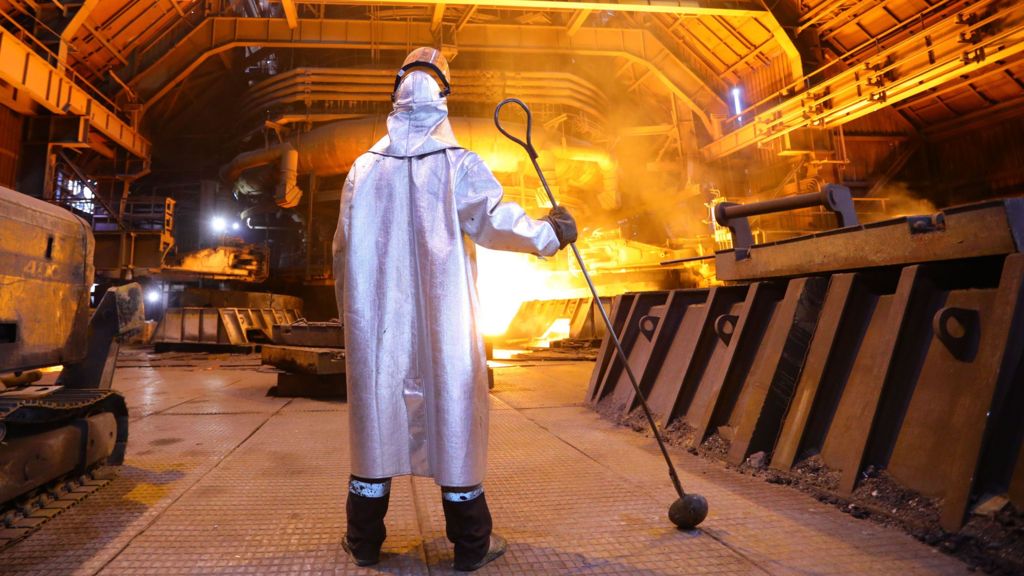
For generations, Zaporizhstal has stood as the beating industrial heart of Zaporizhzhia, Ukraine’s major southern industrial hub. It has been the city’s largest and most stable employer, putting food on the table for thousands of local families like that of long-time worker Denys Maksyshko.
“Zaporizhstal is not just a big company, it’s the heart of the city,” Maksyshko says of the plant that has defined his hometown for decades. Today, that heart has stopped beating, brought down by a sustained campaign of Russian missile attacks. After four waves of strikes between August and September 2026, the 8,500-person facility has suspended operations indefinitely.
Almost every piece of major infrastructure at the plant has been ruined. Blast furnaces are heavily damaged, roofs are punctured by shrapnel, and not a single intact window remains across the sprawling facility. According to Oleksandr Myronenko, chief operating officer of Metinvest — Zaporizhstal’s parent company — Russia launched a total of 17 separate missiles at the plant, leaving eight workers dead and 31 others wounded.
Work crews are currently clearing rubble and drafting tentative recovery plans, but Myronenko confirms there is no guarantee the iconic plant will ever resume full operations. In a grim reminder of just how relentless the attacks have been, Metinvest official Oleksandr Vodoviz revealed that workers managed to restart one blast furnace after an initial strike — only for the facility to be hit again just 10 hours later. With the security situation still volatile, Vodoviz added that investing in large-scale repairs right now makes little practical sense.
Zaporizhstal is far from the only victim. Starting in August, Russia has systematically targeted every major metallurgical facility across Ukraine, hitting many of them multiple times. For Moscow, these plants are high-priority targets: before Russia’s full-scale 2022 invasion, the mining and metallurgy sector made up roughly 10% of Ukraine’s gross domestic product and accounted for one-third of the country’s total export revenue. The industry supported more than 500,000 direct jobs, with one out of every 13 positions in Ukraine linked to the sector in some way.
Today, that entire critical sector has been brought to a near-complete standstill. Myronenko estimates that the industry’s contribution to Ukraine’s GDP is now “probably close to zero,” and all steel plants operated by Metinvest — once Ukraine’s largest steel and iron producer — are currently out of action.
“Clearly, they’re trying to stop Ukraine’s economy and stop Ukraine from getting export money from abroad, from paying taxes and wages, from ensuring that cities live and people have jobs,” Myronenko said. “Their efforts have been very effective so far.”
The destruction of Ukraine’s steel sector extends far beyond lost factory output, carrying cascading consequences for the entire country’s economy, social stability and even war efforts. Since the start of hostilities with Russia in 2014, Ukraine’s count of operational metallurgical plants has already shrunk from 12 to just six, following the loss of key industrial facilities including the Azovstal and Illich plants in Mariupol after the city fell to Russian forces.
One of the latest major facilities to fall silent is Arcelor Mittal Kryvyi Rih, the country’s largest steel plant, located in President Volodymyr Zelensky’s hometown. After five weeks of repeated attacks, the plant announced on September 25 that it would not be able to reopen, noting that five workers had been killed in the strikes. Oleksandr Vilkul, head of the local Defence Council, called the attack a “very serious blow” that extends far beyond the thousands of direct jobs at the plant.
Metal companies have long been the financial backbone of the host cities where they operate, covering between 30% and 70% of all local government spending, according to Stanislav Zinchenko, head of Kyiv-based industrial consultancy GMK Center. Those tax revenues pay for municipal infrastructure, repairs to heating networks, early childhood education centers, social services, and a range of other public services that local residents depend on daily.
“In other words, the physical survival of these cities depended on these companies,” Zinchenko told the BBC. Before the current wave of attacks, the industry was also the country’s largest private investor, pouring an average of $2 billion to $3 billion into annual upgrades and expansion across Ukraine. Zinchenko warns that if steel plants remain closed, hundreds of thousands of people could lose their livelihoods, triggering mass migration that will extend far beyond Ukraine’s borders. “A humanitarian catastrophe is looming,” he said.
The shutdown also directly undermines Ukraine’s defense and post-attack reconstruction efforts. Steel is a critical raw material for manufacturing military equipment, building defensive fortifications, and repairing the thousands of residential and public buildings damaged by Russian strikes. Russia has tried to justify its attacks on steel plants by claiming the facilities were being used to produce military hardware, a claim that Ukrainian officials do not deny but frames as an attack on the country’s entire civilian economy.
Even if attacks stop and plants are able to restart, operating normally will remain nearly impossible for the foreseeable future. Russian strikes on railway infrastructure have made moving raw materials and finished steel across the country dangerous and unpredictable, while repeated attacks on Black Sea ports have turned export operations into a high-risk gamble.
“Ports have essentially been blocked,” Myronenko said. “Every ship is at risk of being attacked, and their chances are 50-50 — either you make it, or you don’t.” Compounding these challenges are new EU import quotas on Ukrainian steel that took effect on July 1, which threaten to further limit the sector’s ability to earn much-needed foreign revenue.
Despite the widespread destruction and grim outlook, many frontline workers like Denys Maksyshko remain determined to keep the industry alive. He and his colleagues continue to show up to the damaged plant every day, clearing rubble and repairing whatever small sections they can to prepare for an eventual restart.
“This is similar to what the military do in the trenches,” Maksyshko said. “Ordinary people are fighting to keep the factory alive like soldiers.”