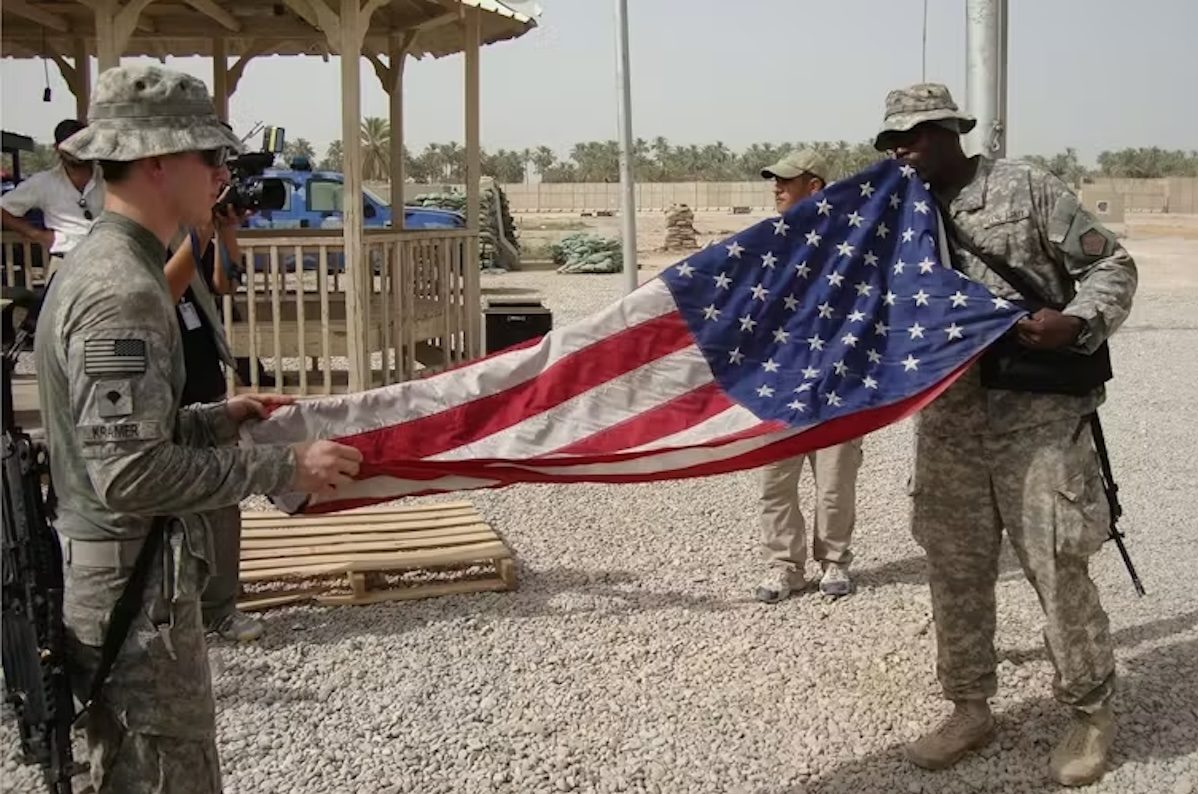
As the final contingent of US-led coalition troops wraps up its withdrawal from Iraq by the September 30 deadline, the moment carries stark geopolitical irony: at the very time Washington is waging a costly campaign to erode Iran’s military and economic power, it is stepping back from the country that has become Tehran’s most consequential strategic gain in the post-Saddam Hussein era. That same September 30 date was also the commitment Baghdad made to bring an array of powerful Iran-aligned militias under formal state control — a deadline that is all but certain to be missed, leaving Iran’s influence in Iraq largely undiminished.
Iraq has long navigated a delicate balancing act, leveraging its strong nationalist impulse to steer an independent course between competing US and Iranian interests. But the US exit removes a critical counterweight to Tehran, opening the door for expanded Iranian sway over Baghdad’s political and economic decision-making. What makes this outcome particularly striking is that Iran did not create these favorable conditions on its own: decades of US policy, culminating in the 2003 invasion that toppled Saddam, cleared the way for Iran’s rise in Iraq.
Iran’s deep connections to Iraqi political factions do not date only to the post-2003 era. For decades prior to Saddam’s ouster, Tehran spent years cultivating relationships with Iraqi opposition groups during the Ba’athist regime’s rule. Two of the most prominent groups it supported, the Islamic Dawa Party and the Supreme Council for the Islamic Revolution in Iraq, remain among the most powerful political actors in modern Iraq.
The Badr Organization stands as the clearest example of how Iran’s decades-long investments translated to institutional power. Founded in Iran in the 1980s with backing from the Islamic Revolutionary Guard Corps and fighting alongside Tehran during the Iran-Iraq War, the group returned to Iraq en masse after Saddam’s fall. It quickly transformed from an exiled militia into a dominant player in Iraq’s security and political spheres.
Unlike the United States, Iran already had deep, direct ties to powerful armed and political networks ready to shape the new Iraqi state after 2003. The fragmented political system that emerged from the rushed 2005 constitutional drafting — a sectarian power-sharing quota system known as *muhasasa*, which divides control of state institutions along ethnic and religious lines — created fertile ground for Iran to embed its networks across every level of Iraqi government. Tehran built overlapping ties spanning political parties, government ministries, religious institutions and armed groups, creating a resilient web of influence that cannot be dismantled by removing just one faction, politician or commercial connection.
The 2014 rise of the Islamic State further accelerated Iran’s growing clout. When IS seized large swathes of northern and western Iraq, Tehran deployed thousands of troops to back Iraqi government forces and anti-IS militias, framing the conflict as a sectarian defense of Shia communities against Sunni extremist aggression. Qassem Suleimani, then-head of the IRGC’s elite Quds Force, even traveled to Baghdad to personally lead the defense of the capital against IS advances.
It was during this conflict that the Popular Mobilization Forces (PMF, known locally as al-Hashd al-Shaabi) was formed from a loose coalition of mostly Shia militias, the vast majority of which pledged formal allegiance to Tehran. The PMF proved critical to defeating IS, and was formally integrated into Iraq’s national security structure in 2016. Even so, its most powerful factions retained their close ties to Tehran and built independent political and economic empires within Iraq.
Beyond political and military influence, Iran has deepened its grip on Iraq through robust economic integration, turning the neighboring country into a critical lifeline that softens the impact of harsh international sanctions on Tehran. Sharing a long border, the two countries have extensive cross-border flows of energy, goods, religious pilgrims and commercial activity. Iraq has long been one of Iran’s largest export markets, and for years depended on Iranian supplies of natural gas and electricity to meet domestic demand. These ties are deeply entrenched: US sanctions have complicated cross-border trade, but they have been unable to sever the economic connections between the two nations.
As far back as 2022, analyst Bamo Nouri (the author of this analysis) documented how Iraq became a financial lifeline for Iran, providing critical export markets, revenue and alternative trade routes to blunt the impact of Western pressure. While US officials have attempted to crack down on these channels, sanctioning Iraqi individuals and businesses accused of facilitating oil sales that benefit Iran and its allied militias, the effort faces a fundamental barrier: as long as Iran retains deep access to Iraq’s political economy, it retains a major avenue to withstand external pressure.
The US withdrawal does not automatically hand Iran full economic control of Iraq, but it eliminates a key source of American leverage at the exact moment Washington is ramping up pressure on Tehran. For Iran, full control of Baghdad is not a necessary goal; retaining enough influence to protect its existing networks, and keep open the economic lifeline those networks provide, is sufficient to weather Western sanctions.
Iran further benefits from Iraq’s highly centralized economy, where the public sector accounts for 40% of all jobs, according to the latest International Monetary Fund estimates. The IMF has warned that this large state footprint has crowded out private sector growth, with profound political consequences: factions that control ministries and state institutions control access to jobs, government contracts and critical resources, building a patronage system that reinforces political loyalty. Many of the most powerful factions that benefit from this system are aligned with Iran.
A more competitive, dynamic private sector would reduce the ability of Iran-aligned networks to turn state control into political dependence: Iraqis who can build careers or run successful businesses without relying on party patronage are far more likely to remain politically independent. For this reason, economic reform in Iraq is not just a matter of improving public prosperity — it is a question of where ultimate political power in the country will reside.
If the US withdrawal allows Iran greater room to expand its existing networks and use Iraq as a buffer against international isolation, Washington faces the unintended consequence of strengthening Tehran’s ability to withstand the pressure it is currently applying. For the United States, the end of its military deployment in Iraq may have come at a far higher strategic cost than it initially anticipated.