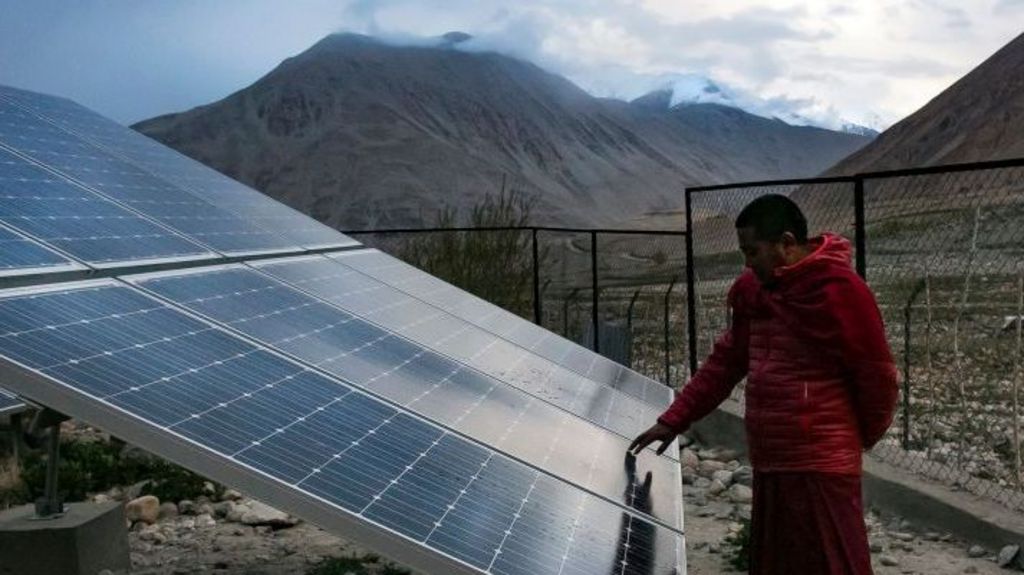
In a landmark breakthrough for global clean energy transition, India has announced that renewable energy now accounts for 54% of its total 552 gigawatts (GW) of installed power capacity — a target reached five years ahead of its original 2030 deadline. This achievement marks a dramatic turning point for a nation long labeled as dependent on coal, signaling how rapidly emerging economies can scale up non-fossil fuel power.
The turning point was highlighted on a hot July afternoon this year, when renewable sources collectively met more than half of India’s peak national electricity demand for just the second time in the country’s history; the first occurrence took place during the same summer period in 2025. While this record only held for a short window, industry leaders frame it as a transformative milestone that redefines the role of clean energy in India’s power landscape.
“Renewable energy is no longer a marginal source sitting at the edge of the power system,” explained Sumant Sinha, CEO of ReNew Power, one of India’s largest Nasdaq-listed clean energy firms, in an interview with the BBC. A decade ago, India’s total installed renewable capacity stood at barely 4GW. Today, that figure has surged to 300GW, a more than 70-fold expansion that underscores the speed of the country’s clean energy push.
Even with this historic progress, coal still generates around 70% of India’s annual electricity output on average, due to coal plants’ higher capacity factors and ability to operate around the clock, unlike intermittent solar and wind generation. Still, the milestone confirms that India’s decades-long transition to clean energy has reached an irreversible inflection point, experts say.
Despite this remarkable growth, three interconnected challenges threaten to derail India’s ambitious 2030 target of 500GW of non-fossil electricity: strained transmission infrastructure, underdeveloped energy storage capacity, and persistent financing gaps that plague the entire sector.
The most pressing issue is the severe mismatch between the speed of renewable generation build-out and the expansion of the nation’s transmission grid. Development of new generation capacity has drastically outpaced upgrades to transmission lines, a problem that policymakers and analysts call the most critical operational risk to India’s climate goals.
According to global energy think tank Ember, transmission constraints were responsible for nearly two-thirds of all renewable energy curtailment — the practice of turning off working renewable plants when the grid cannot absorb their output — in the first quarter of 2026, totaling 300 gigawatt-hours of wasted clean energy. The root of the problem lies in the vastly different timelines for building generation versus transmission infrastructure, Sinha explained.
“Generation projects can be constructed in 18-24 months… Transmission can take much longer because they involve right-of-way, land acquisition, approvals and coordination across many agencies,” Sinha said. “It is an execution issue that becomes more important as the system gets larger.”
Vibhuti Garg, an energy analyst at the Institute for Energy Economics and Financial Analysis, added that poor long-term planning has exacerbated the strain. When India was adding just 10-15GW of new renewable capacity annually, the existing grid was able to absorb the new supply. But last year, India added a record 51GW of new renewable capacity, far outstripping what the aging transmission network can handle. The concentration of most new renewable projects in the northwestern states of Gujarat and Rajasthan has further strained the system, making it harder to move surplus clean power to high-demand regions across the country.
A common proposed fix for this mismatch is building large-scale battery storage systems at renewable energy hubs, which would store excess power for later use instead of curtailing it. But storage deployment has stalled in India, held back by spiking battery prices, raw material shortages linked to ongoing conflict in the Middle East, and a depreciation of the Indian rupee that has driven up financing costs for domestic companies. As a result, dozens of planned storage projects have been canceled or put on hold, Garg said.
Financing constraints extend far beyond storage projects, affecting the entire Indian renewable sector. While developed nations have abundant access to low-cost global capital for green transition, Indian clean energy firms have consistently struggled to secure affordable financing, even as the country has emerged as a global leader in renewable scaling. Government economic data shows that roughly 83% of all climate mitigation financing in India currently comes from domestic sources.
India will need an estimated $400-500 billion in total investment to hit its 2030 500GW non-fossil target. While the Paris Agreement committed developed nations to provide $100 billion annually in climate finance to developing countries by 2025, that pledge has yet to be fulfilled. Sinha noted that emerging and developing economies outside of China receive only around 15% of global clean energy investment, despite being home to roughly two-thirds of the world’s population.
Sinha emphasized that India does not require developed nations to fund its entire energy transition, but called for targeted support in the form of lower-interest loans, risk guarantees, and currency risk protection to encourage greater private sector investment in the sector.
Experts warn that addressing these gaps is critical not just for India, but for the entire world’s fight against climate change. India is the world’s third largest emitter of greenhouse gases, and its electricity demand is growing faster than any major emerging economy, with a compound annual growth rate of more than 7% in recent years. Demand is expected to accelerate even further as new energy-intensive industries such as data centers and semiconductor manufacturing expand across the country. The International Energy Agency projects that India’s total electricity demand will rise by 80% by 2035, the fastest increase of any major emerging economy.
Even with current challenges, the IEA has credited India’s rapid renewable expansion as a key factor that helped slow global emissions growth in 2026, even as energy-related carbon emissions rose in advanced economies at the fastest rate since the 1990s. How successfully India navigates its current hurdles and delivers on its clean energy targets will have an outsize impact on whether the world can meet its global climate goals, analysts say.