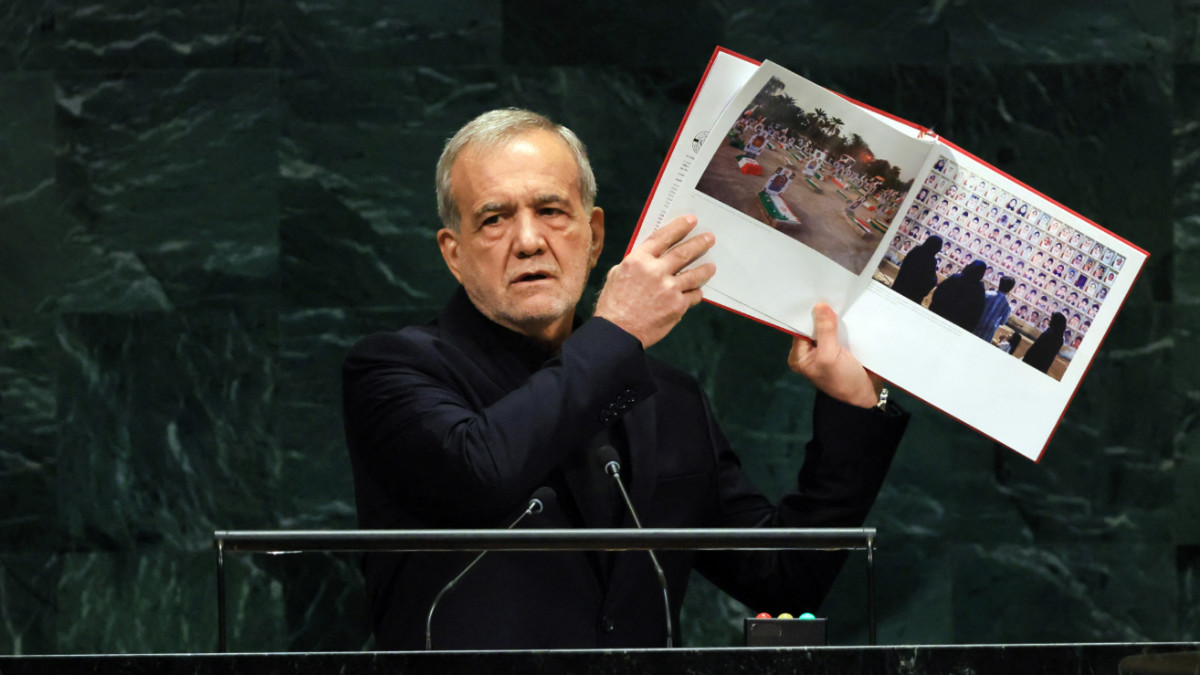
Delivering his first address to the United Nations General Assembly just 24 hours after U.S. President Donald Trump issued a brutal threat to “annihilate” the Islamic Republic, Iranian President Masoud Pezeshkian delivered a defiant yet diplomatic message on Wednesday: Tehran will never capitulate to American pressure, but remains open to negotiated de-escalation.
Speaking directly to Trump, Pezeshkian emphasized that escalating sanctions, coercive pressure and intimidation tactics would only strengthen Iranian resolve. “The resistance of the Iranian people will only increase in the face of sanctions, increased pressure, increased bullying. We will never bow our head or bend at the knee,” he told the assembled global delegation. To open his address, Pezeshkian held up a portrait of Ayatollah Ali Khamenei, Iran’s 86-year-old Supreme Leader, who was assassinated in the opening strikes of the joint U.S.-Israeli attack on Iran launched last February amid stalled nuclear negotiations.
He also displayed graphic photographs of Iranian children killed in U.S. airstrikes, alongside images of their graves. One attack on an elementary school in Minab left at least 150 people dead, roughly 120 of whom were children. A second strike, which dispersed thousands of lethal tungsten pellets, targeted a sports complex in the southern Iranian city of Lamerd. Earlier this month, a United Nations fact-finding mission concluded there were “reasonable grounds” to classify these strikes as war crimes, findings that underpinned Pezeshkian’s critique of U.S. and Israeli military action.
The conflict that began in February has dragged on for months, with two successive ceasefire agreements collapsing, and drawn in regional actors from Arab Gulf states to Yemen and Lebanon, raising fears of a full regional escalation.
Pezeshkian pushed back against long-standing U.S. claims that Iran is a state sponsor of terrorism, arguing that the label is a cynical misrepresentation by the actors that initiated the current war. “Those who are terrorists, and train and protect terrorists, describe us as such. We have only defended ourselves. We are not terrorists. America and Israel attacked us,” he said. He added that Iran has not launched an offensive attack against any other sovereign state in more than two centuries, yet remains branded a rogue actor by Western powers.
Addressing the core nuclear dispute that the Trump administration has cited as a key justification for war, Pezeshkian reaffirmed Iran’s long-held position that Tehran has no interest in developing a nuclear weapon, but will not abandon its right to peaceful civilian nuclear technology. He pointedly noted the contradiction in U.S. framing: the Trump administration has claimed Iran is close to building a nuclear bomb, even as it boasts that it destroyed Iran’s entire nuclear program in 2025 pre-war strikes.
“Iran does not accept for nuclear technology to be at the exclusive disposal of some,” Pezeshkian said. “We will not bow our head and give up the right that is inherently ours. We say it clearly: no nuclear weapons and no limitations to peaceful nuclear technology.” He also called out what he framed as blatant hypocrisy from the U.S. and Israel, noting that the international community allows Israel to maintain an open secret nuclear arsenal while forcing unprecedented inspections and restrictions on Iran’s peaceful program. “Atomic and nuclear bombs are in the hands of the Israeli regime, but the inspectors are requested to come to Iran. The nuclear weapon is in Israel, but the inspectors are in Iran. Israel kills, but Iran is subject to sanctions. They kill. We are sanctioned. We are punished,” he said.
The Trump administration has also pointed to Iran’s ballistic missile program as a core threat to justify military action. In response, Pezeshkian said Iran has every right to maintain a robust defensive military capability to deter potential attacks, noting that its military posture is never aimed at regional hegemony. “Iran must be powerful, so as to avoid being threatened. We do not wish to use our power for hegemony,” he said. “Our defensive systems have been built so that no one can think that the bombing of Iranian cities can go unanswered.”
Pezeshkian also pushed back against U.S. claims that widespread domestic protests earlier this year justified the invasion, arguing that the unrest was orchestrated by Washington and Tel Aviv to undermine Iranian stability, while the overwhelming majority of Iranians support the Islamic Republic. “The people of Iran have been in the street demonstrating in support of their homeland,” he said, adding that pro-government supporters had stood guard against “equipped, armed and trained by America and Israel to cause insecurity in our country.”
The UNGA address comes alongside behind-the-scenes diplomatic engagement: U.S. and Iranian officials held talks on the sidelines of the General Assembly Tuesday, a meeting Iranian state media framed as direct negotiations, a characterization that Trump appeared to confirm before the U.S. later walked it back to describe the engagement as indirect.
As part of new diplomatic proposals, Iran has submitted updated preconditions to reopen the Strait of Hormuz, a critical global energy chokepoint that has become a major flashpoint in the conflict, with both Washington and Tehran imposing rival blockades on the waterway. A senior Iranian official told Agence France-Presse that Tehran’s terms have hardened, now requiring the immediate release of $24 billion in Iranian funds frozen by Western sanctions and an end to Saudi Arabia’s blockade of Houthi-controlled territory in Yemen, a key Iranian ally.
The most recent ceasefire extension, agreed by Iran and the U.S. in June, collapsed over the summer in large part over disputes surrounding the Strait of Hormuz, where Iran has pushed to impose tolls on commercial shipping passing through the waterway. Pezeshkian defended Iran’s position on the strait, arguing that it is unreasonable to allow foreign powers to benefit from the waterway while using it as a tool to pressure Iran. “In the Strait of Hormuz, we can’t let some have free access and gain their interests from a waterway, while at the same time using that waterway to impose their aggressions upon us… to forbid us access to our own waterways,” he said.
Iranian reprisals for the U.S.-Israeli attacks have fallen disproportionately on U.S. Arab Gulf allies, stoking regional pressure for a new diplomatic approach. Earlier this week, both Qatar and the United Arab Emirates called for renewed engagement with Iran and the negotiation of a new regional security framework to end the ongoing conflict.