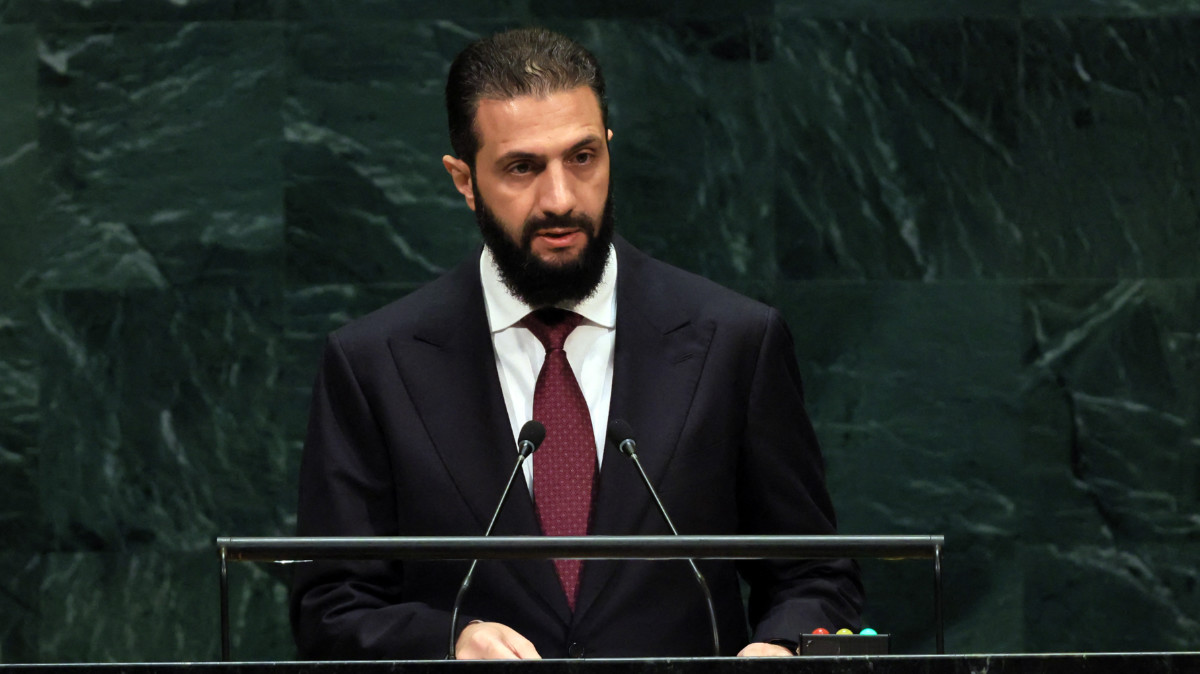
In a high-stakes address to the United Nations General Assembly, Syrian President Ahmad al-Sharaa has formally announced his war-torn nation’s reentry into the global fold, while delivering a sharp rebuke of sustained Israeli military incursions into Syrian territory that he says directly contradict the growing international consensus welcoming Damascus back to diplomatic engagement.
Speaking from the UN podium, Sharaa outlined the scale of unprovoked Israeli actions targeting his country, saying that Israel has carried out more than 500 separate air strikes, over 1,200 ground incursions, and detained more than 300 Syrian citizens in Syrian territory in recent years. “The world celebrates our return to the international community, yet Israel continues to launch attacks against Syria,” he stated. “This trajectory runs completely counter to the global shift we are seeing toward engagement with Syria. We categorically reject all Israeli aggression.”
Sharaa also doubled down on Syria’s sovereignty claims to the Golan Heights, the strategic plateau seized by Israel from Syria in the 1967 Middle East war and illegally annexed by Israel in 1981. “Any attempt to violate our sovereignty and international law will be confronted. The Golan Heights will always remain Syrian territory,” he emphasized. The Syrian leader called for a full return to the terms of the 1974 disengagement agreement between the two countries, which established a UN-monitored buffer zone along their shared border. That agreement broke down after Israel invaded southern Syria and occupied the buffer zone immediately following Sharaa’s government taking power in late 2024, when he led a coalition that ousted long-time former president Bashar al-Assad.
Sharaa’s condemnation received backing from Jordan’s King Abdullah II, who delivered his own blistering address to the General Assembly on Tuesday. King Abdullah argued that Israel’s repeated strikes on Syria make clear that the country holds territorial ambitions that extend far beyond the occupied Palestinian territories.
Diplomatic efforts to normalize relations between Syria and Israel are currently being brokered by the United States, but Sharaa has ruled out any progress toward diplomatic ties while Israeli military actions continue. Speaking at a think tank event Tuesday, he made clear that he cannot entertain the idea of formal diplomatic relations so long as Israel carries out air strikes on Syrian soil and occupies the Golan Heights, his birthplace.
The most recent high-profile Israeli strike came just last month, when Israel bombed a northern Syrian air base that it claimed would be used by Turkish forces. Syria’s close alliance with Turkey has turned the country into an emerging arena of geopolitical competition between Ankara and Tel Aviv, adding another layer of complexity to the already volatile region.
The 1974 disengagement deal was originally reached during the rule of Hafez al-Assad, Bashar al-Assad’s father, and created a security framework and the UN buffer zone that held for decades. The status of the Golan Heights became even more contentious in 2019, when then-US President Donald Trump—who has openly expressed admiration for Sharaa—unilaterally recognized Israeli sovereignty over the occupied territory, a long-sought policy win for Israeli Prime Minister Benjamin Netanyahu.
Sharaa, who addressed the UN General Assembly for the first time last year just months after taking power, used this year’s speech to highlight his administration’s progress in stabilizing Syria after decades of conflict. He said that his government has restored basic security across most of the country, ended Syria’s long period of international isolation, cracked down on transnational organized crime and the trade in captagon—the illicit amphetamine that flourished under the Assad regime—and is cooperating with international bodies to eliminate leftover chemical weapons stockpiles from the previous government.
While international sanctions on Syria have been lifted following the political transition, Sharaa’s administration still faces steep domestic challenges, including a collapsed national economy and slow progress on reconstruction after years of civil conflict. Even amid these hurdles, Sharaa struck a confident note about his nation’s future. “Syria is rising,” he told the assembly Wednesday. “We have proven to the world that regional security can only begin with a stable, restored Syria starting from Damascus.”