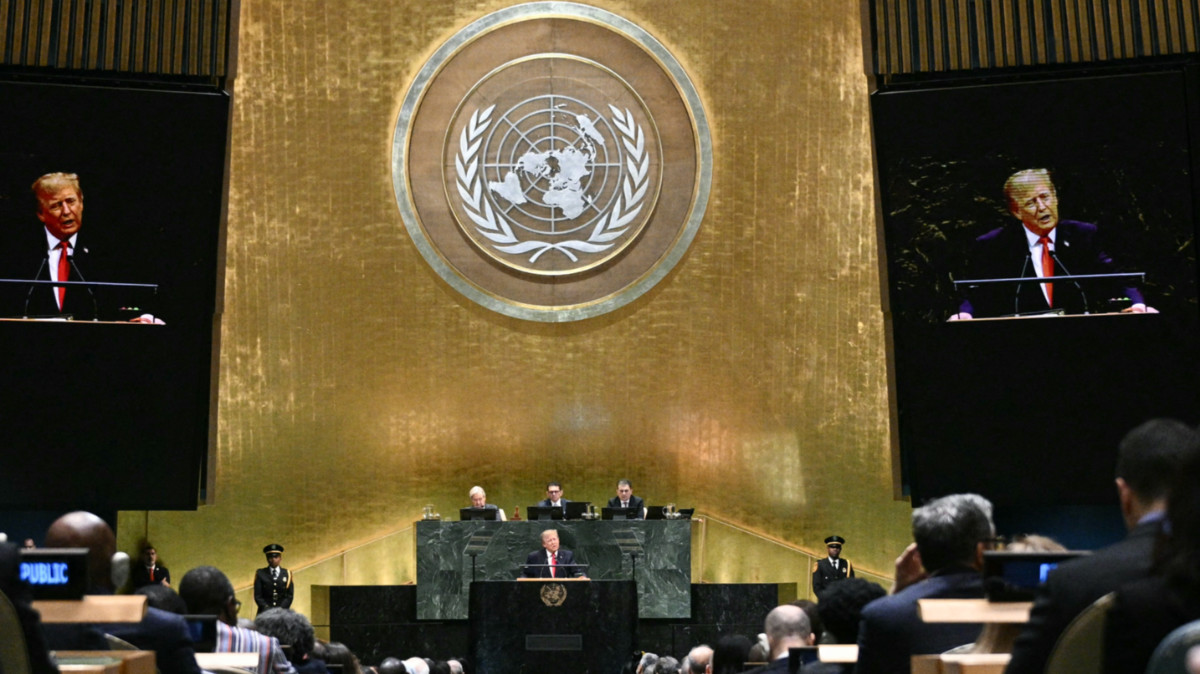
The 81st session of the United Nations General Assembly kicked off this Tuesday at UN Headquarters in New York, with outgoing Secretary-General António Guterres using his final opening address to frame a defining shift in global order and issue an urgent plea to end the bloodshed across the Middle East.
Guterres opened by declaring that the global transition to a multipolar world is an irreversible process, noting that even the world’s most powerful nations are now facing hard limits on the reach of their influence. “Military power alone cannot secure peace. Economic power alone cannot command stability. And technological power alone cannot guarantee security,” he told assembled world leaders. He argued that a interconnected multipolar system can lay the groundwork for more equitable, representative global problem-solving—if that system is anchored by a balanced, inclusive United Nations at its core.
Turning to the escalating crisis in the Middle East, Guterres condemned the hollow ceasefire agreements that have done little to stop civilian harm. “So-called ceasefires have amounted to little more than ‘lesser fires’, with civilians continuing to pay the price,” he said. “Enough is enough. I appeal to the leaders in this chamber to maximise this high-level week for de-escalation and dialogue. Let’s send a clear message from this hall: the fighting must stop.” He warned leaders against abandoning the decades-long push for a two-state solution to the Israeli-Palestinian conflict, marking nearly one year since the October 7 Hamas attacks that killed roughly 1,200 Israelis. He called the subsequent Israeli military campaign in Gaza an “onslaught” of killing and destruction unseen during his tenure as secretary-general, adding that expanding Israeli settlements and escalating violence in the occupied West Bank are erasing the last paths to peace and raising the alarming threat of ethnic cleansing. “We cannot allow the two-state solution to disappear before our eyes,” he stressed.
Following a longstanding UN tradition that grants Brazil the floor as the first member state to address the assembly, Brazilian President Luiz Inácio Lula da Silva delivered a sharp rebuke of unilateral power plays and growing global militarism, without directly naming US President Donald Trump. Lula centered his speech on the legacy of former Palestinian leader Yasser Arafat and former Israeli Prime Minister Yitzhak Rabin, two architects of the 1993 Oslo Peace Accords who he framed as the kind of statesmanship the world desperately needs amid today’s global scourge of war. “We are called to choose between multilateralism and unilateralism. Democracy or extremism. Sovereignty or subordination,” Lula said, warning that trillions of dollars are now fueling a new global arms race. Recounting the legacy of Arafat and Rabin—who were ultimately killed by extremists opposed to their peace deal—Lula said they “challenged the past to envision a future of peace” and were ultimately defeated by hatred.
Lula explicitly condemned what he called Israel’s genocide in Gaza, where official Palestinian health authorities estimate nearly 74,000 Palestinians, most of them women and children, have been killed since the start of the Israeli campaign. He acknowledged that Israeli civilians also suffer from the “radicalism and intolerance of Hamas terrorist acts,” but said generations of Palestinians will carry the trauma of the killings perpetrated by Prime Minister Benjamin Netanyahu’s government.
The Brazilian leader also pushed back against US efforts to undermine the International Criminal Court, which issued arrest warrants for Netanyahu and former Israeli Defense Minister Yoav Gallant in November 2024 over alleged war crimes and crimes against humanity in Gaza. “Persecuting the International Criminal Court and its members encourages these crimes to go unpunished,” he said. He also defended UN Special Rapporteur on the Occupied Palestinian Territories Francesca Albanese, who faced US sanctions earlier this year that were only lifted after a federal judge ruled they violated her First Amendment rights to free speech. “The UN special rapporteur must not be silenced for telling the truth,” Lula added.
Jordan’s King Abdullah II followed with a blistering condemnation of Israeli policy, accusing the Israeli government of committing widespread war crimes across Gaza and the occupied West Bank, and warning that its territorial expansionism extends far beyond Palestinian lands. He accused Israel of intentionally inciting a religious war, framing its conflict with Palestinians as a battle between Judaism and Christianity on one side and Islam on the other. “This [Israeli] government’s sense of impunity has reached terrifying levels,” he said. “No one in this assembly should assume this Israeli government’s appetite stops at Palestine,” he added, pointing to Israeli attacks and occupation of Syrian territory.
King Abdullah cited the recent US-Israeli military campaign against Iran as proof that Middle Eastern instability carries global ripple effects. “If anyone had any doubt that conflict in our part of the world stays there, just look at the energy and grocery bills from ordinary families from Mumbai to Madrid to Minnesota,” he said. “The Iran war has shown how quickly instability can disrupt trade, investment and lives beyond the region.” He criticized the international community for choosing to merely manage the Israeli-Palestinian conflict rather than confront its root causes, with catastrophic results. He detailed widespread abuses against Palestinians in the West Bank, where Israeli home demolitions to expand illegal settlements amount to forcible transfer—a war crime—and said Israel is carrying out a de facto annexation of the territory that amounts to a systematic campaign of subjugation. “Gaza and the West Bank are two fronts of the same Israeli strategy. In both, Palestinians are being killed. In both, the reality on the ground is being remade: Gaza through destruction, the West Bank through de facto annexation,” he said.
Turkish President Recep Tayyip Erdoğan opened by condemning the ongoing ban on Palestinian Authority President Mahmoud Abbas addressing the General Assembly, marking the second consecutive year Abbas has been barred from attending. Calling the exclusion a blatant injustice, Erdoğan said Turkey would continue to stand as a voice for an independent, sovereign Palestine, urging all nations that have not yet recognized Palestinian statehood to reverse their position. He described the past 12 months as one of the bloodiest periods for global conflict in three decades, drawing particular attention to the ongoing violence in Gaza. “We lost [thousands of Palestinians] to what we regard as acts of state terror by Israel,” he said.
Erdoğan noted that even after a US- and Turkish-mediated ceasefire deal was reached between Israel and Palestinian factions in October 2025, more than 1,500 additional Palestinians have been killed in Gaza. While Palestinian resistance groups have followed through on their commitments to move forward with the second phase of the peace plan, he said the Israeli government continues to refuse to end its occupation of Palestinian territories. He added that the occupied West Bank is facing its worst wave of Israeli settler violence in modern history, with data from the Palestinian Wall and Settlement Resistance Commission showing a 63 percent jump in settler attacks in the first seven months of 2026 compared to the same period last year.
Erdoğan also joined calls for sweeping UN reform, arguing that the current global body structure is controlled by the five permanent members of the Security Council and fails to represent the interests of the broader global community of more than 190 member states. “The United Nations, established 81 years ago to maintain peace and security, has become unable to fulfil this mission, or rather it has been made unable to do so,” he said. On the ongoing conflict between Saudi Arabia and Yemen’s Houthi movement, Erdoğan said Turkey continues to work with all parties to reach a negotiated end to the conflict, noting that prolonging the fighting benefits no one. Houthi forces have recently stepped up attacks on Saudi territory and taken control of the Bab el-Mandeb Strait, a critical global energy chokepoint.
Qatar’s ruling Emir Sheikh Tamim bin Hamad Al Thani warned that the Gulf region is entering one of its most dangerous phases in modern history, brought on by decades of delaying meaningful conflict resolution through temporary fixes and unworkable policy. He stressed the urgent need for a regional collective security framework that respects national sovereignty, territorial integrity, the peaceful resolution of disputes and non-interference in internal affairs. “In the absence of such a system, it becomes possible for a war to erupt,” he said. “It has become possible for one party to drag its neighbours into a war that is not theirs, targeting their vital assets and installations despite their strenuous efforts to avert escalation.”
Qatar has found itself drawn into the ongoing conflict between the US, Israel and Iran despite its best efforts to stay neutral and avoid escalation. Iranian attacks on Qatar’s Ras Laffan energy complex damaged two major liquefied natural gas (LNG) processing trains and a gas-to-liquids plant, taking roughly 17 percent of the country’s total LNG export capacity offline temporarily, according to QatarEnergy. The conflict has also completely shut down the Strait of Hormuz—through which roughly a quarter of the world’s global energy trade passes—severely disrupting Qatar’s energy exports and roiling global energy markets. As a result, Al Thani said, food and medicine prices have spiked on every continent, harming the livelihoods of ordinary people with no connection to the conflict.
The Qatari emir called for a diplomatic resolution to the Gulf crisis, urging the reopening of the Strait of Hormuz and a return to negotiations to prevent full-scale regional war. On the Palestinian issue, he condemned Israeli leaders who openly advocate for the forced displacement of Gaza’s population, which they frame as “migration.” He called on Israel to meet its international commitments: end all military operations in Gaza, withdraw all forces from the besieged territory, lift the illegal 19-year blockade on Gaza, and allow unimpeded access for humanitarian aid. “There can be no talk of a just international order as long as Palestine remains a blind spot within it,” he said. “Dealing with Israel, putting an end to the harm it causes, and restraining its unlawful conduct constitutes the true test of the international community’s seriousness in upholding values and the rule of law. The law must apply equally to all.”