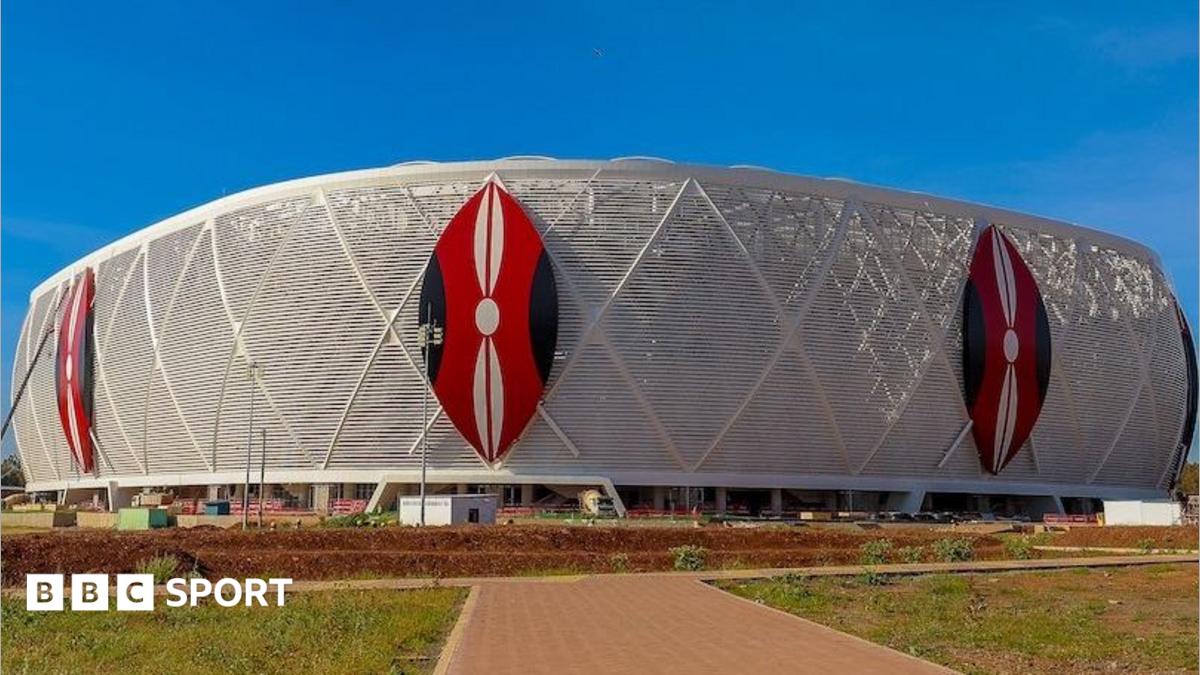
The 2027 Men’s Africa Cup of Nations (Afcon) is locked into its scheduled timeline, Confederation of African Football (CAF) President Patrice Motsepe has confirmed, even as he pushes co-hosts Kenya, Tanzania and Uganda to ramp up preparation work ahead of critical upcoming deadlines. This edition of the continent’s flagship football tournament will mark the first time the competition has returned to East Africa in 51 years, with the opening match set for June 19, 2027 and the final scheduled for July 17 the same year.
During a multi-country inspection tour completed last week, Motsepe told BBC Sport Africa that while overall development has been encouraging, urgent progress is needed to hit upcoming infrastructure milestones. With just nine months remaining before the tournament kicks off, Motsepe emphasized that all host venues must be ready for mandatory operational testing this coming January, leaving zero margin for further delays. “Even though we’ve got nine months, we need to start using those stadiums in January next year to test them and to see what further improvements are required,” he explained after wrapping up his inspection of Kenyan venues.
Motsepe acknowledged that the three co-hosts have made “very good progress” on overall preparation, but was clear that some existing facilities still fail to meet CAF’s strict world-class standards. The governing body requires top-tier infrastructure across all touchpoints of the tournament, from match venues and training pitches to hospitality, transportation and broadcast facilities. “We’ve got very high standards in terms of our expectations of the infrastructure, the facilities and the stadiums, the hotels, the roads, the football pitches where training takes place,” the South African football leader said. “We require those facilities to be world class.”
Despite the existing gaps in some construction and renovation projects, Motsepe stressed that postponement of the 2027 tournament is not being considered at any level. “There isn’t the slightest consideration of a postponement,” he said. “There should be no need because there’s a deep amount of commitment” from the co-host nations, he added. During his visit to Nairobi, Motsepe held formal talks with Kenyan President William Ruto to align on preparation goals.
The inspection tour began in Tanzania before moving to Kenya, where Motsepe assessed two key Nairobi venues: the existing Kasarani Stadium, currently undergoing major renovations, and the newly built 60,000-seat Talanta Stadium, purpose-constructed for the 2027 tournament. Multiple sources familiar with Kenyan preparations tell BBC Sport Africa that the most significant pressing concern centers on Kasarani Stadium and its attached training facility.
Kasarani is already set for a major global sporting milestone even before Afcon kicks off: earlier this week, Nairobi was awarded the right to host the 2029 World Athletics Championships at the venue, beating out competing bids from London and Rome. During CAF’s last major inspection in mid-February, local organizers were given a target to have all venues and training facilities at least 80% complete by August this year. But Kasarani has seen only limited progress over the past seven months, with multiple critical systems still unfinished. The playing surface has yet to be laid, and work remains incomplete on broadcast cabling, floodlighting, and premium sky box suites. Motsepe also noted that security and seating plans for visiting heads of state and hundreds of other VIPs require a reworking of original stadium design layouts.
“Security issues in relation to where the special guests, particularly the heads of state, will be seated requires a revision of the original plans,” the 64-year-old CAF chief explained.
Kenyan Sports Cabinet Secretary Salim Mvurya has given formal assurances that all preparation work will be completed on schedule, telling reporters that work will be accelerated to wrap all projects by December. That timeline will allow for test events to be held across all venues ahead of Motsepe’s next scheduled assessment visit in January. “I assure CAF and Kenyans we will accelerate the preparations for Afcon 2027,” Mvurya said. “We will conclude everything by December to be sure we can have test matches in the various facilities.”
The call for urgency comes amid a recent pattern of tournament postponements across CAF competitions, which has raised external scrutiny of the 2027 preparation process. This year’s Women’s Africa Cup of Nations was postponed just 12 days before its planned March kickoff, eventually moving to July. The 2024 African Nations Championship, originally scheduled for February 2025 in the same three East African co-hosts, was pushed back to August 2025 to allow for infrastructure completion — a decision made just 18 days before the tournament was set to begin. The 2023 men’s Afcon in Ivory Coast was also shifted from its original date to early 2024 over concerns about rainy season disrupting matches.
CAF has long struggled with scheduling conflicts amid a crowded global football calendar: two years ago, Motsepe’s former deputy Veron Mosengo-Omba acknowledged the organization faced a “scheduling nightmare” fitting its regular biennial tournaments into the global match calendar. Many industry analysts believe this challenge is the core driver behind CAF’s decision to shift the men’s Afcon from a quadrennial to a biennial tournament after 2028.
Even with this history of delays, Motsepe has repeatedly reaffirmed that the 2027 timeline is non-negotiable. “There’s no plan B, there’s no plan C,” he said.
For Kenya, successful delivery of the 2027 Afcon carries far broader national importance beyond football, as it already helped the country secure the right to host the 2029 World Athletics Championships. “One of the reasons why Kenya won the 2029 World Athletics Championship bid is because we are hosting Afcon. Therefore this is a legacy,” Mvurya said. The tournament is also framed as a catalyst for broader national economic transformation, with tourism expected to be a major long-term beneficiary. “Sport is not just entertainment, it is livelihood, it is economic transformation,” Mvurya added. “Therefore we are aware the opportunity to host Afcon will be key for our economic inspiration. Our tourism will be a big beneficiary. As government, we are confident we will host a successful Afcon.”
The next three months will prove the most critical period for turning that promise into a reality, as construction teams race to hit the December completion target ahead of January’s high-stakes CAF assessment.