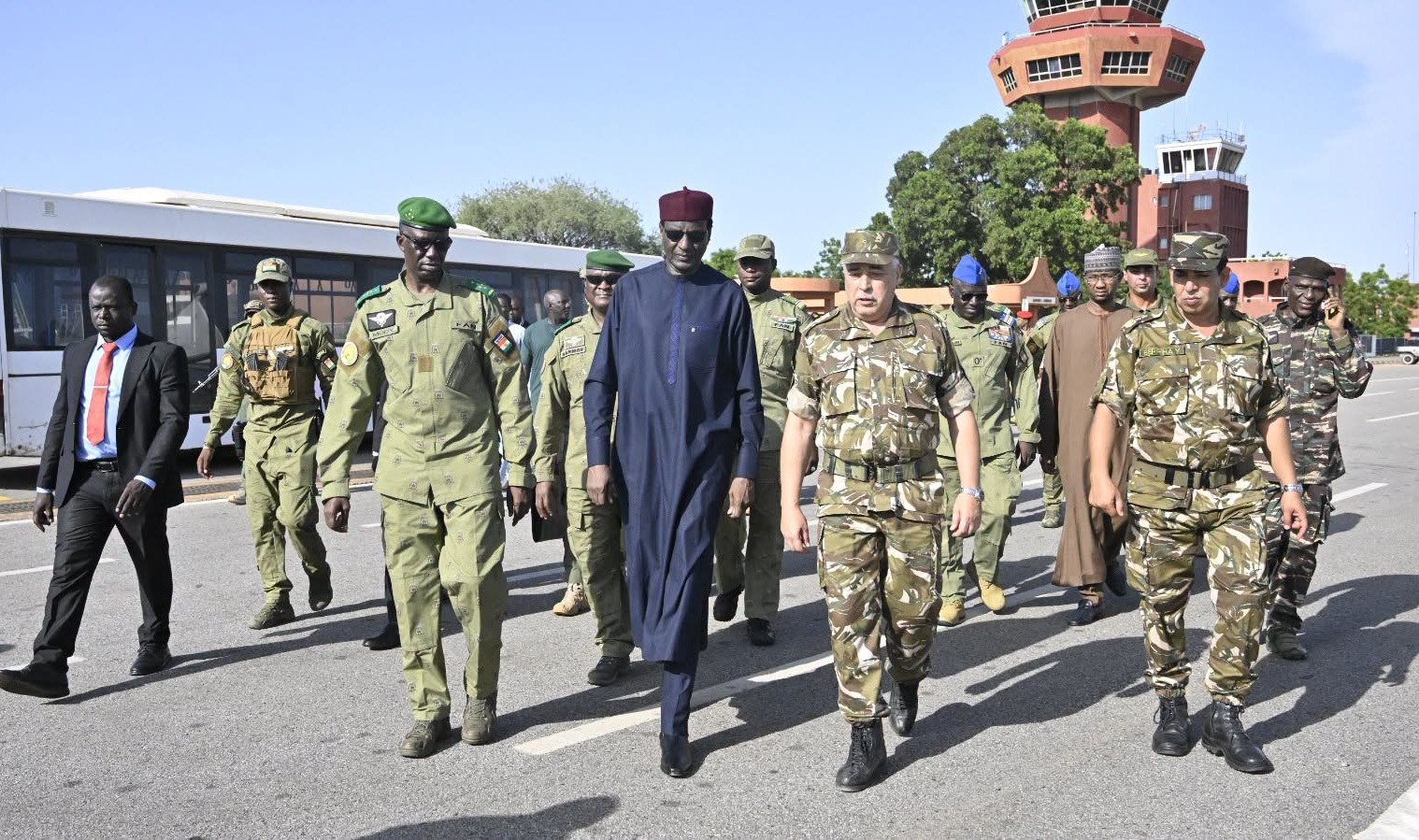
On August 30, following an official request from Niger’s transitional authorities and direct orders from Algerian President Abdelmadjid Tebboune, Algiers made an unprecedented public announcement: it had deployed four Su-30 fighter jets, one refueling aircraft, and one military transport plane to Niger, to support its southern neighbor in countering rising internal instability.
This deployment came just one day after a foiled mutiny against the government led by General Abdourahamane Tiani, who seized power via a military coup in July 2023. Over August 28 and 29, renegade soldiers attacked multiple key sites across Niamey, Niger’s capital, including the presidential palace, Diori-Hamani International Airport, and Military Base 101, sending tensions surging across the already volatile Sahel nation.
A senior anonymous researcher from The Sentry, a U.S.-based non-profit investigative and policy organization, explained that the mutineers’ anger stems from deep-rooted institutional and military inequities within Niger’s armed forces. Rank-and-file soldiers have suffered repeated heavy casualties in counter-insurgency operations across the country’s rural regions, while Tiani’s loyal Presidential Guard remains concentrated in the capital, equipped with superior hardware and receiving far better benefits and treatment. The researcher added that a deadly clash that killed approximately 18 soldiers near the city of Dosso just one week before the mutiny was the immediate trigger for the uprising, a tragedy that is part of a years-long pattern of devastating insurgent attacks on Niger’s military. In 2019 alone, Islamic State in the Greater Sahara claimed two major attacks that killed 160 Nigerian soldiers near the Malian border: 71 at the Inates military base in December, and 89 more at the Chinagodrar outpost just one month later. A suicide attack claimed by the group also struck central Niamey in January this year, underscoring the persistent threat Tiani faces from both militant groups and internal military discontent.
For Algeria, which shares a 950-kilometer porous border with Niger, this spiraling instability has forced a long-overdue reckoning: can Algiers continue to stand on the sidelines as chaos, armed insurgency, human trafficking networks, and political fragmentation take hold along its southern frontier, and across the broader Sahel region?
Regional analysts broadly view Algeria’s open deployment of military assets to Niger as a potential turning point in the country’s foreign policy, breaking with a strict doctrine of non-intervention in the internal affairs of other states that has been a cornerstone of Algiers’ approach to global affairs since it won independence from France in 1962.
“Algeria can no longer protect its own national security and core interests just by guarding its own borders. It has to secure its strategic depth,” explained Riccardo Fabiani, North Africa Project Director at the International Crisis Group. What makes this move particularly notable is that Algiers has chosen to openly communicate the operation to the public, a sharp departure from its past preference for quiet diplomacy. Algeria’s official press agency ran full coverage of the deployment, video footage of Algerian aircraft arriving in Niger circulated publicly, and a joint press conference was held between Nigerien officials and the Algerian military delegation led by Major General Rachid Cheblaoui.
Fabiani noted that this deployment signals the emergence of a new, far more pragmatic foreign policy for Algeria, one where the country is prepared to take on direct security and military roles in the region, rather than relying exclusively on diplomatic engagement to advance its goals in a rapidly shifting regional landscape. This public show of force also serves a second key purpose: it asserts Algeria’s regional influence amid growing competition from outside and regional powers seeking to expand their footprint in the Sahel.
Fabiani added that Algeria has deep historical and cultural ties with Niger, and a core strategic interest in protecting the sovereignty of Sahel nations against interference from third parties such as Morocco, Israel, and the United Arab Emirates. “Algeria does not want any foreign interference, official or unofficial, in Niger’s political and security affairs,” he said. In fact, Algiers’ suspicion of foreign involvement in the region escalated to a formal break in diplomatic relations with Abu Dhabi on September 10, after months of growing tensions; Algeria accuses the UAE of indirectly funding armed separatist groups in the Sahel, including through multimillion-dollar ransom payments for released hostages.
The Sahel has in recent years become a hotspot for competing foreign interests: Morocco has deepened security and economic cooperation with Niger since the 2023 coup, Turkey supplies combat drones to the Nigerien military, Italy maintains a deployment of over 300 soldiers at Military Base 101 in Niamey, and Russia maintains a presence through the Africa Corps paramilitary group, which local reports say assisted in foiling the late August mutiny.
Beyond security and geopolitical competition, the partnership between Algiers and Niamey carries major economic stakes, particularly in the energy sector. The Senty senior researcher explained that the two countries have rebuilt cooperation around two major projects: the Bilma oil block in northeastern Niger, and the 4,100-kilometer Trans-Saharan Gas Pipeline, which plans to transport natural gas from Nigeria through Niger to export markets via Algeria’s Mediterranean coast. Morocco has backed a competing 5,600-kilometer pipeline project running from Nigeria along the Atlantic coast to Morocco, arguing that persistent instability in Niger makes the trans-Saharan route unfeasible. With construction of Algeria’s section of the Trans-Saharan pipeline already kicking off in the Adrar region in June, maintaining a stable pro-Algeria government in Niamey serves both security and economic goals for Algiers.
Mourad Preure, an Algerian energy and strategy consultant, argues that military support is just one piece of a broader, development-focused Algerian strategy to stabilize Niger. “Algeria already supports Niger’s electricity sector, providing small-scale power plants. The Trans-Saharan Gas Pipeline will generate transit fees for Niger, creating a steady source of revenue and affordable energy for the country,” Preure said. “Algeria is also building a trans-Saharan road and rail corridor to enable the transit of goods and people, advancing deeper regional integration.”
The core question now is whether this military deployment marks a permanent break with Algeria’s 60-year tradition of non-interventionism. It is true that Algeria deployed military forces as part of an Arab coalition supporting Egypt and Syria during the 1967 and 1973 Arab-Israeli wars, but these were widely viewed as exceptional cases, rooted in core pan-Arab interests, rather than a shift in doctrine. Non-interventionism, rooted in Algeria’s post-independence non-alignment stance, remained a central principle of its foreign policy even after those conflicts. The principle was never formally codified in the constitution, creating inherent legal ambiguity, but in practice, Algiers long favored quiet diplomacy and mediation over overt military engagement – the 2015 Algiers Peace Accord between Mali’s government and northern Tuareg rebel groups is a key example of this approach.
A turning point began to emerge in 2020, one year into Tebboune’s presidency, when the government passed a sweeping constitutional revision, born out of the 2019 Hirak pro-democracy movement that toppled long-time leader Abdelaziz Bouteflika. Article 91 of the revised constitution grants the president the authority to deploy Algerian military forces abroad, contingent on approval by a two-thirds majority vote in both chambers of parliament. Article 32 also permits Algerian participation in United Nations, African Union, and Arab League peacekeeping operations, and rules out offensive war that would undermine the sovereignty of other states. At the time of the revision, the amendment sparked significant pushback from civil society and Hirak activists, who opposed any potential deployment of Algerian troops to foreign conflicts.
Notably, the current deployment to Niger – which for now only includes technical personnel to operate the deployed aircraft, no frontline combat troops – has not received parliamentary approval. Fabiani argues that from Algiers’ perspective, this deployment does not qualify as a long-term combat presence that would require legislative sign-off. “Direct combat deployment would be politically problematic, both domestically and regionally. But deploying equipment and supporting personnel falls outside that framework,” he explained. This is not Algiers’ first recent military support to Niamey: the country donated four helicopters and additional military equipment to Niger in early August, before the late August mutiny. What is new is the open, public acknowledgment of the deployment, designed to send a clear political as well as military signal to regional and global actors.
Whether this operation is an isolated case or the first sign of a deeper, permanent shift in Algeria’s security doctrine remains unclear. No analysts contacted for the original reporting were willing to make definitive predictions, noting that everything depends on how the Sahel’s security situation evolves in the coming months. Preure emphasized that Algeria’s role remains limited to responding to requests from neighboring states: “When Algeria is asked, it provides assistance as a good neighbor, but it is not Algeria’s role to take on responsibility for the national defense and security of other states.”
The Sentry researcher similarly noted that any future Algerian engagement across the Sahel will be decided on a case-by-case basis, rather than representing a blanket policy shift. Neighboring Mali, where Algiers has recently repaired relations after years of diplomatic tension over the Tuareg insurgency, offers a clear example: even with rapprochement, a similar military deployment to Mali is not on the table in the near term. “Relations between Algeria and Niger are far less complicated, because the Tuareg issue that has long poisoned Algeria-Mali ties does not carry the same weight in Algiers’ relationship with Niamey,” the researcher explained. That allows Algeria to deploy aircraft and provide military support without being drawn into the complex, sensitive internal conflicts that have complicated its engagement with Mali.
Still, faced with continued deterioration of security across the Sahel, Algiers has clearly concluded that it can no longer rely solely on border defense to protect its national interests. Instead, it must now proactively shape its strategic environment. As Africa’s second largest military power by size and its largest defense spender, a more proactive Algerian role in the Sahel could fundamentally reshape the region’s security dynamics for years to come.