Nestled between rolling mountains just a short distance from Seoul’s bustling city center, the quiet residential neighborhood of Buam-dong has long been a haven for visitors and locals alike. Restricted urban development, a result of its proximity to the Blue House presidential residence, has preserved the area’s quaint, charming character, dotted with independent art galleries, cozy neighborhood cafes, and pockets of lush, mature greenery. For more than a century, one ginkgo tree standing sentinel along a residential sidewalk has stood as a unifying, beloved landmark for the Buam-dong community — a tree locals have affectionately called “Grandpa Ginkgo.”
Unlike most ginkgos in Seoul that grow tucked away in private gardens or wild forested areas, this hardy, centuries-old tree belongs to everyone in the neighborhood. Jung, a local resident who requested anonymity (and is referred to here by a pseudonym) who moved to Buam-dong just four years ago, formed an immediate, deep bond with the tree. “I pass this tree whenever I come home. I would say, ‘Grandpa, I’m home.’ Or ‘Grandpa, I’m heading out now,’” she explained. For 74-year-old lifelong resident Park Jeon-hee, the ginkgo is his oldest friend. Even 10-year-old Kim On, who walks past the tree every school day, feels its loss acutely: “It has stood since before I was born. Thinking it might fall down makes me sad.”
It was Jung who first noticed something was terribly wrong in the summer of 2026, when Seoul’s normally lush summer foliage turned the city deep green. While other trees thrived under the humid skies, “Grandpa Ginkgo” was visibly ailing. Healthy green fan-shaped leaves were dropping to the ground en masse, an abnormality that should not occur during peak growing season. Within weeks, the base of the tree was blanketed in a rotting carpet of fallen leaves, and its branches began to thin and turn brown.
Jung’s initial quiet curiosity quickly bloomed into urgent concern, and she rallied neighbors who had also noticed the tree’s decline to form an informal group of amateur investigators to uncover what was ailing their hardy community landmark. The mystery captured national attention across South Korea, making front-page national headlines — a level of scrutiny that left Jung uncomfortable, prompting her request for anonymity. She compares the experience to watching a beloved family member fade: “Imagine a grandfather who silently embraces you every day, listens to you, and has always been strong and full of life. Suddenly, he begins to die. How heartbreaking would that be?”
As the community dug into the mystery, they spotted 10 white plastic funnels protruding from the soil just behind the tree’s trunk. Jung initially assumed the devices were installed to deliver nutrients to the tree, but soon began to suspect foul play. The group obtained access to nearby home security camera footage, which captured two men in white gloves crouching at the tree’s base with a power drill on an April morning. Though the footage did not definitively show the men installing the funnels, it aligned with a detail local officials had previously shared: the Whanki Museum, located steps from the ginkgo’s trunk, had previously requested permission from local landowners to remove the tree entirely. The museum claimed the ginkgo’s expanding roots were damaging its outer brick perimeter wall.
Arborists called in to inspect the tree echoed the community’s worst fears: the funnels were almost certainly being used to inject herbicide to slowly kill the 100-year-old tree, and residents placed the blame squarely on the Whanki Museum. A group of residents accompanied by police confronted museum staff shortly after the discovery, and locals allege a museum employee essentially confirmed the institution’s involvement. The museum has never issued a public confirmation or denial of the herbicide claims, and declined repeated requests for comment from the BBC. In a brief May statement, the museum said its outer wall was collapsing due to the ginkgo’s roots, that it had contacted more than 40 local property owners to request a solution, and that after receiving no responses, its staff “attempted to resolve the situation” — offering no further details on what actions were taken. Local council officials, however, told the BBC a 2025 inspection found “no meaningful connection” between the ginkgo’s roots and the claimed wall damage, adding that any legitimate structural issue would have prompted official intervention and public notification.
The irony of the accusation is not lost on angry local residents, as the Whanki Museum was founded in 1992 to honor the legacy of Kim Whanki, one of South Korea’s most celebrated pioneering abstract artists, often called the “Picasso of Korea.” The museum’s architect designed the space to harmonize with the natural landscape that was central to Kim’s work, and Kim himself wrote nature-focused essays under the pen name Su-wha, which translates to “conversation with trees.” “Treating life that way is ignorance and there was never any apology,” Jung said.
Residents have adopted Kim’s pen name for their ailing tree, and partnered with local environmental activists to launch a national petition calling for the creation of an official urban tree guardian program to protect landmark community trees. Activist Choi Jin-woo, who joined the campaign, said he initially could not believe the allegations: “When I first heard that a tree next to a museum had been poisoned with herbicide and was dying, I simply couldn’t believe it. But when I saw the ginkgo shrivelling, I realised something this horrific could actually happen in our society.” Residents have filed a formal police complaint against the museum’s director, and authorities confirm an investigation is ongoing, though they have declined to release further details. They are demanding the museum reveal what substance was injected into the tree so arborists can begin targeted treatment to save it.
Despite the grim prognosis — one arborist concluded the tree is 90% dead — the fight to save “Grandpa Ginkgo” has yielded an unexpected silver lining: it has united the Buam-dong community in a way no other event has. As Jung spent days organizing support and gathering information, neighbors left home-cooked meals on her doorstep, and she in turn shared homegrown vegetable soup with neighbors she had never met before. For Jung herself, who had struggled with mobility issues and depression after a serious illness last winter, the campaign pulled her back into community life: “I felt so depressed and hopeless but those feelings disappeared. I entered a tree-like state. The tree helped bring me back out into life again. Ironically, it was because the tree became sick.”
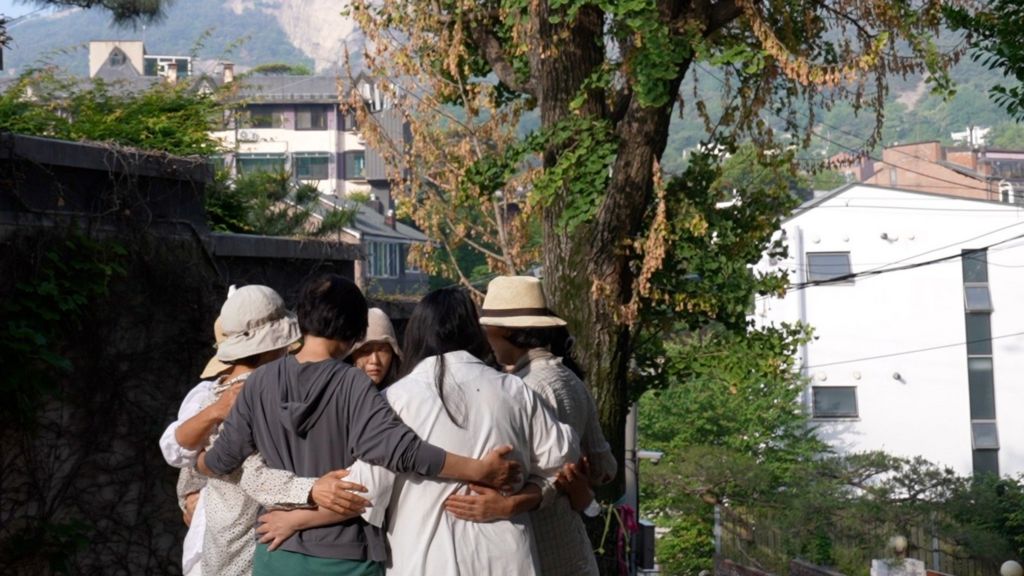
For weeks, roughly 20 residents gathered daily at the tree’s base to pray for its recovery: some read aloud Kim Whanki’s own essays about nature, a local shaman led a traditional healing ritual, and the group joined hands for an “elm dance,” a ceremonial practice some ecological activists believe promotes healing for ailing trees. Notes of support and well wishes are tied to the ginkgo’s trunk, fluttering in the mountain breeze.
As autumn settles over Seoul, turning the city’s deciduous trees into vibrant shades of gold and yellow, Buam-dong’s most famous tree still stands with mostly crispy, brown, bare branches. Jung says the tree’s fate is now “in the hands of heaven,” and all the community can do is stay by its side and hope for a miracle. For Buam-dong, the tree is far more than just greenery along a sidewalk: it is a centurylong companion, a community landmark, and an irreplaceable part of the neighborhood’s identity. Residents cannot imagine an autumn without pausing to admire “Grandpa Ginkgo” in his full, golden, feathery glory — and they are not ready to let him go.