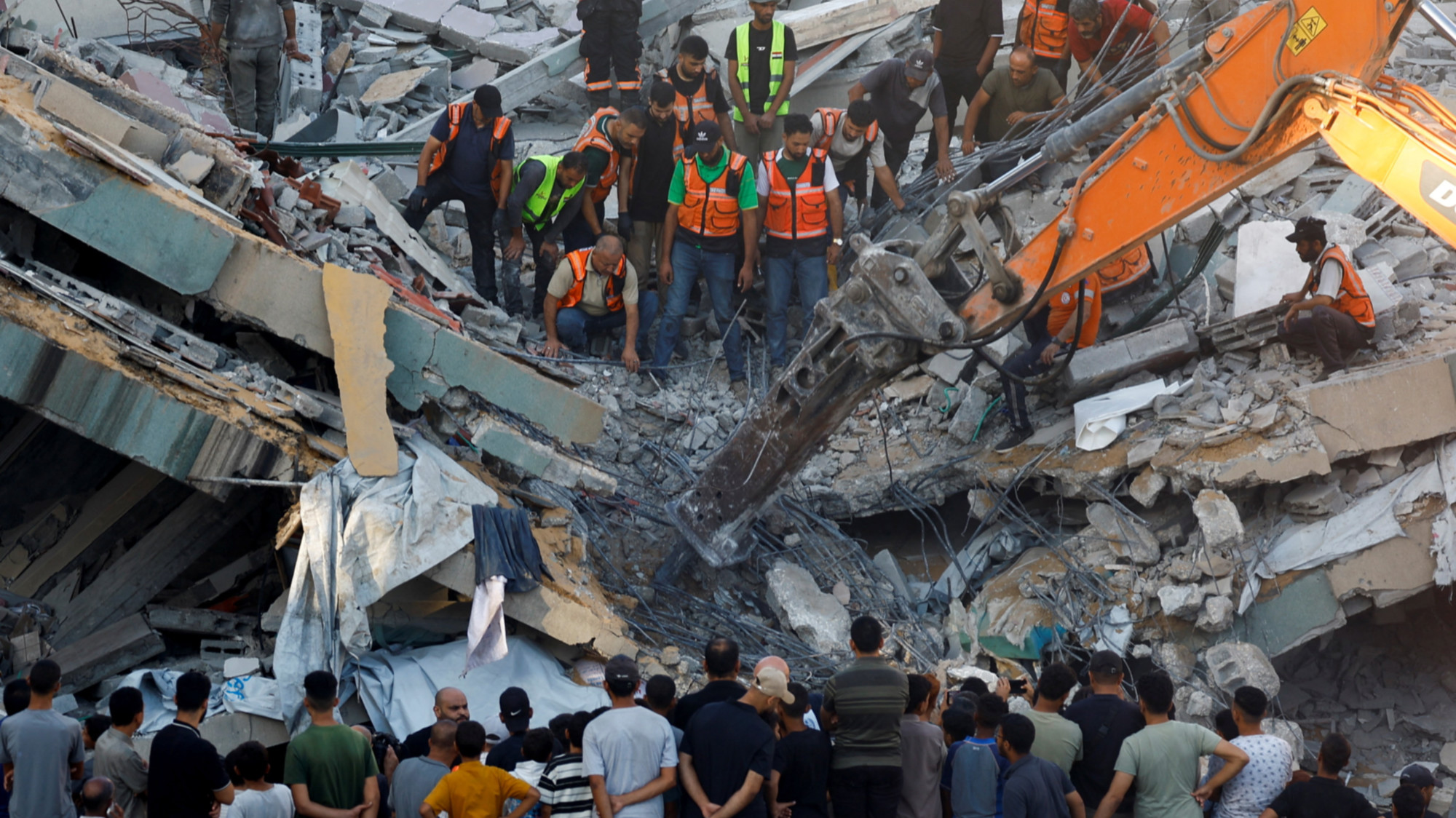
In the early hours of Wednesday, a six-story residential building that had sustained previous damage from Israeli military strikes in western Gaza City collapsed suddenly, leaving at least 14 people dead and dozens more — including many children — trapped under tons of rubble. The catastrophe unfolded while most residents inside were asleep, according to local emergency officials.
The building, located on al-Sinaa Street, was home to more than 10 extended families totaling approximately 80 people, a large share of whom were children. As of Wednesday afternoon, Gaza’s Civil Defence, the territory’s official emergency and rescue agency, confirmed that 14 bodies had been recovered from the site, including five children, while 10 injured survivors have been pulled out and transported to local medical facilities.
Mahmoud Basal, spokesperson for the Civil Defence, told reporters that rescue teams can still hear the cries of trapped people calling for help from beneath the debris, and crews are working around the clock to reach them. Abdullah al-Majdalawi, the agency’s director of public relations and media, added that operations have continued nonstop since the collapse was reported at roughly 3:10 a.m. local time. “Every victim we have pulled from beneath the rubble appears to have been sleeping on a mattress. They were asleep when the building collapsed,” Majdalawi explained to Middle East Eye in an on-site interview.
Critical equipment shortages have severely hampered rescue efforts, however. Years of Israeli military operations have destroyed the vast majority of Gaza’s heavy rescue machinery, leaving crews without the tools needed to clear large sections of reinforced concrete quickly. “We lack even the most basic tools,” Majdalawi said. “In the first moments after the collapse, we had to ask neighbours and displaced people nearby to bring hammers, shovels and other tools because of the severe shortage of equipment.”
Witnesses who live in the surrounding area described the collapse as sudden and devastating. Talal al-Harazin, a 53-year-old displaced Palestinian who lives in a makeshift tent near the building, said the sudden collapse felt like an earthquake. “It took less than 10 seconds for the entire building to come down,” he recalled. Al-Harazin added that the building had been visibly unstable for weeks: it had already sunk roughly three floors after an earlier Israeli strike, and debris fell from its damaged facade daily. “Unfortunately, we expected it to collapse. People had warned them, but they said, ‘Where can we live?’” he said. “Just yesterday, stones fell from it, and we said it could collapse. And that same night, it collapsed.”
Sabreen Nassir, a 33-year-old displaced woman who also lives in a nearby encampment, said two of her daughters’ close friends remain trapped under the rubble. “My daughters are standing here, watching and waiting for their friends to be pulled out,” Nassir said, noting her family has lived near the building for seven months as displaced people.
This disaster is not an isolated incident, according to Civil Defence officials. An estimated 2,000 damaged buildings across the Gaza Strip are currently at high risk of sudden collapse after sustaining damage from Israeli strikes, and the vast majority of these structures remain occupied because residents have no alternative shelter. “This is a recurring situation. Buildings at risk of collapse are becoming graves for their residents. The only difference is the timing,” Majdalawi warned. “Dozens of homes have collapsed, and dozens of people have been killed in this way.”
Officials are also sounding the alarm about growing risks as the winter season approaches. Without a massive influx of temporary shelter units and reconstruction materials, far more deadly disasters are on the horizon, Majdalawi said. “We are now on the verge of a real disaster as winter approaches. If mobile homes, caravans and reconstruction materials are not brought into Gaza, we will see more of these disasters.”
The ongoing shelter crisis in Gaza stems from the widespread destruction of housing during Israel’s military campaign that began in 2023. UN data estimates that roughly 90 percent of all housing units across Gaza have been damaged or destroyed, leaving nearly all of the territory’s 2.2 million residents internally displaced. A report released last month by the Shelter Cluster, led by the Norwegian Refugee Council, found that 1.98 million Palestinians — 94 percent of Gaza’s total population — require urgent shelter assistance and basic household supplies.
A US-mediated ceasefire agreement reached in October last year was meant to end hostilities, open Gaza’s borders to large-scale humanitarian aid including construction and shelter materials, and launch formal reconstruction efforts. But Israel has repeatedly violated the terms of the truce, carrying out near-daily military operations across the territory, restricting access for reconstruction teams, and blocking the entry of most critical aid supplies, including materials needed to repair or replace damaged housing.