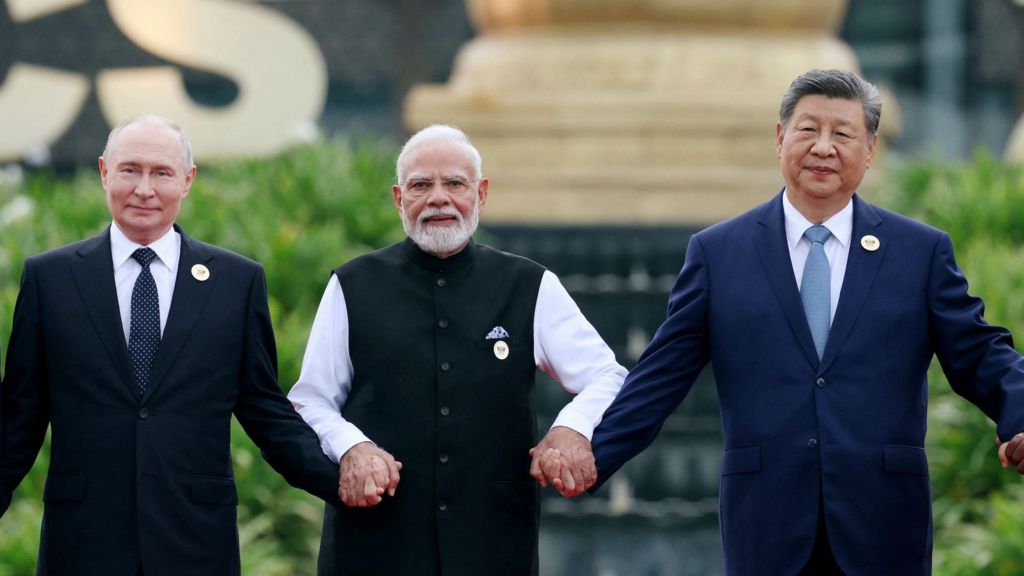
This past weekend, the Indian capital played host to a high-stakes gathering of global leaders at the 2026 Brics Summit, bringing together heads of state from a bloc that has increasingly positioned itself as a counterweight to Western-dominated global governance. Opening the summit, Indian Prime Minister Narendra Modi framed the group’s collective mission: to evolve from passive “rule-takers” in the existing global order to active “rule-shapers” that reflect the interests of the world’s emerging economies. Among the attendees were heavyweight leaders including Chinese President Xi Jinping, Russian President Vladimir Putin, newly inaugurated Iranian President Masoud Pezeshkian, Abu Dhabi Crown Prince Sheikh Khaled bin Mohamed bin Zayed Al Nahyan, and South African President Cyril Ramaphosa.
It is no understatement to call this assembly of leaders remarkable on its own. Brics’ current membership brings together nations with long-running disputes, competing geopolitical interests, and even recent military conflicts. The 2020 deadly border clash between India and China remains a source of underlying tension, while Iran and the United Arab Emirates have found themselves on opposite sides of the ongoing Middle East war that has roiled global energy markets and sent shockwaves through the global economy. That India managed to bring all these rival leaders together for in-person talks stands as a major demonstration of New Delhi’s growing diplomatic clout, and offered a rare space for powers to reassess their bilateral relationships in the wake of escalating regional conflict.
Despite this diplomatic win, the summit was defined by underlying tensions between members with competing visions for the bloc’s future. For core members including China, Russia, and Iran, Brics serves as a key tool to reduce the geopolitical and economic influence of the United States and Western Europe. But India has long rejected framing the bloc as an explicitly anti-Western alliance, a position driven by New Delhi’s goal of maintaining strategic ties with both Western and non-Western powers. “The group is not against anyone,” Modi emphasized in his opening remarks. Veteran Indian diplomat and former ambassador Anil Trigunayat explained that India’s core goal for the summit was to advance collective strategic autonomy for Global South nations amid a period of widespread geopolitical conflict, rather than positioning the bloc as a hostile counter to the West. “There are countries in the grouping which would like it to become anti-western, but it is not that,” Trigunayat noted.
Against a backdrop of stark divisions that had derailed two previous joint ministerial statements earlier this year, the summit did achieve a rare milestone: the adoption of the consensus-based New Delhi Declaration. What the declaration omits, however, is as notable as what it includes. To reach consensus, negotiators side-stepped the bloc’s most divisive issues, offering only vague language that avoided assigning blame for ongoing conflicts. On the escalating Middle East war, the text calls for “maximum restraint,” condemns attacks on civilian infrastructure and peaceful nuclear facilities, and reaffirms support for a two-state solution for Palestinians while opposing forced displacement and prolonged occupation – but names no responsible parties. In a sharp break from previous Brics declarations, the text makes no mention whatsoever of Russia’s full-scale invasion of Ukraine. On trade and economic policy, the declaration voices concern over “indiscriminate rising tariffs” and condemns unilateral punitive sanctions, but again avoids naming the United States, a choice widely seen as an effort to avoid triggering backlash from the Trump administration. Trump has previously labeled Brics’ collaborative initiatives, including plans for linked cross-border central bank digital currencies, as explicitly “anti-American,” leading many member states to avoid provoking his anger. Praveen Donthi, senior analyst at the International Crisis Group, noted that the vague, un-named framing of contentious issues bears the clear mark of India’s negotiating approach. “Not mentioning any country by name, even as they condemned the conflict in the Middle East, bears the hallmark of India,” Donthi said, adding that the inclusion of strong language on tariffs was a notable surprise, as it allowed India to quietly convey its economic displeasure without direct confrontation.
Beyond the formal declaration, the summit created space for diplomatic breakthroughs that seemed unthinkable just months earlier. Most notably, Iranian President Pezeshkian held face-to-face talks with Abu Dhabi’s Crown Prince – the highest-level in-person meeting between the two rival states since the outbreak of the latest Middle East war. For Iran, which is facing intense military pressure from the U.S. and Israel, sweeping American sanctions, a U.S.-led naval blockade of its ports, and Washington’s “Operation Economic Outcast” campaign to isolate Tehran globally, the summit offered a critical opportunity to demonstrate that it remains a respected global actor with regional and international partners. Pezeshkian used his time at the summit to push for deeper economic integration and expanded trade ties with other Brics members, including Malaysia, India, and Ethiopia.
The summit also marked a key milestone for India and China: it was President Xi’s first visit to New Delhi in seven years, a trip that came amid gradual de-escalation of border tensions that reached a crisis point with the 2020 Galwan Valley clash. While deep mistrust and a massive lopsided trade imbalance in Beijing’s favor remain unresolved, the two leaders held cordial talks, agreeing to expand bilateral business ties, improve cross-border transport links, and work to reduce remaining trade barriers. Though Xi stayed less than 24 hours and skipped the summit’s gala dinner, trading only a handshake rather than Modi’s signature welcoming hug, Trigunayat framed the meeting as part of a gradual warming of bilateral ties, driven by mutual interest in cooperation. “We have to trust, but verify first,” he noted, adding that whether the talks will produce tangible long-term progress remains to be seen.
Ultimately, the 2026 Brics Summit in New Delhi made clear that the bloc has carved out a unique role in global politics: it provides a space for rival powers to talk, advance their shared interests in reforming the global order, and operate outside the framework of Western-led international institutions. The core question that remains unanswered, however, is what comes next. While all members agree that a more inclusive, multipolar global order is needed now more than ever, reaching consensus on what that new order should look like, and how to achieve it, remains the bloc’s greatest unmet challenge.