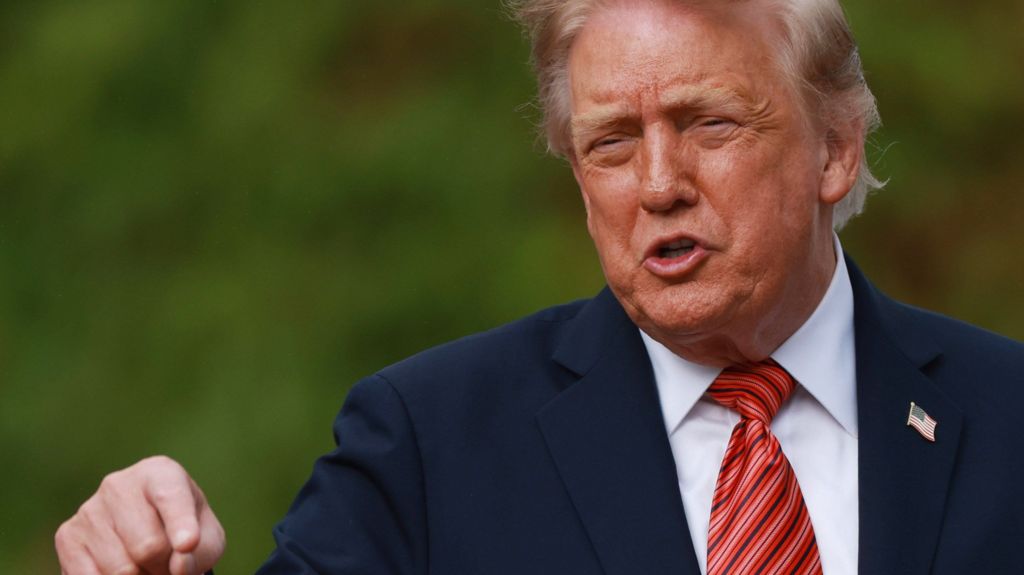
When former U.S. President Donald Trump arrived at his own Doonbeg Golf Resort in County Clare, Ireland, to attend the Irish Open alongside his family, few expected a casual golf trip would ignite a fierce cross-border political controversy.
For years, Trump had navigated around the sensitive, long-debated issue of Irish unity. While he once referenced the concept of a “merger” between Northern Ireland and the Republic of Ireland, he repeatedly avoided sharing explicit personal views, citing the deeply complex historical and political relationships at play. That all shifted on Saturday, when during a public appearance alongside Irish Taoiseach Micheál Martin, Trump broke his long-standing silence: he predicted that a united Ireland would ultimately come to pass, and said he would “love to see it” happen.
Contrary to assumptions that this was another impulsive, off-the-cuff remark from the famously unpredictable former president, sources indicate Trump had already discussed the topic of Irish unity in private meetings with Irish leaders ahead of the public comment. Political analysts have floated multiple theories for his sudden shift: some argue it was a calculated diplomatic tactic to put his Irish hosts at ease, diverting attention from more contentious global topics such as the Gaza conflict and escalating tensions with Iran. Others point to domestic political incentives, noting that a public show of support for Irish reunification could help Trump court critical Irish-American voters ahead of upcoming U.S. midterm elections.
In the 24 hours following his initial comment, Trump walked back slightly, acknowledging during a subsequent event that there was no “good” easy answer to the Irish unity question. Even so, he stopped short of retracting his original stance, adding that a united Ireland would be “cool” to see.
The comment has already sparked immediate backlash from unionist politicians and the UK government, who have labeled the intervention “unhelpful.” Critics have brushed off the remark as just another outlandish “Trumpism,” drawing comparisons to past provocative proposals like purchasing Greenland or annexing Canada as the 51st U.S. state. Unlike those tongue-in-cheek suggestions, however, the conversation around Irish reunification is already an active, ongoing political process, with a clear legal pathway outlined in the Good Friday Agreement to hold a border poll on unification.
While Trump’s endorsement is not a game-changer that will immediately accelerate the push for unification – a border poll remains no closer than it was before Trump’s visit to Ireland – it has already altered the momentum for pro-unification campaigners, who are expected to cite the backing of the former U.S. president in future advocacy. It is important to note that only the UK government holds the authority to trigger a border poll, and no clear threshold for holding such a vote has yet been established.
Among the spectators at the Doonbeg resort was prominent former Democratic Unionist Party (DUP) MP Ian Paisley, a long-time friend of the Trump family. Paisley attempted to downplay the comment Saturday, arguing that while everyone is entitled to a personal opinion, Trump’s stance was wrong. Many political observers expect Paisley will push for a more explicit retraction from Trump during Sunday’s closing round of the Irish Open, when the former president is set to be back in the media spotlight.
With Taoiseach Martin also expected to be in attendance near the 18th green on Sunday, political reporters are already preparing to press both leaders on the controversy. While both sides have signaled they intend to keep the focus on the golf tournament, the question of Irish unity is now firmly on the agenda, and unlikely to be avoided.