As leaders from 11 full BRICS member states and invited guest Saudi Arabia gather in New Delhi this weekend for the bloc’s annual summit, one notable non-member will cast an outsized shadow over every discussion: former U.S. President Donald Trump. Against a backdrop of ongoing conflict in Iran, sweeping tariff threats that have roiled global energy and financial markets, and rising tensions over de-dollarization efforts, the expanded bloc faces a defining test: can it bridge stark internal geopolitical divides to deliver a cohesive agenda, even as it avoids open confrontation with Washington?
BRICS, which has grown exponentially in global clout over the last decade, now counts 49% of the world’s population, 40% of global GDP, and 26% of total international trade within its ranks, per analysis from BBC Monitoring. Its most tangible institutional successes to date include the New Development Bank, which has approved billions in infrastructure and development financing across the Global South, and a $100 billion contingency reserve fund designed to buffer member states against financial crises—though the fund has yet to be put to a major test. This year’s summit comes on the heels of the bloc’s largest expansion, which brought major emerging economies including the UAE and Iran into the fold, expanding its geopolitical reach but also deepening internal disagreements.
The core tension shaping this year’s gathering stems from conflicting positions toward Trump’s policies. Trump has repeatedly singled out BRICS for criticism, particularly its ongoing efforts to reduce global trade reliance on the U.S. dollar. In a November 2024 threat, he pledged to impose 100% tariffs on all BRICS nations if the bloc moved forward with launching an alternative reserve currency to challenge the dollar’s global dominance. Today, the ripple effects of Trump’s policy agenda are already felt across the global economy: the ongoing conflict in Iran, amplified by U.S. foreign policy shifts, has destabilized global energy markets, while the constant threat of new tariffs on allies and adversaries alike has created widespread uncertainty for businesses and governments worldwide.
Yet despite calls from some members—most notably Russia and Iran—for a clear, public rebuke of Trump’s agenda, analysts agree the bloc is highly unlikely to produce a consensus statement that openly confronts Washington. Deep internal divisions have made a unified, hardline stance all but impossible. As Michael Kugelman, senior fellow at the Atlantic Council, explained to the BBC, New Delhi simply cannot afford to back a statement that openly attacks Washington, particularly as it enters the final stages of negotiating a bilateral trade deal with the U.S. China, too, has remained wary of being seen as using BRICS as a platform to target American interests. Even the UAE, which has suffered Iranian attacks amid Tehran’s retaliation against U.S. and Israeli strikes, is unlikely to back language that aligns with Iran’s position: the Gulf state hosts major U.S. military bases and has long prioritized stable diplomatic ties with Washington.
“BRICS has become more significant through its expansion, but that has also made consensus harder,” Kugelman noted. “You’ve added a number of members that don’t get along, which leaves host India with the enormous challenge of uniting countries that hold a wide array of views and positions on the global order.”
While open confrontation with the U.S. is off the table, the bloc is still expected to advance a substantive agenda focused on its core priorities as a leading voice for Global South nations. Leaders are set to explore reforms to streamline cross-border payments using local currencies—a measure of particular urgency for Russia and Iran, both of which face crippling U.S. sanctions that limit their access to dollar-denominated financial systems. BRICS leaders are also expected to reiterate their collective call for reforms to multilateral institutions including the United Nations, International Monetary Fund, and World Bank, arguing that these bodies fail to reflect the shifting balance of power in the modern global economy.
For host India, the summit carries uniquely high stakes. Prime Minister Narendra Modi’s government has made leading the Global South a central pillar of its foreign policy, and the gathering offers a critical opportunity to cement that claim, even as it navigates China’s longstanding influence across developing economies. “India’s efforts to gain deeper inroads in Africa and Latin America have had limited success, where China has been more successful,” Kugelman noted, adding that the expanded BRICS bloc gives New Delhi a chance to deepen ties with emerging economies across both regions and build a stronger global profile. Recent months have also seen New Delhi’s global profile overshadowed by Pakistan’s high-profile mediation efforts in the Middle East around the Iran war, making this summit a key moment to reassert India’s diplomatic relevance.
The challenge of forging consensus was already previewed in May, when BRICS foreign ministers failed to agree on a joint statement after their meeting due to intractable differences over the Iran war, forcing New Delhi to release a chair’s summary instead. India is drawing on its 2023 experience hosting the G20, where it managed to broker a joint declaration despite deep divisions over the war in Ukraine, but analysts caution the gaps are wider this time around. New Delhi is keen to avoid having BRICS dismissed as a mere “talk shop,” and is pushing for substantive announcements on financial cooperation that can showcase the bloc’s progress.
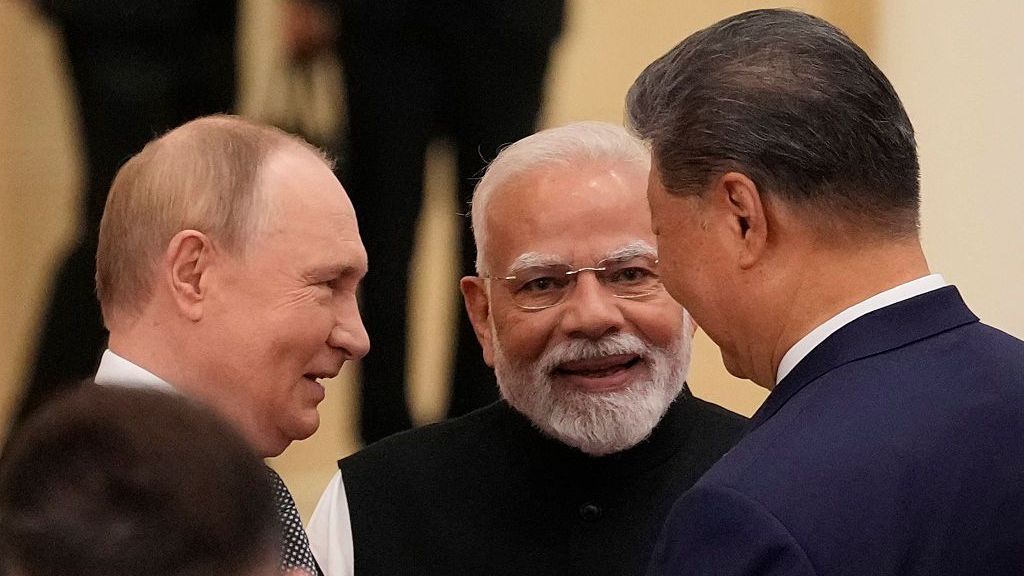
Beyond plenary discussions, the summit will host a series of high-stakes bilateral meetings that are drawing global attention. A Saturday meeting between Chinese President Xi Jinping and Narendra Modi is widely watched, as the two neighboring powers continue gradual, cautious efforts to repair and rebuild bilateral ties that have been strained for years. Modi is also set to hold talks with Russian President Vladimir Putin, where the war in Ukraine and India’s growing trade deficit with Russia will top the agenda. When the two leaders met last month on the sidelines of the Shanghai Cooperation Organisation summit in Bishkek, Modi issued a highly public appeal for peace in Ukraine—a move some outside observers framed as a rebuke of Moscow, though Russian officials publicly welcomed the outreach and did not interpret it as criticism. Trade imbalances with both China and Russia are also expected to feature prominently in Modi’s bilateral discussions.
In the end, all sides agree that any language addressing U.S. policy will be carefully crafted to avoid unnecessary confrontation, even as the bloc advances its own priorities of deeper financial integration and greater representation for Global South nations. For India, a successful summit that delivers a unified, if muted, outcome would mark a major diplomatic win that reinforces New Delhi’s rising influence on the global stage. And for BRICS as a whole, the gathering will test whether the expanded bloc can turn its growing economic heft into cohesive, impactful global action—all while navigating the unpredictable landscape shaped by U.S. policy.