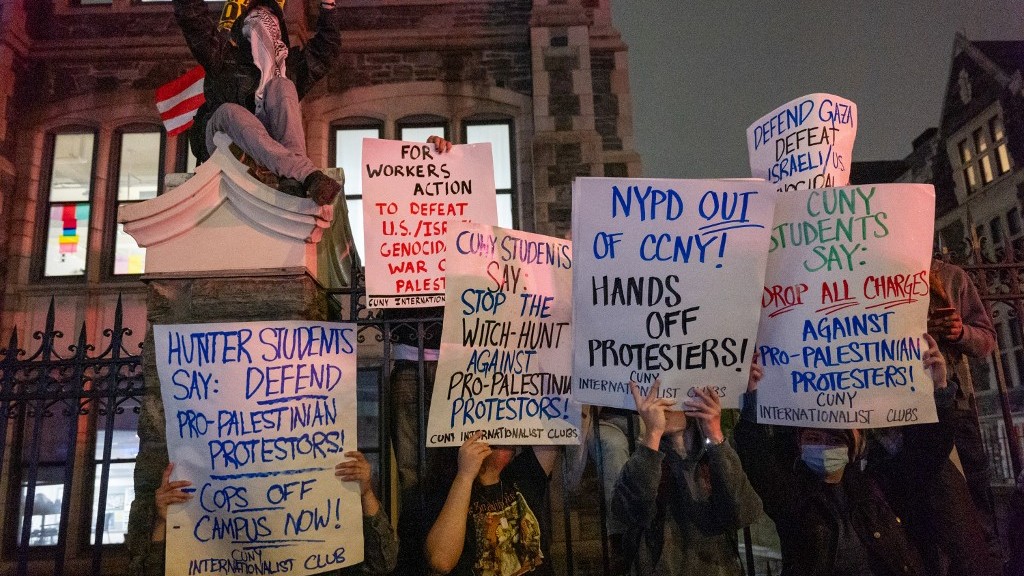
After a years-long campaign by pro-Palestinian student and faculty organizers, newly released financial records from the City University of New York (CUNY) have confirmed the public university system holds more than $715,000 in investments in major weapons manufacturers that supply military equipment and technology to the Israeli military. The disclosures, which came via a court-ordered settlement following a freedom of information lawsuit, mark a rare instance of a U.S. university publicly confirming such holdings, a detail most higher education institutions have long kept hidden from public view.
The records, obtained by two campus advocacy groups — CUNY4Palestine and CUNY Law Students for Justice in Palestine (CUNY Law SJP) — reveal CUNY’s investment portfolio includes stakes in six major defense and military technology firms: Boeing, Lockheed Martin, Raytheon, Palantir, Elbit Systems, and General Dynamics. All six firms openly maintain active supply contracts with the Israeli army. A breakdown of 2025 holdings shows CUNY holds more than $319,000 in Boeing stock, roughly $65,300 in Lockheed Martin stock, $141,200 in Raytheon stock, and nearly $189,350 in Palantir stock — figures that activists say exceeded their initial expectations.
Pro-Palestinian organizers have long flagged the specific role each firm plays in Israel’s military campaign in Gaza, which launched after the October 7, 2023 Hamas attacks on southern Israel. To date, the conflict has left more than 250,000 Palestinians in Gaza killed or injured and reduced much of the enclave to rubble. Activists note Boeing produces F-15 fighter jets, AH-64 Apache attack helicopters, and bunker-buster bombs that have been used in strikes across Gaza, Lebanon, and other regional conflict zones; Lockheed Martin and Raytheon manufacture the missiles and munitions deployed by Israeli ground and air forces; and Palantir provides surveillance and data management technology that the Israeli military relies on for targeting operations.
In a joint statement released this week, the two advocacy groups argued CUNY’s financial ties to these firms make the university directly complicit in what they call the ongoing genocide of Palestinian people in Gaza. A CUNY faculty organizer, speaking through the groups, extended that criticism further, saying the investments also make CUNY complicit in broader imperialist violence across West Asia and the Global South, as well as in what they describe as fascist border enforcement carried out by U.S. Immigration and Customs Enforcement and U.S. Customs and Border Protection.
The release of the records follows years of organizing and transparency demands from pro-Palestinian groups on CUNY’s campuses. CUNY was one of the first U.S. universities to join the wave of Gaza solidarity encampments that spread across higher education institutions in April 2024, starting at Columbia University, where protesters demanded administrations disclose and divest from companies supplying Israel. Though ties between U.S. academia and the defense sector have long been an open secret, most universities have refused to release detailed breakdowns of their investment holdings to the public.
In 2024, after the escalation of conflict in Gaza, CUNY4Palestine and CUNY Law SJP filed a Freedom of Information Law (FOIL) request to force CUNY leadership to release full details of its defense industry investments. When university administrators refused to turn over the records, activists and a student plaintiff filed a lawsuit — Sarah Southey v. City University of New York — to compel disclosure. The case reached a settlement in mid-August that required CUNY to release all investment records dating back to July 2023.
Veronica Salama, senior staff attorney at the New York Civil Liberties Union, which supported the lawsuit, noted that while the disclosure marks a win for transparency, it is unacceptable that legal action was required to get public information from a taxpayer-funded institution. “While we’re grateful that the largest, urban public university in the country will finally disclose its investment records, it is outrageous that our client had to file this lawsuit in the first place,” Salama said in a statement.
On Wednesday afternoon, campaigners planned a press conference outside New York City Hall to lay out the full details of the disclosures to the public. Activists say the released records are only the first part of a larger body of investment data, framing the $715,000 figure as “just the tip of the iceberg.” They have vowed to continue their campaign until CUNY divests all holdings from arms firms and redirects that funding toward institutional and community programs that serve public good. “As we declared during CUNY’s Gaza Solidarity Encampment: we will not stop, we will not rest until our tax and tuition dollars are divested from death and destruction and reinvested in life-sustaining institutions and practices! We demand CUNY live up to its name as a ‘People’s University!’” the groups’ statement read.
The disclosures are also drawing new scrutiny to CUNY leadership and the crackdown on pro-Palestinian protests on its campuses. While high-profile encampments at Ivy League institutions like Harvard and Princeton drew widespread national and international media attention, CUNY’s protest movement has received far less coverage. Organizers and analysts argue that makes the new revelations even more significant: as the nation’s largest urban public university serving a working-class, majority minority student body across New York City, CUNY’s investment decisions carry unique public weight.
Critics are also pointing to the political ties of CUNY’s top investment leadership. William C. Thompson, who currently chairs CUNY’s board executive committee and investment subcommittee — a post he has held since 2016 — was reappointed to a six-year term in June 2023 by New York Governor Kathy Hochul, a well-known staunch supporter of Israel. CUNY has not yet responded to requests for comment from media outlets including Middle East Eye, which first reported on the disclosures.