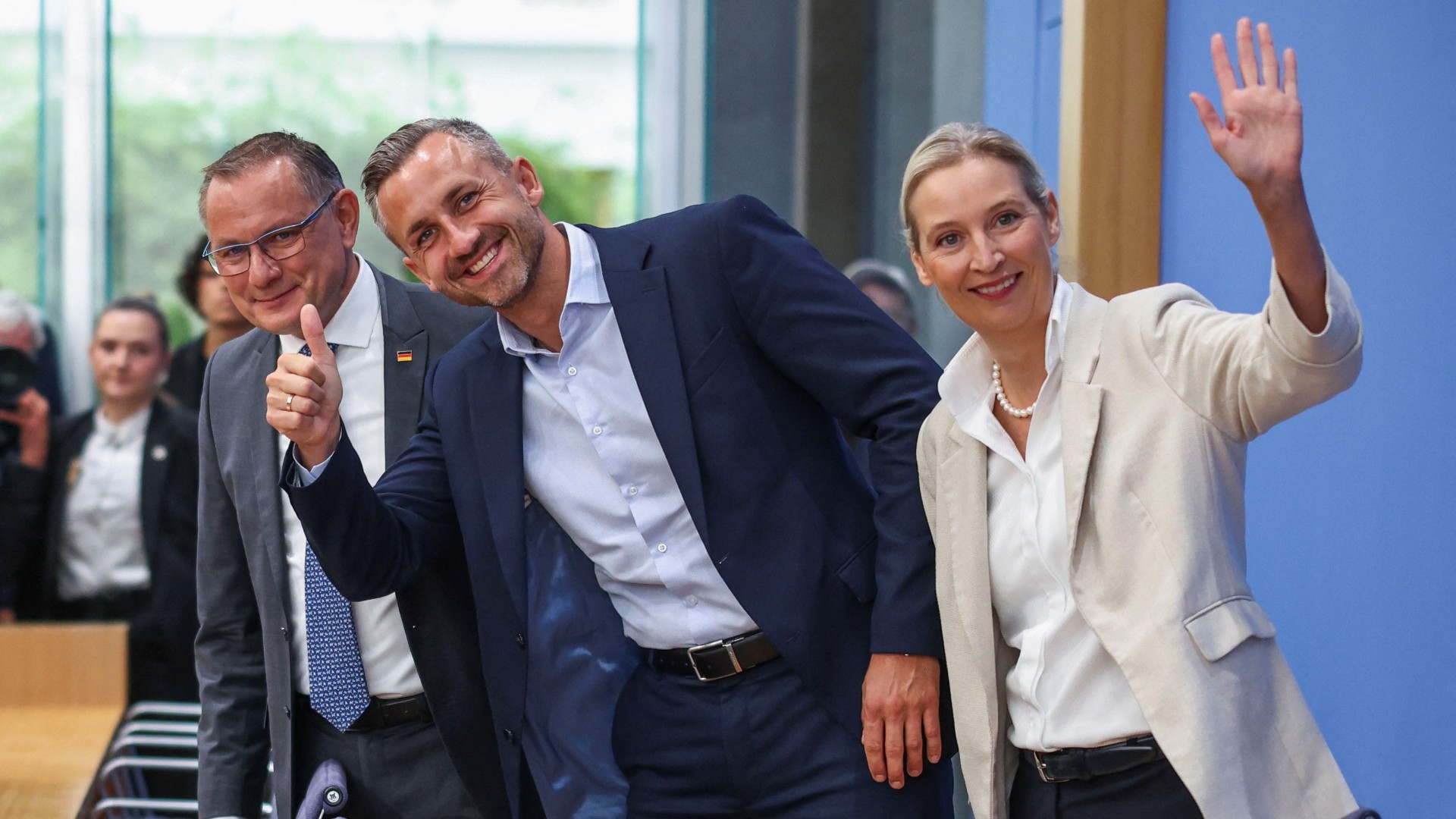
In a historic upset that has sent tremors through German national politics, the far-right Alternative for Germany (AfD) has secured a record-breaking share of the vote in regional elections for the eastern German state of Saxony-Anhalt, marking the strongest electoral performance by the party in any state contest to date.
Sunday’s election results, released after polls closed, put the AfD at 43.8% of the popular vote — a staggering 23-point surge from its performance in the state’s 2021 election. The party will take 39 of the 83 total seats in the Saxony-Anhalt state legislature, falling just short of the absolute majority it would have needed to form a government on its own. Had the party crossed the 45% threshold for a single-party majority, it would have marked the first time a far-right party held full unilateral legislative and executive control of a German state since the end of World War II, a outcome that had been widely feared across mainstream German political circles for weeks.
The historic result is a catastrophic defeat for Germany’s long-ruling Christian Democratic Union (CDU), which had held the position of Saxony-Anhalt’s largest party for four consecutive election cycles stretching back to 2002. This year, the CDU crashed to an all-time low of just 17.4% of the vote — less than half its 2021 vote share. German Chancellor Friedrich Merz, leader of the CDU, acknowledged the depth of the party’s losses in a public statement Monday afternoon, ending hours of post-election silence from the party leadership.
“We are all in deep shock,” Merz stated, admitting that he never anticipated the final result would be so lopsided against his party. “This shakes our party to its very foundations. We cannot simply carry on as before, nor can I, nor can the federal government.” Merz added that the devastating defeat would have concrete political consequences, and reaffirmed his commitment to pushing through fundamental systemic reforms across the country. The shockwaves have already spread to the state-level CDU: the party’s Saxony-Anhalt youth wing, Junge Union, has publicly called for the resignation of the entire state party executive committee, from the state chairman down to all regional leadership posts. “After a defeat on this scale, we cannot simply carry on as before,” explained Junge Union chair Nico Elsner.
AfD’s lead candidate in the election, Ulrich Siegmund — labeled “Germany’s most dangerous man” by leading German news outlet Der Spiegel — is now on track to become Saxony-Anhalt’s next chief minister. Siegmund framed the landslide result as an unambiguous mandate from voters, saying “this is a sign that could hardly be any clearer.” His core policy priorities include abolishing Germany’s compulsory schooling framework, cutting public broadcasting to only two “opinion-free” channels, and enacting sweeping new restrictions on asylum and immigration. The AfD’s election platform also outlines radical overhauls to the state’s education system: the party frames inclusive education, which integrates children with disabilities and migrant backgrounds into mainstream classrooms, as a “failed experiment that must be brought to an end,” and calls for segregating children with refugee status and disabilities into separate special schools. It also proposes rewriting school curricula to refocus history education on building national identity, with an outsized focus on 19th-century German unification under Otto von Bismarck and the founding of the 1871 German Empire, while making the display of the national flag and daily singing of the national anthem mandatory in all schools.
With just under 44% of the vote, the AfD is required to form a coalition government with at least one other party to take power — a scenario that has sparked uncertainty across the state, as the party has so far rejected any compromise coalitions. Nearly all mainstream German parties maintain a longstanding “firewall” policy, which bans any formal cooperation with the AfD at the state or federal level. The only exception is the left-conservative populist party Bundnis Sahra Wagenknecht (BSW), which cleared the 5% vote threshold needed to enter the state legislature and has already publicly expressed interest in joining an AfD-led coalition. Other potential governing paths remain on the table, including the defection of sitting CDU lawmakers to support an AfD minority government, while Siegmund has openly raised the possibility of triggering new state elections if a governing coalition cannot be formed.
International reaction also followed the announcement of the results, with U.S. tech billionaire Elon Musk — who has previously publicly backed the AfD during the 2025 federal Bundestag election campaign — congratulating AfD co-chairwoman Alice Weidel on the social platform X with a brief “Well done!” and the German phrase “Gut gemacht!”.
Domestically, the result has sparked immediate concern from civil society groups. In a joint statement, the heads of the German Rectors’ Conference and the Saxony-Anhalt State Rectors’ Conference called for urgent safeguards to protect academic independence from political interference. “Academic freedom, artistic freedom and university autonomy must be removed from the realm of day-to-day political disputes,” the statement read. For migrant and refugee communities already in the state, the result has sparked widespread anxiety: Saaeid Saaeid, spokesperson for the Saxony-Anhalt Refugee Council, described the election outcome as “a black day for Saxony-Anhalt” on social media, noting that many migrants are already questioning whether they will be allowed to remain in the country. “We do not yet know what sort of government will be formed, but we do know the fear these results are already causing,” he said. “Our demand of any democratic government formation is therefore clear: protect refugees, create prospects for residency and facilitate access rather than imposing bans.”
Founded in 2013, the AfD began as a free-market, Euroskeptic party critical of the eurozone. Following the 2015 European refugee crisis, which saw millions of people fleeing conflict in Syria, Afghanistan, and Iraq arrive in Europe, the party shifted its agenda sharply to center on hardline anti-immigration policies and anti-Islam rhetoric, embedding anti-Muslim sentiment into mainstream German party politics. Today, the party’s core policy platform centers on the controversial concept of “remigration,” a policy widely interpreted as a proposal for mass deportation of migrant communities living in Germany. Since the 2025 federal election, the AfD has held the position of the second-largest party in the 630-seat Bundestag, Germany’s national parliament, with 150 seats. Since May 2025, Germany’s domestic intelligence agency, the Federal Office for the Protection of the Constitution, has formally classified the AfD as a “confirmed right-wing extremist endeavour.”
Under Germany’s federal system, state-level governments hold significant authority over key policy areas including education, policing, and cultural policy, giving an AfD-led government in Saxony-Anhalt substantial power to implement the party’s radical policy agenda regardless of federal government composition.