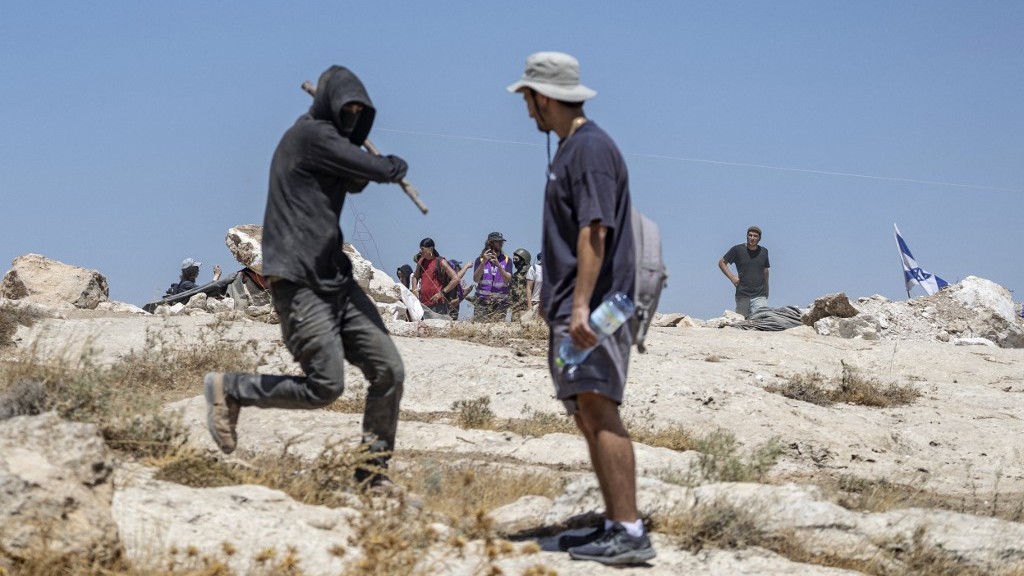
On a Wednesday evening in the Palestinian village of Al-Mughayyir, located east of Ramallah in the Israeli-occupied West Bank, a violent settler incursion targeting sheep theft ended with two Palestinian civilians dead at the hands of Israeli soldiers, deepening longstanding concerns over systemic, state-backed settler violence in the region.
According to official records from the Palestinian Ministry of Health, the two victims have been identified as 19-year-old Omar Muhammad Na’san and 16-year-old Khalil Rasem Shahada, both fatally shot by Israeli military personnel during the incident. Marzouq Abu Na’im, a village council member and local activist who has spent years documenting settler attacks in the area, detailed the sequence of events to Middle East Eye, confirming that armed settlers first launched an assault on a local residential property with the explicit goal of stealing the family’s livestock.
Shortly after the incursion began, Israeli forces stormed the village to provide armed protection for the settlers, positioning troops and snipers on the roof of the targeted home. “The settlers stole the sheep and attacked the homeowners, who were unable to resist or object due to the heavy presence of soldiers and snipers on the roof,” Abu Na’im explained.
Na’an, whose own home sits adjacent to the targeted property, stepped outside to investigate the commotion when an Israeli sniper positioned on the rooftop opened fire, killing him instantly. Minutes later, 16-year-old Shahada emerged from his home on the opposite side of the village after hearing residents screaming in alarm from their windows. Abu Na’im confirmed that the teenager had moved barely a few meters from his front door when Israeli soldiers also shot him.
Tragically, both victims were left bleeding heavily for an extended period after the shooting, as Israeli forces blocked ambulances from reaching the scene. Though coordination was eventually secured through the military liaison office to allow medical transport, both civilians had already succumbed to their injuries by the time paramedics arrived. “Their blood filled the ambulance because of the severity of the bleeding. The paramedics tried to resuscitate them, but they had already passed away. Meanwhile, the settlers managed to steal the sheep and left under the protection of the army,” Abu Na’im added.
This deadly incident is far from an isolated event: Al-Mughayyir has already seen five Palestinian residents killed since the start of 2026, three of those deaths at the hands of settlers. Human rights organizations have repeatedly warned that settler attacks across the occupied West Bank are escalating rapidly, and the violence has grown increasingly deadly with the explicit backing and protection of the Israeli military.
New data from the Wall and Settlement Resistance Commission underscores the scale of the crisis: in August 2026 alone, the group recorded 2,030 total attacks across the West Bank, 1,402 carried out by Israeli soldiers and 628 by extremist settlers. Attacks were concentrated in the flashpoint regions of Ramallah and al-Bireh, which saw 157 incidents, followed by Nablus with 137 and Hebron with 120. The report also documented that settlers attempted to establish 32 new unauthorized settlement outposts in August, part of a broader pattern of land seizure. Joint soldier-settler raids on agricultural land damaged more than 21,500 trees, 19,375 of which were productive olive trees that form a critical livelihood for thousands of Palestinian families. Overall, 164 Palestinians suffered direct harm from settler violence in August, including 20 children and 17 women.
A major August 20 report from Human Rights Watch, titled *West Bank: Israel-Backed Settler Violence Drives Displacement*, outlines the broader humanitarian impact of the ongoing escalation. The organization confirmed that rising settler attacks have forced complete or partial displacement of residents from 107 Palestinian towns and villages since January 2023. Data indicates 2026 is on track to become the deadliest year on record for settler violence, with attacks driving widespread displacement of Palestinian rural communities.
Citing statistics from the United Nations Office for the Coordination of Humanitarian Affairs (OCHA), the report notes that the average number of daily settler attacks resulting in injury or property damage now stands at 6.6, the highest rate recorded in the agency’s history. As of July 24, OCHA had documented 15 Palestinians killed by settlers in 2026, including two children, putting the year on track to surpass the previous record of 16 settler killings set in 2023.
Human Rights Watch has explicitly accused Israeli authorities of not only failing to uphold their obligation to protect Palestinian civilians from settler violence, but also actively providing financial, material, and legal support to the extremist settlers responsible for these attacks.
International officials have echoed these warnings. The UN deputy special coordinator for the Middle East peace process warned in August that settler violence in the West Bank has reached unprecedented levels, stating that the occupied territory has “reached a breaking point.” He confirmed that the UN had recorded more than 1,430 separate incidents of settler violence since the start of 2026, impacting roughly 260 Palestinian communities. As of August 10, 76 Palestinians had been killed in the West Bank by either Israeli forces or settlers in 2026, and more than 3,800 Palestinians have been displaced since January as a result of settler violence, home demolitions, and forced evictions.
Late last month, the European Union issued a formal statement condemning the ongoing violence, specifically highlighting the crisis in the village of Qusra, where Palestinian families were trapped in their homes for more than a week by a sustained settler siege. Even U.S. Ambassador to Israel Mike Huckabee labeled the settlers besieging Qusra as terrorists. The EU demanded an immediate end to intimidation, harassment, property destruction, and physical assaults against Palestinian civilians, calling on Israeli authorities to take decisive action and hold all perpetrators of violence accountable.
Despite this international outcry, Palestinian leaders and activists argue that statements of condemnation are no longer sufficient to end the crisis or hold perpetrators accountable. Palestinian officials are now calling on the international community to move beyond rhetoric and take concrete legal action against the Israeli government and extremist settler groups.
Salah Khawaja, director of the Wall and Settlement Resistance Commission’s central West Bank office, noted that all international statements and institutional responses have so far been limited to condemnation, which he says has effectively provided political cover for Israel to continue its expansion and aggression. “The fundamental problem is the absence of any effective international steps to hold Israel, as a government, and the settler groups accountable for their practices and support of terrorism and attacks in various areas of the West Bank,” Khawaja told Middle East Eye.
Khawaja explained that while successive Israeli governments have prioritized settlement construction, expansion, and land seizure, the current Israeli administration has advanced these policies further than any preceding government. He added that Israel openly defies international norms and institutions, while the global community’s response remains limited to empty statements of condemnation.
Data confirms 2026 is already the most violent year on record for settler violence: for comparison, only one Palestinian was killed by settler gunfire in 2019, two in 2020, and five in 2021. In the first half of 2026 alone, 20 Palestinians were killed by settler gunfire. “This escalation represents one aspect of a systematic approach…which enjoys the full support of the Israeli government and security apparatus,” Khawaja concluded.