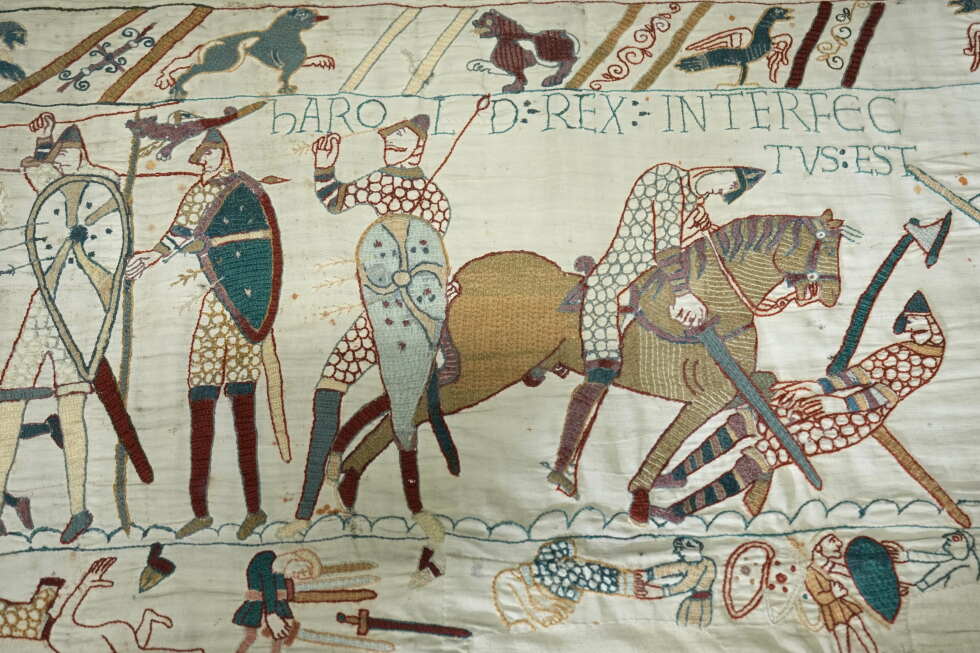
Nearly a millennium after it was last on British territory, one of the world’s most iconic medieval artifacts has made its historic debut to the British public this week at the British Museum. The 70-meter embroidered Bayeux Tapestry, which chronicles the 1066 Norman Conquest of England — the last successful invasion of the British Isles — has drawn extraordinary public excitement months ahead of its opening, with all advance tickets sold out and organizers projecting up to 1 million visitors before the exhibition closes in July 2027. Special educational programs will also bring the tapestry’s history to life for school groups across the United Kingdom, ahead of a private pre-opening preview attended by Britain’s King Charles III and French President Emmanuel Macron. As British Prime Minister Keir Starmer’s government has joked, the legendary work is ultimately a 230-foot reminder of one of the most consequential defeats in British history.
More than a simple medieval artwork, the tapestry unfolds as a narrative panorama of betrayal, conflict and regime change that shaped the course of European history. Structured in 58 sequential scenes, it opens with English nobleman Harold Godwinson’s journey to Normandy, where he swears an oath to support William, Duke of Normandy’s claim to the English throne. When Edward the Confessor, the ruling English king, dies months later, Harold claims the crown for himself, prompting William to assemble an invasion fleet and sail across the Channel. The tapestry builds to the climactic Battle of Hastings, where William’s forces defeated Harold’s Anglo-Saxon army, a victory that installed William as England’s first Norman king, tied the fates of Britain and France irrevocably, and introduced French linguistic and cultural influences that endure in English society to this day.
Exhibition curator Michael Lewis explained at a press preview on Monday that the work carries an intentional early political messaging core. “1066 is the most important event in English history,” Lewis noted, adding that the tapestry was stitched with a clear propaganda function: it was designed to convince the conquered English population that while loyalty to Harold was understandable, the old order had fallen, and the new Norman rule under William had to be accepted.
Beyond its political purpose, the tapestry offers an unparalleled, granular window into daily life in 11th-century Europe, blending depictions of brutal battlefield violence with intimate, mundane domestic details. It shows soldiers stealing livestock, cooking meals over open fires, eating from their own shields, and sacking English settlements as women and children flee the violence. Lively marginal illustrations fill the top and bottom edges of the fabric, populated by fish, hunting dogs, mythical winged beasts and ordinary commoners that often offer subtle ironic commentary on the main narrative. For 11th-century audiences, Lewis argued, the work would have felt deeply immersive: “Maybe they would even have tried to pick out themselves in the story of these events,” he said.
For modern historians, the tapestry remains an invaluable primary source, revealing insights into medieval shipbuilding, fashion, cuisine, military armor, architecture and even astronomy. One panel clearly depicts Halley’s Comet streaking across the sky, matching the comet’s actual appearance in 1066, the year of the invasion. Many mysteries still surround the centuries-old work, however: scholars continue to debate whether the famous arrow that strikes Harold’s eye, killing the Anglo-Saxon king, was added centuries after the original stitching; a final planned panel, likely showing William’s coronation as king, has been lost to time; even the exact count of human and equine genitalia depicted in the marginalia remains a point of contention, with counts ranging from 93 to 94.
In the modern era, the tapestry’s enduring cultural popularity stems in part from its accessible, comic-strip style that makes it adaptable to contemporary commentary, explained Leonie Hicks, a professor of medieval studies at Canterbury Christ Church University. Hicks noted that its simple, vivid illustrations are “very meme-able,” often repurposed to mock modern political events. She pointed to a recent magazine cover that reimagined a 2020s UK leadership contest, depicting current Prime Minister Keir Starmer as Harold falling with an arrow in his eye, and former opposition leader Andy Burnham as William advancing on horseback, with modern touches like Big Ben and Downing Street’s resident Larry the Cat added to the tapestry-style margins.
Historians broadly agree that while the tapestry has been housed in the French town of Bayeux for nearly 1,000 years, where it was likely commissioned by Bishop Odo of Bayeux, William the Conqueror’s half-brother, it was almost certainly stitched by female artisans in southeast England, just miles from the Battle of Hastings battlefield. King Charles III even noted at a joint reception with Macron last week that the work could just as accurately be called the Canterbury Embroidery.
The landmark loan has been framed by both the British and French governments as a powerful symbol of enduring Franco-British friendship, but securing the artifact’s journey to London required nearly a decade of delicate diplomacy. Decades of repeated British requests to borrow the tapestry were unsuccessful, before an initial agreement was reached in 2018. The opening was then delayed repeatedly by COVID-19 pandemic disruptions and post-Brexit diplomatic tensions, before the arrangement was finally confirmed during Macron’s state visit to the UK in 2024.
The move has not been without controversy: some French cultural heritage advocates and the late legendary British artist David Hockney opposed the loan, citing major risks of irreversible damage to the fragile, nearly 1,000-year-old textile. To mitigate risk, the tapestry was insured for 960 million euros ($1.1 billion), packed in custom climate-controlled, shock-proof packaging, and transported to London under heavy police escort via road and rail, arriving at the museum under cover of darkness. Unlike its traditional hanging display in Bayeux, the tapestry will be exhibited flat in a purpose-built, state-of-the-art protective case that curators say eliminates strain on the fabric. Lewis confirmed that the collaborative work of conservation teams from both France and Britain allowed the artifact to arrive in London completely undamaged, noting that the planning process for the trip has generated new conservation knowledge that will ensure the tapestry’s safe return to France when the exhibition concludes. “It has to make that trip back as well,” Lewis said. “But we’ve learnt so much in that process. I’m confident that we’ve learned a lot that helps us be sure that going back is going to be as good.”