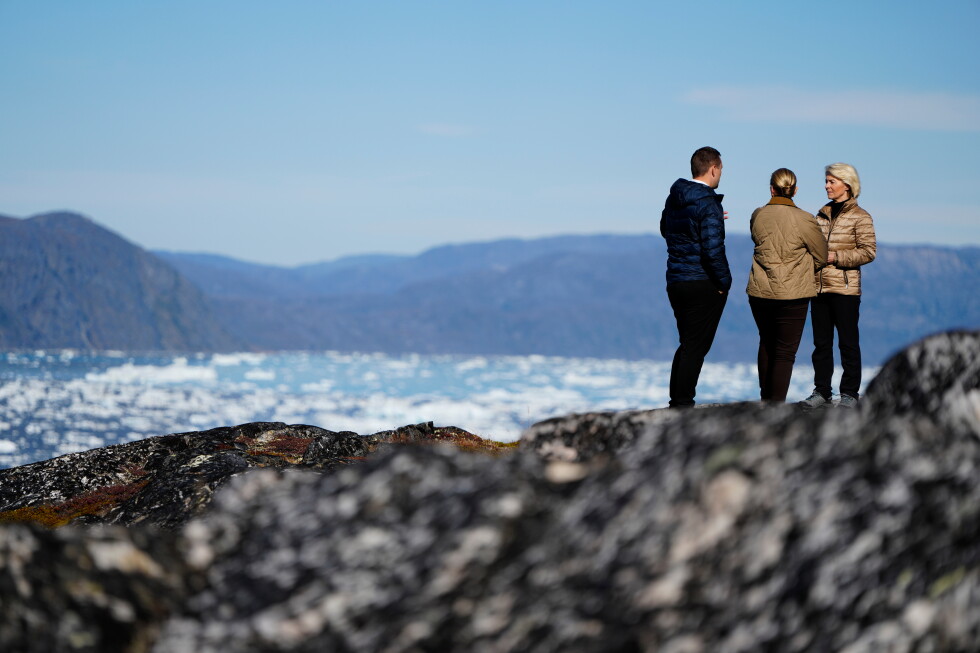
BRUSSELS – On a landmark visit that underscores growing European interest in the Arctic region, European Commission President Ursula von der Leyen announced a €200 million ($232 million) strategic investment package for Greenland on Monday, as the bloc moves to deepen diplomatic and economic ties with the semi-autonomous Danish territory.
Following a trio of high-level meetings that brought together von der Leyen, Greenlandic Prime Minister Jens-Frederik Nielsen and Danish Prime Minister Mette Frederiksen, the two sides signed a joint EU-Greenland declaration cementing their new partnership. “Greenland can count on the EU,” von der Leyen affirmed during the ceremony, framing the investment as a long-term commitment to the island’s development and regional stability.
As a semi-autonomous territory of Denmark, a core NATO member, Greenland has risen sharply in global geopolitical prominence since former U.S. President Donald Trump first publicly pushed claims that the United States should acquire the island for national security purposes. Trump’s repeated assertions sparked immediate sovereignty fears among both Greenlandic and Danish leadership, triggered widespread pushback, and stoked unprecedented tensions within the NATO alliance.
In a show of collective support for Greenland’s sovereignty earlier this year, Denmark and seven other European allies deployed a small contingent of military personnel to the island for publicly announced military exercises focused on bolstering Arctic security, a move widely interpreted as a unified response to Trump’s territorial claims. In retaliation, Trump threatened to impose sweeping new tariffs on Denmark, Finland, France, Germany, the Netherlands, Norway, Sweden and the United Kingdom. European leaders pushed back firmly against the pressure, issuing a joint statement warning that “tariff threats undermine trans-Atlantic relations and risk a dangerous downward spiral” while reaffirming their unwavering commitment to upholding Greenlandic sovereignty. The standoff ultimately de-escalated after NATO reached a new regional security agreement, and Trump backed down from his territorial demands.
The multi-sector investment package announced Monday targets key areas of Greenlandic development: it will fund upgrades to education programs and fisheries management, expand broadband internet connectivity across the sparsely populated island, modernize existing hydropower infrastructure, and support sustainable development of Greenland’s abundant reserves of critical raw minerals. Additional funding is allocated to expanding affordable housing, providing targeted support for local small and medium enterprises, and building out a sustainable tourism sector that aligns with the island’s environmental protection goals.
Von der Leyen emphasized the strategic logic of the EU’s growing engagement, noting that the investment partnership “will create new opportunities and establish a strong and engaged EU in both Greenland and the Arctic, because Greenland is a strategic ally and a trusted friend.”
Coinciding with von der Leyen’s visit, 11 NATO countries launched the 12-day Arctic Shield military exercises in Greenland on Monday, bringing together roughly 400 military personnel, including elite special forces trained for Arctic operations from Canada, Denmark and Finland. Notably, no U.S. troops are participating in the drills, which are scheduled to run through September 18.