Tucked along the northern coast of Africa, Spain’s tiny autonomous exclave of Ceuta has long marked its annual official holiday on September 2 as a quiet, local affair, largely overlooked by the Spanish mainland hundreds of kilometers away. But 2026 is different. Just over a month after the territory became the flashpoint of the most severe border crisis Spain has faced in modern history, what would typically be a day of celebration has been replaced by anger, political tension, and a nationwide wave of protest, as a lingering humanitarian crisis continues to strain the small territory and divide Spanish politics.
The crisis unfolded in late July, when an unprecedented 72,000 people crossed the border from neighboring Morocco into Ceuta, a territory that is home to just 84,000 permanent residents. At least 90 people died during the dangerous crossing attempt, according to official estimates. While the vast majority of migrants either returned voluntarily or were escorted back to Moroccan territory within days, the Spanish national government confirms that roughly 5,000 people — including 1,200 unaccompanied minors — remain stranded in Ceuta weeks later. The mass arrival overwhelmed the exclave’s limited housing, medical, and social services, sparking widespread frustration among local residents, who have criticized the central government in Madrid for ignoring repeated advance warnings that a large-scale crossing was being organized.
For Ceuta’s regional leader Juan Jesús Vivas, a member of Spain’s main conservative opposition Popular Party (PP), the event was far more than a migration crisis. “What happened to us was not a migratory crisis,” Vivas stated during an institutional commemoration for the holiday on Wednesday. “What happened was the violation of Spain’s territorial integrity.”
The crisis has quickly become a central political battleground ahead of Spain’s national election scheduled for next year. The PP and far-right opposition party Vox have seized on the incident to ramp up pressure on the left-wing government of Prime Minister Pedro Sánchez, aiming to turn public anger over the crisis into support to oust the current administration.
The main event marking this year’s holiday is a protest scheduled for Wednesday evening in Ceuta, with coordinated demonstrations planned in more than 200 cities and towns across the country. The officially nonpartisan Spanish Federation of Municipalities and Provinces is listed as the organizer, but the events have been heavily promoted by the PP and Vox, which has taken a hardline stance against irregular migration. Spain’s Territorial Policy Minister Ángel Víctor Torres dismissed the protests as a transparent political power play, telling national radio: “This is not to show support for the city of Ceuta or its residents; it is to attack the government of Spain.”
In a bid to counter criticism that it has abandoned the exclave, the Sánchez administration this week announced a 309 million euro ($357 million) aid package to boost Ceuta’s social services, fund migrant housing support, shore up local security, and revitalize the territory’s economy damaged by the crisis. In a pre-recorded video address released Wednesday, Sánchez reiterated that his administration is deploying every available resource to help Ceuta return to normalcy and restore peace of mind for local residents.
One of the most divisive points of the crisis is the question of what triggered the unprecedented mass crossing. Many Spanish political observers and opposition figures have questioned whether the Moroccan government could have done more to prevent the border breach, but Sánchez has repeatedly defended Moroccan authorities, noting they acted quickly to assist with the repatriation of most migrants. “There is no information from any of our intelligence services that points to the participation of Moroccan authorities,” Sánchez told Cadena Ser radio earlier this week.
The prime Minister has instead blamed a misinterpretation of a recent Spanish Supreme Court ruling and coordinated disinformation campaigns on social media for encouraging the border rush. He went further to accuse social media accounts linked to Russia, Israel, and domestic right-wing groups of amplifying disinformation to exacerbate the crisis for political gain. The Sánchez administration has not released any public evidence to back up these claims, citing internal classified reports from the Spanish Foreign Ministry and the European Union’s diplomatic service. Both the Russian and Israeli governments have strongly rejected the accusations. Russian Foreign Ministry spokesperson Maria Zakharova told reporters: “Without facts, without materials backed up by numbers, dates, names there is simply nothing to talk about.”
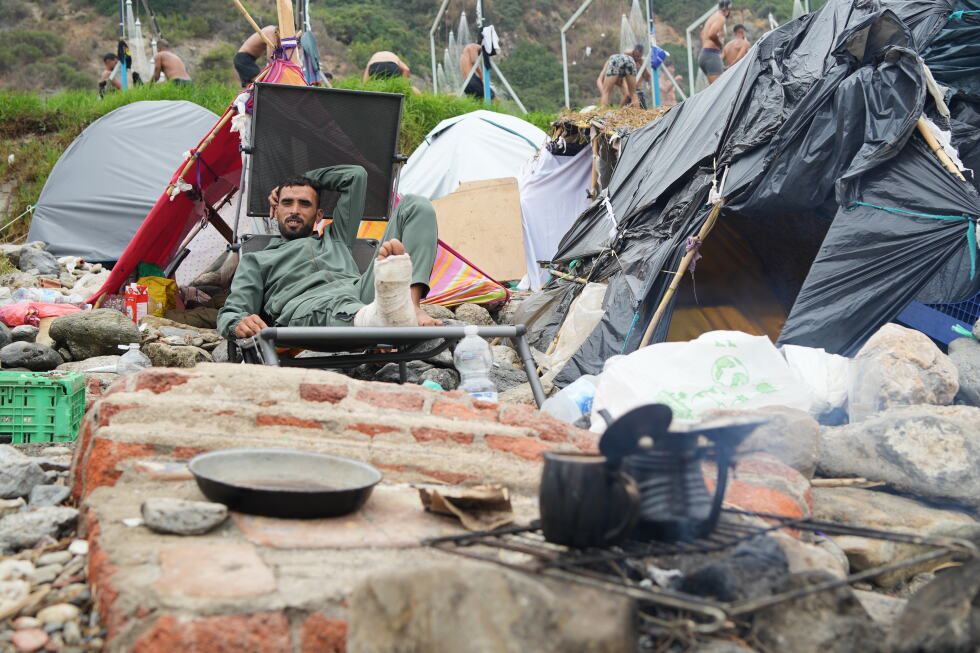
Weeks after the initial border rush, daily life in Ceuta remains far from normal. Thousands of migrants still remain without formal housing, sleeping in makeshift camps along the city’s El Trampolín beach and in public spaces, despite ongoing efforts by authorities to register, shelter, and repatriate those eligible to return to Morocco. “We’re suffering and we want to get to Europe or find a solution right now. Here, we’re all sleeping on the beach and having a really hard time,” Nebil Tazi, a 24-year-old Moroccan migrant stranded in Ceuta, told the Associated Press. “We’ve been waiting for a month, waiting for a solution here, but there isn’t one.”
Vivas, Ceuta’s regional president, has called on the central government to prioritize returning the exclave to stability and commit to permanently strengthening the border with Morocco, rather than relying on bilateral cooperation with Rabat to prevent future crises. “If we don’t do this, there will always be someone tempted to use migration as a tool for political ends,” Vivas warned.
Ceuta’s September 2 holiday commemorates the 1415 arrival of the first Portuguese governor, just weeks after Portuguese forces seized the territory from local rulers. The territory was transferred to Spanish control in 1580, and has remained an overseas possession of Spain ever even as Morocco has continued to claim sovereignty over the area.