As record-shattering summer heat pushes Tunisia into a dual crisis of widespread infrastructure collapse and growing public fury, President Kais Saied’s administration has intensified a sweeping, systematic crackdown on the country’s already beleaguered civil society sector, a new Human Rights Watch (HRW) investigation has found. In a 49-page report published Wednesday, the global rights watchdog warns that the escalating targeting of non-governmental organizations (NGOs) is not isolated harassment, but a deliberate campaign to eliminate independent civil society from the North African nation entirely.
The report lays out a detailed timeline of repression that began between May and December 2024, when authorities arrested 14 staff members from two types of groups in particular: organizations that provide support to asylum seekers, and anti-racism advocacy groups. From 2025 through the first half of 2026, at least 47 individuals linked to targeted NGOs have gone through prosecution in Tunisian courts, the investigation found. At least 10 of those people have been held in pre-trial detention for periods longer than the 14-month maximum allowed under Tunisian national law, a clear violation of domestic legal standards.
One of the highest-profile cases highlighted in the report is that of Saadia Mosbah, a leading Tunisian human rights defender. In March 2026, Mosbah was sentenced to eight years in prison and ordered to pay a substantial fine on what HRW calls “abusive charges of financial crimes” that are widely seen as politically motivated. Five additional employees of asylum support organizations have also been convicted on similar fabricated charges tied directly to their professional work assisting vulnerable populations, the report confirms. All targeted organizations have been forced to cease operations entirely, leaving critical gaps in services for marginalized communities across Tunisia.
Saied’s government has also weaponized existing counterterrorism and anti-money laundering laws to criminalize even basic assistance to foreigners living in Tunisia with irregular immigration status, turning humanitarian work into a criminal act.
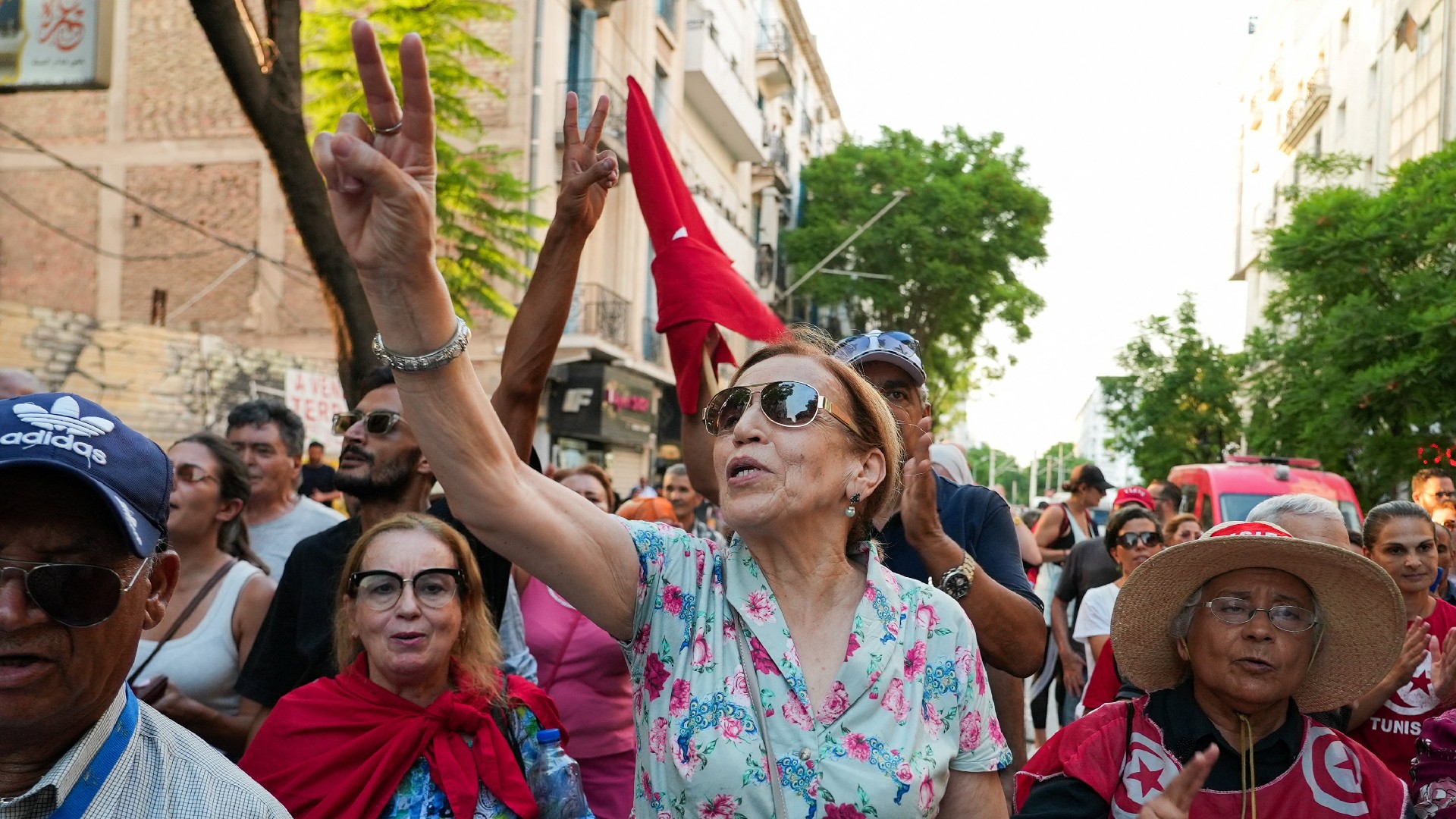
The government’s crackdown on dissent has done little to quell growing public anger, which has boiled over into mass street protests in recent weeks amid an unfolding climate and infrastructure emergency. This summer, temperatures in Tunisia have repeatedly climbed close to 50 degrees Celsius, driving unprecedented demand for electricity for cooling and increased strain on water supplies. To cope with constrained generation capacity, the Tunisian Company of Electricity and Gas rolled out rolling, rotating power cuts across multiple regions of the country.
Those outages have triggered a cascading crisis that has hit the country’s water distribution network, which depends on electric-powered pumping stations to deliver supplies to homes and businesses. The outages have added extra pressure to a water system already severely weakened by years of persistent drought. Compounding the crisis, power cuts and shortages of raw plastic have disrupted production of bottled water, leaving communities without reliable access to safe drinking water during the record heat wave.
The public health system has been pushed to breaking point as a result. Emergency departments across the country are already overwhelmed treating heat-related illnesses, and on August 29, the Tunisian Organisation of Young Doctors issued a statement warning of an “unprecedented” spike in heat-related deaths, and calling on the Saied administration to declare an official national health emergency.
Facing growing public outrage over the failures of basic services, Saied has responded by blaming unspecified actors for sabotage, a familiar pattern of conspiratorial rhetoric from the president. He has claimed the outages and shortages are “premeditated acts aimed at inflaming the situation by any means necessary, spreading lies and rumours to sow confusion” and “mistreating citizens even in the most basic services” — but has failed to produce any public evidence to back up these claims.
The current crackdown on civil society is part of a broader erosion of democratic norms that began shortly after Saied’s July 2021 power grab, when he dissolved the sitting parliament, seized executive authority, and moved to consolidate power under his personal control. Since that time, Tunisian civil liberties have deteriorated to what multiple local and international rights groups describe as an “alarming” state, with widespread condemnation of what they call Saied’s “authoritarian drift” and the sharp, systemic erosion of fundamental rights across the country. Dozens of journalists, opposition politicians, and human rights defenders have been arrested, with many handed lengthy, heavy prison sentences in recent years.