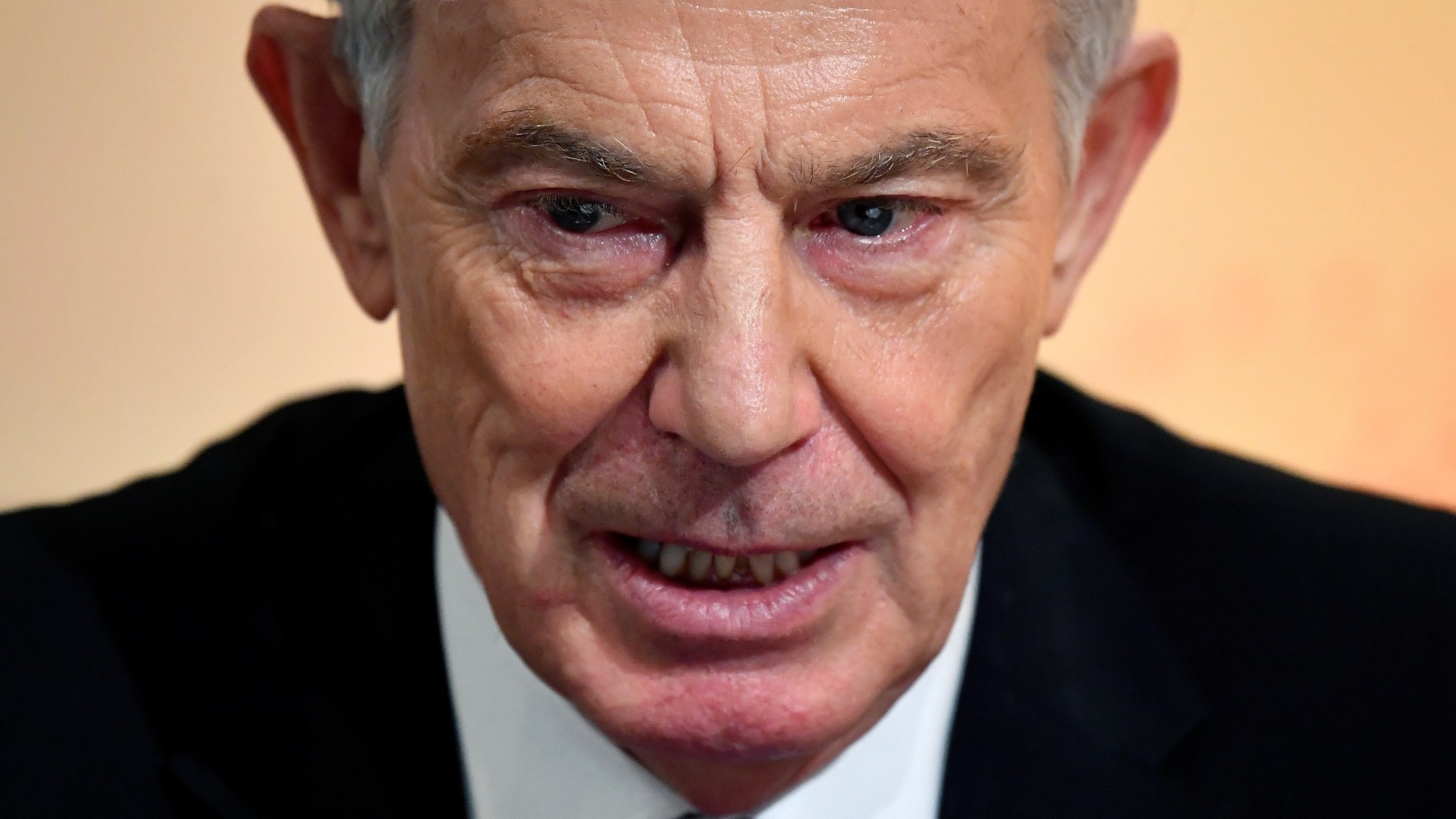
In a bombshell revelation shared during the David Hearst Podcast, former British Permanent Representative to the United Nations Jeremy Greenstock has pulled back the curtain on a controversial diplomatic demand tied to Donald Trump’s Board of Peace, the U.S.-established body tasked with overseeing post-war Gaza reconstruction. According to Greenstock, the board tapped former UK Prime Minister Tony Blair to pressure the Palestinian Authority (PA) to strip all references to the word ‘Palestine’ from its national school curricula, replacing the term with ‘Samaria’ – the Jewish historical designation for the region. Greenstock, who served as Blair’s senior diplomatic envoy during his time in Downing Street, confirmed the condition was explicit: only if the PA complied with the erasure would the Board of Peace recognize it as a legitimate negotiating partner for a final peace deal with Israel to end the ongoing Gaza conflict.
The demand was immediately and unequivocally rejected by PA President Mahmoud Abbas, Greenstock confirmed. This revelation has sparked fierce debate over the underlying principles guiding the U.S.-backed peace body, with Greenstock questioning the board’s commitment to basic concepts of justice, historical fairness, and longstanding diplomatic norms in the Middle East.
Blair’s own policy institute, the Institute for Global Change, has issued a flat denial that the former prime minister made the request. Still, the disclosure lines up with a growing, coordinated global campaign led by Israel and its supporters to eliminate references to ‘Palestine’ and Palestinian identity from educational materials and public cultural institutions, multiple recent investigations and on-the-ground actions confirm.
Greenstock, speaking from his decades of firsthand experience in Middle East diplomacy, also pulled no punches in his assessment of Blair’s current role heading postwar Gaza planning for the Board of Peace, noting the former prime minister has already encountered significant headwinds in the position. ‘Because of his record on Iraq and on Palestine since he left government, he will be seen as prejudiced. So I think he will have, and is having, difficulties,’ Greenstock explained. He went further, dismissing the entire Board of Peace as an ‘abstract and arbitrary committee’ structurally incapable of shouldering the weight of the high-stakes decisions required to resolve the future status of the Palestinian territories. ‘I don’t think the Board of Peace is a strong enough construct to bear the weight of the difficult decisions that are going to have to be made,’ he emphasized.
The timeline of diplomatic activity confirms Blair travelled to Israel in mid-August alongside Jared Kushner, Trump’s son-in-law and senior political advisor, and Nickolay Mladenov, the board’s high representative for Gaza. The trio held closed-door, high-stakes talks with Israeli Prime Minister Benjamin Netanyahu, who has already rejected the board’s proposed postwar roadmap for Gaza. Following the Israel meetings, the delegation travelled to Cairo to meet with a proposed Palestinian technocratic interim government that would take control of Gaza post-conflict, as well as representatives of Hamas.
Greenstock’s criticism extends far beyond the Board of Peace and Blair’s role. In a sharp rebuke to Britain’s new Prime Minister Andy Burnham, the former envoy urged the UK government to stand firm on principle in its Middle East policy, questioning the contradiction of British support for Ukraine in the face of illegal Russian invasion, while failing to hold Israel accountable for its actions in occupied Palestinian territories. ‘How can Andy Burnham go to Kyiv and support President Zelensky because the Russians invaded Ukraine illegally against United Nations principles, to be condemned around the world for going against the United Nations Charter, and not stand up for justice in the Middle East in the Arab-Israel question?’ Greenstock asked.
He called for a full review of British arms sales to Israel, and argued that under international law, the UK is obligated to arrest both Netanyahu and former Israeli Defense Minister Yoav Gallant if they enter British territory, as both men face active arrest warrants from the International Criminal Court. ‘We’re under an obligation through our treaty position in the UN and through our support for the statute of the ICC. I think as far as the ICC is concerned, and if anybody who had been indicted by the judges of the ICC, they should be arrested,’ he stated.
Greenstock also outlined his analysis of Netanyahu’s long-term strategic goals, arguing the Israeli prime minister is acting to fulfill a promise to his late father, historian Benzion Netanyahu, to annex the entire West Bank (referred to by Israelis as Judea and Samaria) and bring it under permanent Israeli sovereignty. He said Netanyahu saw the October 7, 2023 attacks as a unique opportunity to advance that goal.
Turning to broader trends in global power and the ongoing regional conflict, Greenstock warned Israeli citizens that their country is rapidly losing soft power influence across the globe, a shift that will have long-term consequences for Israeli security. He emphasized that lasting peace can only come through compromise with regional actors, noting that military solutions to long-standing political disputes have repeatedly failed in the modern era. ‘If I was an Israeli citizen, I would worry that my country was losing soft power appeal around the world. It matters in the long term, and it matters for peace and security in the Middle East that there should be some sense of compromise,’ he said.
Greenstock, who served as a senior coalition official in Iraq immediately after the 2003 invasion, reflected on his firsthand experience with U.S. foreign policy, arguing that America’s overreliance on hard power has led to repeated military failures across the Middle East over the past two decades. He noted that since the 1999 Kosovo conflict, neither the U.S. nor the UK has achieved a decisive, lasting victory in any military intervention, a trend he attributes to a fundamental misunderstanding of modern power dynamics. ‘We are in a world now where power has been diffused in all sorts of ways. And soft power has become more important. The capacity to persuade rather than compel has become extremely important… The legitimacy of using weaponry to force your will has become diminished in world opinion,’ he explained.
On the recent U.S.-Israeli strikes on Iran, Greenstock argued the Trump administration failed to adequately plan for the consequences of the attack, miscalculating Iran’s asymmetric military capabilities, including its ability to disrupt global oil trade through the Strait of Hormuz. He also suggested the timing of the strike was not accidental, noting it aligned with growing domestic political pressure on Trump over the Jeffrey Epstein files and multiple legal challenges facing his administration. ‘It’s not an accident that the timing of that attack on Iran might have been affected by things that were happening domestically,’ he said.
Greenstock also addressed the recent Mecca Agreement signed by Turkey, Saudi Arabia, and Pakistan, framing the pact as a clear response to growing Arab and Muslim distrust of U.S. leadership in the region. He explained that two key factors have eroded confidence in U.S. leadership: the repeated failure of U.S. hard power to deliver stable political outcomes in the Middle East, and the Trump administration’s explicit prioritization of ‘Make America Great Again’ domestic interests over the needs and priorities of U.S. allies in the region.
Looking at the broader shift in global diplomacy, Greenstock noted that the core moral and legal principles enshrined in the UN Charter are increasingly being set aside in favor of unilateral pursuit of narrow national interest, a shift that has reshaped Middle Eastern politics more than any other region. Today, he argued, there is no shared framework of principles guiding regional negotiation, unlike the cooperative security model developed in Europe after the Cold War.
Contextualizing the reported textbook demand, recent weeks have seen multiple high-profile actions advancing the erasure of ‘Palestine’ from public life. Just days before Greenstock’s interview, Israeli authorities began imposing their national curriculum on more than 45,000 Palestinian students in state-run East Jerusalem schools, part of a broader crackdown on Palestinian education in the occupied city. Earlier this year, UNRWA Lebanon, the UN agency for Palestinian refugees that Israel has banned from operating, faced intense pressure that forced it to replace the word ‘Palestine’ with ‘West Bank’ and ‘Gaza Strip’ on sixth-grade geography maps, a move that sparked widespread protests and strikes across Palestinian communities. That pressure came even after an independent review led by former French Foreign Minister Catherine Colonna found no evidence to support Israeli claims that UNRWA staff participate in terrorist organizations.
In the United Kingdom, a cross-party group of members of Parliament has recently called for a formal investigation into the British Museum’s decision to remove references to ‘Palestine’, ‘Palestinian’ and ‘Israelite occupation’ from its public displays. An investigation by Middle East Eye confirmed the museum’s decision came directly in response to targeted lobbying by pro-Israel activists between October and December 2024.
Since the October 2024 ceasefire brokered by the U.S. that established the Board of Peace, violence has continued unabated in Gaza. Israel has carried out repeated air and drone strikes across the enclave, killing at least 1,300 Palestinians and wounding more than 4,000. Just this week, at least seven rapid air strikes hit an area west of Gaza City, followed by drone attacks on any moving person in the area, local reports confirm. While Hamas and other Palestinian factions have agreed to a disarmament plan as part of the ceasefire framework, Israel has refused to withdraw its forces from Gaza until the disarmament process is fully completed.