For decades, Germany’s economic identity has been built on a reliable growth model: manufacturing and exporting high-value, complex industrial goods — from passenger cars and locomotives to factory equipment, aircraft and construction machinery — that power global commerce. Today, that foundational model is facing unprecedented pressure from a new, formidable competitor: China, whose finished manufactured goods now match or near German quality levels while hitting the market at far lower price points.
This shift, widely dubbed the “China shock” by economic analysts, has emerged as a core driver of the chronic stagnation that has gripped Europe’s largest economy since the COVID-19 pandemic. The prolonged slowdown has dragged down approval ratings for Chancellor Friedrich Merz’s governing coalition, just days ahead of a pivotal regional election in Germany’s eastern state of Saxony-Anhalt, where the far-right Alternative for Germany (AfD) stands its best chance ever to claim its first state governorship.
Not long ago, German industrial giants reaped substantial profits from sales into China’s vast growing market. But the tide has turned dramatically. Beijing’s industrial policy strategically targets and supports domestic manufacturing in exactly the sectors where German firms have long dominated. With domestic demand stuck in a prolonged slump in China, surplus Chinese goods are flooding foreign markets, including the European Union.
Germany’s economy has now gone years without meaningful expansion: it contracted in both 2023 and 2024, posting just 0.2% overall growth over the last year. While the country’s 4% unemployment rate remains lower than the European Union average, the public mood has soured sharply amid a wave of high-profile layoffs at iconic domestic manufacturers that have defined Germany’s industrial legacy for decades. Automotive giant Volkswagen is cutting 50,000 positions, with local media reporting more cuts are planned; BMW is offering 8,000 voluntary buyouts by the end of next year; and leading auto tech supplier Bosch is eliminating 13,000 roles by 2030. Post-pandemic inflation has also outpaced wage growth for years, with real wages only just returning to 2019 levels in 2024.
Volkswagen CFO Arno Antlitz summed up the pressure facing manufacturers, noting costs must be cut “in an environment where the Chinese total market is down by 20%, and Chinese competitors are increasing exports and thereby competitive pressure in Europe.”
Among the world’s major advanced economies, Germany has borne the brunt of this shift. Unlike the U.S., which uses tariffs to block many categories of Chinese goods, most notably automobiles, Germany’s economy is heavily geared toward exports of the very manufactured goods China now prioritizes for growth. Peer major European economies including France, Italy and the U.K. have far smaller manufacturing export sectors, leaving them less exposed.
Today, Germany imports more from China than it exports in every sector where German firms once claimed global leadership: passenger and commercial vehicles, rail rolling stock, aircraft, industrial machinery, and medical devices. “China has already eaten much of German industry’s lunch and is preparing to start on dinner,” economists Brad Setser and Sander Tordoir wrote in a recent analysis.
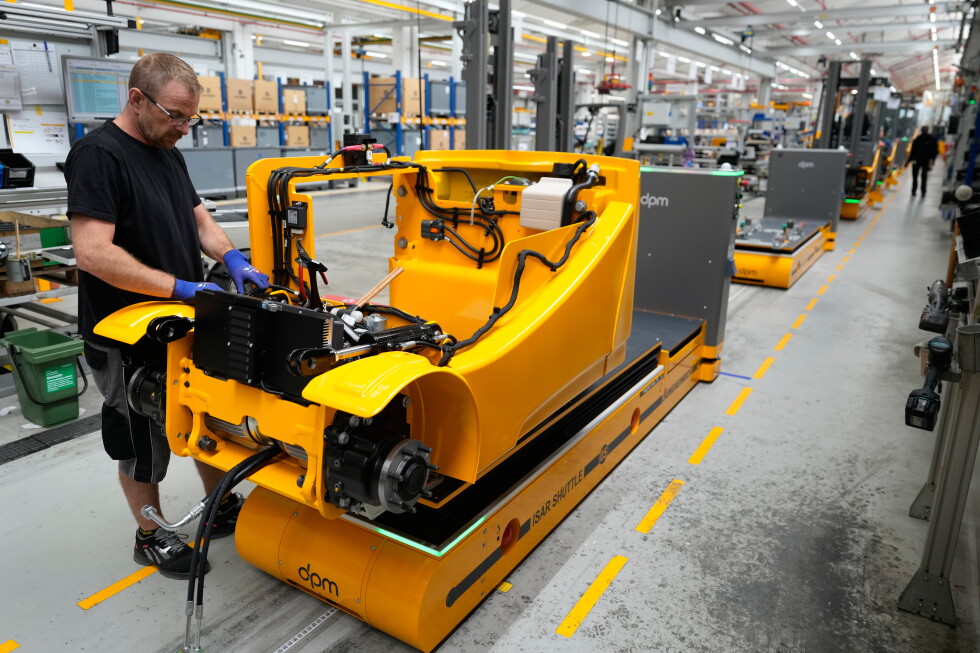
Some German firms have chosen the pragmatic approach: if you can’t beat Chinese competitors, partner with them. Moosburg-based Jungheinrich AG, one of the world’s top three manufacturers of forklifts and warehouse logistics vehicles, has launched a joint venture with Chinese manufacturer EP Equipment to produce a new line of entry-level forklifts branded AntOn, designed to match Chinese rivals on price. The partnership combines EP’s large-scale, low-cost Chinese production with Jungheinrich’s global distribution network and trusted brand reputation.
The AntOn lineup forgoes some premium features found in Jungheinrich’s exclusively German-made high-end models — it uses basic lever controls instead of modern joysticks, lacks built-in storage for personal electronics and wallets, and comes with an uncushioned seat — but meets core performance needs for customers that do not operate equipment 24/7, and retails for half the price of comparable premium machinery. To differentiate the new line, AntOn units are painted a distinctive bright purple, standing out from Jungheinrich’s signature yellow premium equipment.
“The challenge is, there comes a massive wave with Chinese products and Chinese offerings into Europe, but also into the international markets. And the key question is, how do you react?” said Nadine Despineaux, Jungheinrich’s Chief Sales Officer, during an interview at the company’s Moosburg facility near Munich. Despineaux frames the growing demand for affordable mid-tech industrial equipment as an untapped opportunity, noting “AntOn is a good combination of German engineering, market access and customer proximity, which we bring to the table, and highly efficient production sites, which we use in China.”
Volkswagen has taken a different approach, adopting an “in China, for China” strategy that includes opening a dedicated vehicle development center in Hefei to design models tailored specifically to Chinese consumer preferences.
German policymakers, for their part, are keen to avoid repeating the collapse of the country’s domestic solar industry. Germany was an early pioneer of solar panel manufacturing and adoption in the early 2000s, but lower-cost Chinese imports drove most domestic producers into bankruptcy, and today nearly all solar panels used in Germany are imported from China.
Critics point out that Chinese industrial policy provides targeted advantages to key domestic sectors, including low-cost access to credit, cheap raw materials, subsidized land, and local content requirements in some cases. Chinese manufacturing labor also costs far less than European labor, and many economists argue China maintains its currency at an artificially low exchange rate to keep export prices competitive.
But China’s export strength is not solely a product of government support. Domestic Chinese companies face cutthroat price competition amid the country’s own ongoing domestic slowdown, forcing constant efficiency gains and rapid adoption of new manufacturing technology to stay afloat.
Beijing rejects criticism from Western trading partners over its trade practices. A recent white paper from China’s Ministry of Commerce, titled “China’s Position on the So-Called Excess Capacity Issue,” argues that framing China’s industrial growth as a “China shock” falsely misrepresents the country’s development as a threat to Western economies.
The German federal government has attempted to jumpstart growth with a €500 billion ($579 billion) infrastructure fund targeting upgrades to roads, bridges and rail networks. A July economic proposal also includes income tax cuts for middle- and low-income households, alongside broad measures to cut bureaucratic red tape for businesses.
Yet leading analysts argue the solution to Germany’s China challenge may not rest with Berlin or German industry alone, but with EU trade policy overseen by the European Commission in Brussels. The Commission has already imposed targeted tariffs on specific Chinese imports, including electric vehicles and construction aerial work platforms. Setser, a senior fellow at the Council on Foreign Relations, says trade data confirms the China shock is the single dominant driver of Germany’s current economic malaise, and calls for a more assertive EU trade approach.
“We do think that Europe needs a tougher trade policy, that it needs to insulate its market from some of the spillovers from China’s own industrial policies,” Setser said. “There has to be a bit more symmetry … that the rest of the world will not remain open to a China that itself is not open to new imports.”