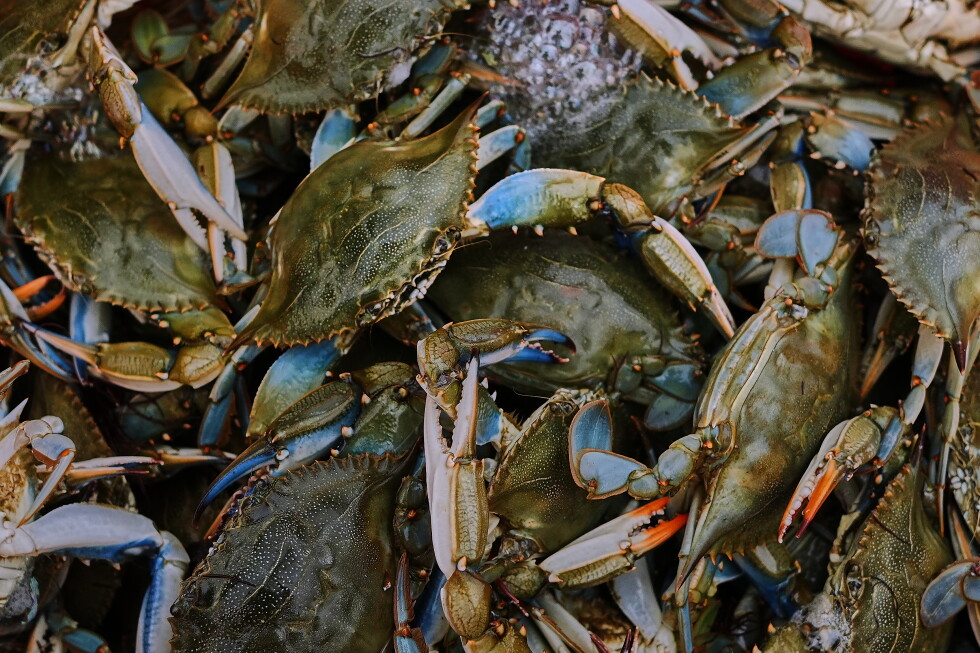
For two years, fishermen in Italy’s Po River Delta, south of Venice, took a straightforward approach to the rampant invasion of non-native Atlantic blue crabs: incinerate every single one they caught. The aggressive invasive species had decimated the region’s lucrative Manila clam beds, and few domestic consumers had any appetite for the predator that had destroyed the local fishing industry’s most valuable product. Now, after failed eradication efforts and ecological interventions that showed little promise, local fishing groups are rewriting their playbook, turning the unwanted crustacean into an unexpected export commodity to salvage battered livelihoods. This new strategy is already putting revenue back in fishermen’s pockets, and some advocates believe it could even reshape the much-maligned invader’s reputation among Italian consumers over time.
The invasion has hit generations of local fishermen hard. Second-generation fisherman Federico Zago, like all members of his local cooperative, watched his income collapse after blue crab populations exploded in 2023. The Polesine Fishermen’s Cooperative Consortium, which represents the region’s fishing industry, saw its annual revenues plummet 75% to 15 million euros ($17 million) between 2024 and 2025, while the number of active working members dropped from 1,500 to just 850. “We needed to change strategy, and create an opportunity from this disaster,” explained Paolo Mancin, the cooperative’s president. Desperate to protect the remaining Manila clam and mussel populations that had delivered decades of prosperity to the shallow lagoons of Veneto and Emilia-Romagna, the group pivoted to building new export markets for the excess crabs rather than destroying them.
Today, Zago pulls up cage after cage full of blue crabs from his traditional stilt fishing cabin over Scardovari Lagoon, and the cooperative’s new strategy is already exceeding expectations. In 2025, every crab caught by the consortium has been sold, eliminating the need for the mass incineration that was standard practice just months ago. The group now projects full-year revenue will hit 20 million euros ($23 million) in 2025, with the vast majority of that sum coming from blue crab sales. “Since we’re going to have to live with these crabs, I hope they become an opportunity,” Zago said. “I hope the market continues to grow.”
To understand how the invasion reached crisis levels, experts point to a perfect storm of human activity and climate change. Atlantic blue crabs first arrived in the Adriatic Sea as early as the 1940s, carried in the ballast water of transoceanic commercial vessels, according to Piero Genovesi, an invasive species specialist with Italy’s national environmental protection institute. For decades, populations remained small and contained, with fishermen only reporting occasional catches. That all changed in 2023, when populations exploded almost overnight. The crabs ripped through fishing nets, devoured native mollusk populations at alarming rates, and displaced the native green crab, a popular local soft-shell delicacy.
Genovesi notes climate change was a core driver of the population boom. Warmer Adriatic water temperatures create ideal conditions for blue crab reproduction, but the immediate trigger was a severe drought that pushed water levels in the Po River down sharply. Low freshwater flows allowed saltwater from the Adriatic to infiltrate inland tributaries and delta lagoons—where commercial clam and mussel farms offered an endless supply of prey. “Climate change may therefore have favored reproduction through both temperature and salinity, because it changed the salinity of the water,” Genovesi explained.
Facing widespread industry collapse, the Italian government launched a large-scale eradication program in 2024. Over two years, the state paid the Polesine consortium to catch and incinerate nearly 2.3 million kilograms (5 million pounds) of blue crabs, with fishermen in neighboring Sacca di Goro lagoon and Tuscany’s Orbetello lagoon following the same protocol. But the cull barely made a dent in blue crab numbers: a single female blue crab can produce up to 8 million eggs per breeding season, making population control through culling functionally impossible. The eradication program has since been shelved, according to Enrico Caterino, the government’s extraordinary commissioner for the blue crab emergency.
In a separate experimental intervention, scientists from the University of Bologna released 150,000 baby octopuses—one of the blue crab’s natural predators—into the Adriatic off the Riviera Romagnola, around two hours south of the Po Delta. The project gained viral attention for footage showing an adult octopus catching and consuming a blue crab, but both fishermen and independent experts remain deeply skeptical. Most of the juvenile octopuses are not expected to survive to adulthood, and blue crabs prefer the same open sandy lagoons that octopuses avoid, while the crabs’ extreme reproductive rate means even a thriving octopus population is unlikely to control overall numbers. “If an animal with such high reproductive potential finds suitable environmental conditions, predators may not be able to keep it under control,” Genovesi said.
Today, the majority of blue crabs caught by Italian fishermen are bound for processing overseas. Every morning, fishermen unload 100 to 150 kilograms of live crabs from trucks and cars for shipment. While crab sales are currently keeping many fishermen afloat, earnings still lag far behind the industry’s glory days of clam fishing. A kilogram of blue crab sells for just 1.30 euros, compared to 10 euros per kilogram for Manila clams—once the source of 90% of the region’s fishing income, now just 10%.
The crabs are steamed, frozen, and shipped to Sri Lanka, where workers manually extract the meat in a joint venture between Sri Lankan seafood firm Taprobane Seafoods and the Scardovari cooperative. The operation produces a full range of blue crab products, from whole claw meat to mixed minced meat and fillets, most of which are exported to global markets, with only a small volume currently returned to Italy. Taprobane is already planning large-scale retail expansion of blue crab products across Italy and Western Europe, which Mancin hopes will help win over skeptical domestic consumers who have so far rejected the region’s “If you can’t beat ’em, eat ’em” public outreach campaign launched in 2023.
Changing long-held cultural attitudes toward the invasive crab remains the biggest barrier to growing domestic demand. The FIPE Venice restaurant federation reports that blue crab is still almost entirely absent from top Venice restaurants that specialize in native green crab dishes, held back by both the extra labor required to process the invasive species and its lasting negative reputation as a pest.
One notable exception is Yogi, a small restaurant and bar in Porto Tolle in the Po Delta, which has fully embraced blue crab out of both necessity and passion. After the invasion left the restaurant without its traditional supply of local seafood, owner and chef Stefania Marchesini—who worked as a professional fisherman for 11 years before opening the restaurant—chose to build an entire menu around the invasive species. She pays a premium to local fishermen for fresh crabs, especially soft-shell blue crabs known locally as moeche, and offers a range of preparations from fried crab balls to creamed crab served over polenta, whole soft-shell crabs, and sectioned crab in the shell designed to highlight the species’ delicate flavor. “At first, the customer is very skeptical. But then the reaction is completely positive, and they want to try the entire range of products,” Marchesini said.
Marchesini also runs a small separate workshop where she pre-processes blue crab for other restaurants, offering individually packed soft-shell crabs and vacuum-sealed pre-cut whole crabs designed to cut down on preparation time and mess for home and restaurant cooks. Even when her products sell out at partner restaurants, however, most owners refuse to reorder, a trend Marchesini attributes to deep-seated cultural resistance to the invasive species. Undeterred, she has begun taking her blue crab menu to international food industry events, including Barcelona’s Alimentaria, one of the world’s largest food and beverage trade fairs, to build global demand. “We are all angry because it invaded our seas,” Marchesini said. “But we also have to eat. Once people understand how it should be prepared, they will realize it is an excellent product.”