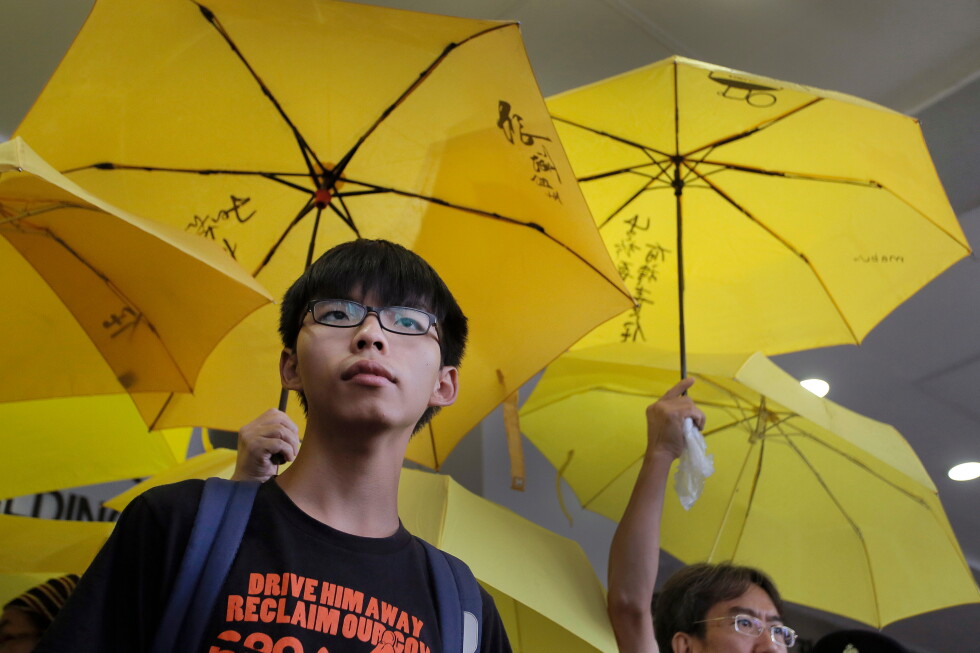
HONG KONG – Twenty-nine-year-old Joshua Wong, one of the most high-profile faces of Hong Kong’s pro-democracy movement, has entered a guilty plea to a charge of conspiracy to collude with foreign forces to undermine national security. The charge is laid out under the 2020 national security law enacted by Beijing, legislation that has effectively crushed the once vibrant pro-democracy movement in the semi-autonomous city.
This marks the second time Wong, a former student protest leader, has been prosecuted under the sweeping national security legislation. The law was introduced in 2020 in the aftermath of large-scale anti-government protests that roiled Hong Kong in 2019. Under the statute, the collusion charge carries a base sentence of three to 10 years in prison, and can be punished by up to life imprisonment for cases deemed of a grave nature. Wong is scheduled to receive his sentencing at a later date, with a life term the maximum possible penalty.
Wong is already currently serving a combined prison sentence of four years and eight months stemming from a separate 2020 national security case tied to an unofficial pro-democracy primary election held ahead of planned legislative council elections. Legal norms in Hong Kong mean that his guilty plea in this latest case will likely result in a reduced sentencing discount. Prior to his June 2025 arrest on the collusion charge, Wong had been projected to be released from his current sentence in January 2026.
The charge against Wong centers on allegations that between July 1 and November 23, 2020, he conspired with exiled fellow activist Nathan Law and other unnamed parties to lobby foreign governments, international institutions, and foreign non-state actors to impose sanctions, trade blockades, or other hostile actions against both the Hong Kong Special Administrative Region and mainland China. Law, who co-founded the pro-democracy political party Demosisto with Wong in 2016, fled Hong Kong for the United Kingdom shortly after the national security law came into force, and Hong Kong authorities have issued a 1 million Hong Kong dollar (approximately $127,600) bounty for information leading to his arrest.
Wong first rose to public prominence back in 2012, when as a teenage high school student he led widespread public protests against the introduction of mandatory pro-Beijing national education curricula in Hong Kong’s public schools. He gained global notoriety four years later as a core student leader of the 2014 Occupy Central (Umbrella Movement) protests, which called for greater democratic accountability in Hong Kong’s leadership selection process. In 2016, he co-founded Demosisto, a youth-led pro-democracy party, alongside Law, who that same year became the youngest legislator ever elected to Hong Kong’s Legislative Council before being unseated over his pro-independence remarks.
During the 2019 leaderless anti-government protests that swept Hong Kong, Wong worked to coordinate international outreach to build support for the pro-democracy movement, including advocacy with U.S. policymakers for legislation supporting Hong Kong’s autonomy. Beijing and Hong Kong authorities characterized these actions as “begging for foreign interference” in China’s internal affairs. Following the imposition of the national security law in June 2020, Demosisto announced it was immediately disbanding, with authorities framing the law as a necessary measure to restore stability and root out secessionist and subversive activity in the city.
Wong’s prosecution has sparked divergent reactions across global political and civic circles. Critics of the national security law argue that the case is a clear demonstration of the Hong Kong and Beijing authorities’ unwavering commitment to silencing all high-profile dissenting voices, arguing that the consistent use of the law against opposition figures has created a profound chilling effect on all forms of civic activism in the city. For Beijing, however, Wong is classified as an anti-China figure who openly supports Hong Kong independence, a position that falls far beyond the red line set by Chinese authorities.
Wong is not the only high-profile figure to be jailed under the national security law: dozens of leading pro-democracy activists have been prosecuted since 2020, including former Hong Kong media tycoon Jimmy Lai, who is currently serving a prison sentence over national security charges. Dozens of other opposition activists have fled into self-imposed exile in democratic countries including the United States, the United Kingdom, Canada, and Australia, many of whom now face similar bounties issued by Hong Kong authorities for their arrest.