CAIRO – At first glance, Chinese President Xi Jinping’s three-day visit to Egypt this week appears to be a standard diplomatic trip focused on deepening existing economic and diplomatic bonds between the two nations. But beneath the formal ceremonies and planned talks lies a far more strategic subtext: as Washington’s primary global competitor, China is actively building a broad, enduring partnership with a key U.S. ally in the Middle East, part of a larger push to expand its footprint in the rapidly shifting regional landscape.
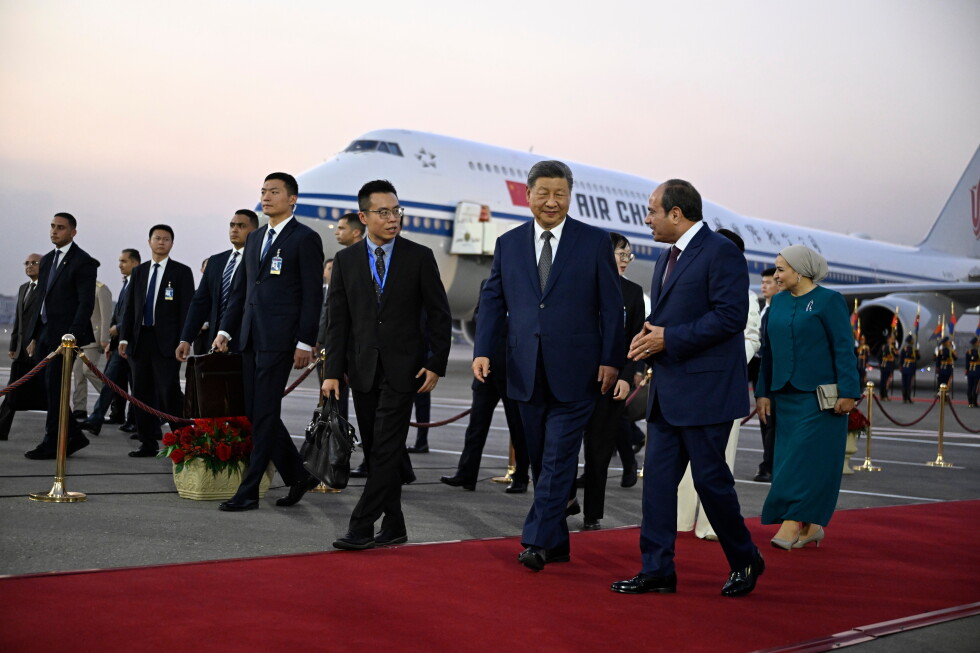
Xi’s arrival at Cairo International Airport Tuesday evening carried all the trappings of a high-profile state visit: Chinese and Egyptian national flags lined terminal access roads, and President Abdel Fattah el-Sissi greeted Xi on the tarmac alongside military honor guards during a formal red-carpet welcome. The two heads of state are set to hold in-depth bilateral talks Wednesday, and Xi is scheduled to tour the newly completed Grand Egyptian Museum located near the iconic Giza Pyramid complex during his stay. This trip marks Xi’s first visit to Egypt in 10 years, and his first journey to the broader Middle East region since a 2022 trip to Saudi Arabia. In contrast, el-Sissi has traveled to China multiple times over the past half-decade, and the two leaders marked the 70th anniversary of bilateral diplomatic relations by publishing joint opinion pieces in Egyptian state-owned newspapers Tuesday.
In his contribution, Xi emphasized that Beijing and Cairo must “expand the scope of pragmatic collaboration” centered on shared development. For his part, el-Sissi praised the billions of dollars in Chinese investment already flowing through Egypt, and reaffirmed Cairo’s longstanding stance that Taiwan is an inalienable part of Chinese territory, a core requirement for Beijing as it builds global support for its territorial claims.
From Egypt’s perspective, deepening ties with China offers a valuable opportunity to diversify its strategic partnerships beyond its longstanding alignment with the U.S. In 2023, Egypt received an invitation to join the BRICS bloc, an alliance of major emerging economies consisting of Brazil, Russia, India, China, and South Africa that is widely viewed as a counterweight to Western-dominated global governance institutions like the G7. A year after that invitation, Egypt finalized a set of agreements with China to join the Belt and Road Initiative (BRI), Xi’s signature global infrastructure project aimed at building connected transportation, energy, and trade networks across Asia, Africa, and Europe.
To date, Chinese firms have invested more than $10 billion in Egyptian projects, including a new commercial and logistics hub east of Cairo and a modern electric freight rail line serving industrial zones in the Nile Delta. Official bilateral trade data puts annual two-way commerce between the two countries at roughly $20 billion, compared to $15.7 billion in annual trade between the U.S. and Egypt as of 2025. Despite growing Chinese engagement, Egypt remains a critical security partner for Washington, whose leaders maintain close personal and diplomatic ties with el-Sissi’s administration.
This state visit is just the latest step in China’s years-long campaign to position itself as a neutral alternative power broker in the Middle East. In 2023, Beijing successfully brokered the resumption of diplomatic relations between Iran, China’s key regional ally and primary oil supplier, and Saudi Arabia, a longstanding U.S. partner. The deal marked a major public demonstration of China’s ambition to compete with the U.S. for influence across the region. However, relations between Riyadh and Tehran have deteriorated in recent months, after Iran launched strikes against Saudi Arabia and other Gulf states as part of its retaliation against the U.S. and Israel following the outbreak of war in February.
Beyond the Iran-Saudi detente, China has sought to frame itself as a neutral mediator for other longstanding regional conflicts. It has consistently supported a two-state solution to the Israeli-Palestinian conflict, a position widely backed by Arab nations as the foundation for lasting regional stability. Shortly before the 2023 Hamas attack on Israel that sparked the ongoing Gaza war, Xi hosted Palestinian President Mahmoud Abbas in Beijing and formally announced a new strategic partnership between China and the Palestinian Authority.
The current disruption to global energy markets has added new urgency to China’s outreach to Egypt. With oil shipments through the Strait of Hormuz heavily disrupted by the ongoing war between the U.S. and Iran, the Egypt-controlled Suez Canal has emerged as a critical alternative route for moving energy exports out of the Persian Gulf. “China has very clear strategic reasons to strengthen ties with the country that controls the only open major energy transit route out of the region right now,” explained Muhammad Zulfikar Rakhmat, a Middle East analyst at the Center of Economic and Law Studies in Jakarta. Rakhmat added that amid Washington’s shifting global priorities that have drawn U.S. attention away from the Middle East, Xi sees Egypt as a strategic hub to project influence across the broader Arab and African continents.
The growing security cooperation between the two nations has already produced tangible milestones. In August, Chinese and Egyptian forces held a multi-day joint air exercise across multiple Egyptian bases, marking the first ever combat exercise pairing China’s J-16 fighter jets with Egypt’s French-built Rafale fighter aircraft.
Xi’s trip to Cairo comes directly after he attended a two-day summit of the Shanghai Cooperation Organization (SCO) in Bishkek, the capital of Kyrgyzstan. The SCO is a 10-nation political and security bloc explicitly positioned as a counterweight to U.S.-led global security architecture, and this year’s summit was attended by the leaders of Russia, India, Pakistan, and Iran.
The visit also follows the Trump administration’s latest round of sweeping “economic onslaught” targeting Iran’s global financial networks. The new sanctions are designed to isolate Tehran from its remaining global economic partners, including China, which purchases more than 80% of Iran’s crude oil exports, most often through indirect trade channels. Beijing has repeatedly stated that all trade between China and Iran adheres to international law.
Writing in a joint research paper published earlier this year, Amr Hamzawy, director of the Carnegie Middle East Program based in Washington, and former program fellow Kathryn Selfe summed up the shift: “China continues to build up its soft power reserves while the United States self-sabotages its own stock” in the region. For Beijing, the contrast is intentional: Xi’s administration has sought to position China as a stable, non-interventionist alternative to the U.S., which has faced decades of costly military entanglement in the Middle East, with the six-month ongoing U.S.-Iran war being only the most recent example.
This report was compiled with contributions from Associated Press correspondents Noha el-Hennawy in Cairo and Huizhong Wu in Bangkok.