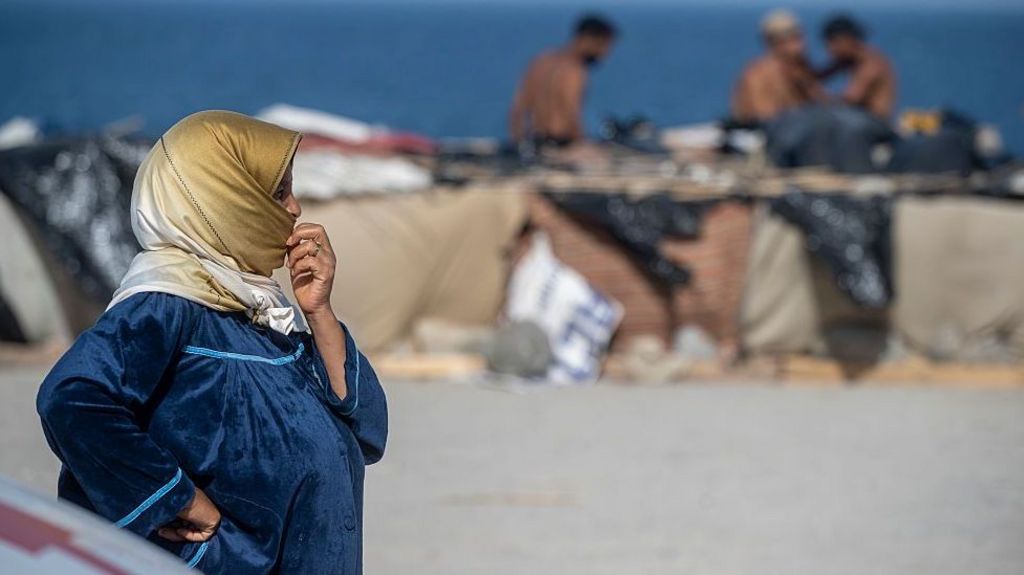
Nearly two months after an unprecedented mass migrant crossing into the Spanish North African exclave of Ceuta, the territory remains mired in a deep humanitarian, political and security crisis, with thousands of migrants still stranded and rising tensions between local communities, national political leaders and regional neighbors.
Between July 30 and 31, more than 72,000 migrants crossed the border from Morocco into Ceuta, one of two Spanish autonomous territories on North Africa’s coast that Morocco has long claimed as its own. While the vast majority of arrivals have since returned to Morocco, official estimates indicate as many as 5,000 migrants remain in the exclave — a figure that includes between 1,400 and 1,600 unaccompanied minor children. The unplanned, sustained population surge has upended daily life in Ceuta, stoked violent clashes between migrants and long-term local residents, and created one of the most pressing political challenges for Spanish Prime Minister Pedro Sánchez’s government in recent years.
Among the most alarming developments to emerge from the ongoing crisis has been a sharp rise in reported sexual assaults across Ceuta. Chief prosecutor Silvia Rojas confirmed to local media that 23 sexual assault cases have been formally recorded since the mass influx began in late July, a rate of roughly one incident per day. Nine of these recorded assaults targeted minor children. Rojas emphasized that migrant girls and young women face disproportionate risk in the current environment, noting that their irregular legal status leaves them particularly vulnerable to exploitation. Many additional assaults are believed to have gone unreported, Rojas added, with victims deterred from coming forward by fear of repercussions and their unstable living situation in Ceuta. So far, eight suspects have been identified in connection to the cases: four Moroccan citizens, three Spanish nationals and one Belgian, according to Spanish news agency Efe. The Spanish Society of Epidemiology has publicly warned that gender-based violence in this context cannot be dismissed as an isolated collection of unconnected incidents.
In response to mounting pressure, the Sánchez government has taken a series of steps to address the crisis. Spain’s cabinet has approved a multi-million euro emergency aid package designed to expand access to essential public services and fund care for the hundreds of unaccompanied migrant children remaining in Ceuta. On Tuesday, Sánchez convened his second national security council meeting in one week to coordinate a whole-of-government response to the unrest. In a move widely interpreted as an effort to reassert Spanish sovereign authority over the exclave, Sánchez announced earlier this week that King Felipe VI would visit Ceuta “as soon as conditions allow.” The announcement carried significant diplomatic weight: the last visit by a Spanish monarch to Ceuta, in 2007, prompted Morocco to recall its ambassador from Madrid in protest, and a new royal visit is expected to reignite diplomatic friction between Madrid and Rabat.
Sánchez’s handling of the announcement has already drawn domestic criticism. Political commentators have highlighted that the prime minister’s public remark — noting that no Spanish king had visited Ceuta in 20 years — was factually inaccurate: current King Felipe has only occupied the throne for 12 years, and the 2007 visit was conducted by his predecessor, Juan Carlos I. The comment was widely read as an implicit criticism of the monarch, even as Sánchez met with the king later the same day. The prime minister also noted that he is the only sitting Spanish prime minister to have made an official visit to Ceuta while in office, having traveled to the territory on July 31 as the crisis unfolded.
Beyond domestic pushback, the Sánchez government faces widespread condemnation from political opposition over its management of the entire crisis. The conservative mayor of Ceuta, Juan Jesús Vivas, has called for nationwide demonstrations across mainland Spain on Wednesday, timed to coincide with Ceuta’s annual public holiday, to demand stronger government action. Main opposition party the People’s Party (PP) has accused Sánchez of improperly exonerating Morocco of involvement in the crisis. Hard-right party Vox has gone even further, claiming that Sánchez has not merely lost control of Ceuta — he has intentionally ceded Spanish authority over the territory. Local business leaders echo the frustration: Arantxa Campos, president of the Ceuta Employers’ Confederation, told the BBC that local authorities and businesses have received no clear plan from the national government, leaving them unable to plan for or address the ongoing strain on public services and local infrastructure. “We don’t even know when they’re going to finish screening everyone,” Campos said.
A core point of political contention is the question of who bears responsibility for the unprecedented mass crossing. Sánchez has deliberately avoided blaming Moroccan state authorities, stating that no available intelligence reports point to any official Moroccan involvement in organizing or encouraging the surge. Morocco has repeatedly denied any role in orchestrating the crossing, and PP spokesperson Borja Sémper has questioned this narrative, arguing that tens of thousands of people could not have mobilized to the Ceuta border without the knowledge of Moroccan authorities.
Instead, Sánchez has pointed to disinformation campaigns on social media as a key driver of the crisis, claiming that false content has been spread by actors linked to Russia, Israel and an international far-right movement, which has long weaponized migration to destabilize European governments. He clarified that the disinformation campaign did not necessarily originate with a state actor, but his allegations have already drawn fierce pushback from both countries. Israeli Foreign Minister Gideon Sa’ar called the claim “a blatant lie”, while Russia’s foreign ministry spokeswoman has demanded concrete evidence to support the allegations. Both nations have outright denied any involvement in the crisis.
Spanish fact-checking organization Maldita has confirmed that in the weeks leading up to the July 30 crossing, encouraging messages circulated widely on Moroccan social media platforms, urging people to attempt the crossing after a June ruling from Spain’s Supreme Court. Multiple posts in August falsely framed the Ceuta border fence as easy and safe to cross, despite the high human cost: Ceuta’s mayor confirms that at least 100 people died attempting to swim around the border barrier during the mass influx.