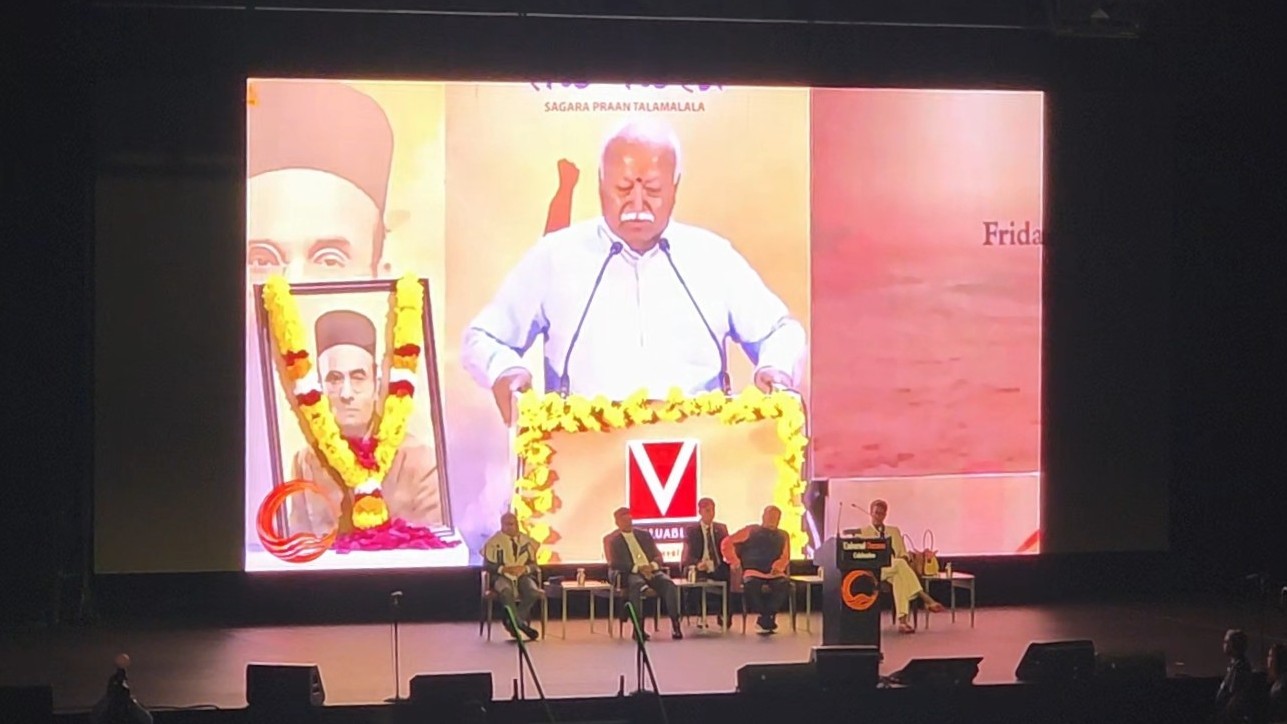
For over 140 years, New York City’s Madison Square Garden has stood as the world’s most iconic arena, hosting everything from championship NBA games to blockbuster sold-out concerts for global superstars. But on a recent Saturday afternoon, this legendary venue played host to a far different gathering: thousands of Indian and Hindu Americans, dressed in vibrant saffron accessories and traditional cultural garments, traveled from across the United States to hear from Mohan Bhagwat, the head of the Rashtriya Swayamsevak Sangh (RSS), a far-right Hindu nationalist paramilitary organization whose affiliate groups have been linked to escalating violence against religious minorities in India.
Organized by a group called American Hindus for Engagement And Dialogue (Ahead), the gathering was branded as the “Universal Oneness Celebration,” marketed as an afternoon of interfaith dialogue, shared cultural expression, and collective unity. As a correspondent for Middle East Eye, I gained access to the event after passing a strict identity-based vetting process — a requirement that contradicts the event’s public framing of radical inclusion. To receive a free ticket, attendees were required to list an affiliated Hindu temple or organization, provide a unique five-digit code for that group, and submit a reference from within the organization. Unlike many other prospective guests who received follow-up screening calls or were denied entry entirely, I was approved without question, a outcome I attribute to my clearly Hindu Brahmin surname — a detail that aligns with the RSS’s long history of Brahmin dominance within its leadership ranks.
Founded in 1925, the RSS boasts more than 5 million members worldwide and is built around the political ideology of Hindutva, a project that seeks to transform India, a constitutionally secular state, into a ethnically homogeneous Hindu nation. The movement’s earliest ideologues openly drew inspiration from authoritarian exclusionary projects: MS Golwalkar, the RSS’s second supreme leader, once framed Nazi Germany’s ethnic cleansing of European Jews as “a good lesson for us in Hindustan to learn and profit by,” explicitly targeting India’s Muslim community. VD Savarkar, widely considered the founder of Hindutva, held up the Zionist project in Palestine as a model for his exclusionary vision for India.
India’s current ruling party, the Bharatiya Janata Party (BJP), emerged directly from the RSS’s ideological coalition, the Sangh Parivar, and nearly all of its top leaders — including Prime Minister Narendra Modi — hold active membership in the organization. In recent years, senior BJP cabinet ministers have delivered public hate speeches calling for the killing of Indian Muslims, labeling the community “green snakes” that must be eliminated.
Even before entering the venue, the demographic homogeneity of the crowd — carefully curated to align with the RSS’s core values — was unmistakable. As more than 5,000 attendees waited in line to enter MSG’s Infosys Theater, the crowd broke out into repeated chants of “Jai Shri Ram,” a phrase that originated as a Hindu religious greeting but has since become a battle cry for perpetrators of anti-minority violence in India. The slogan was politicized in the 1980s to rally support for the construction of a Hindu temple on the site of the 16th-century Babri Masjid, a mosque demolished by Hindu mobs led by prominent BJP leaders in 1992.
Attendees also chanted repeatedly “Vande Mataram,” India’s national song, whose full version — championed exclusively by the RSS and affiliated groups — includes references to Hindu deities that secular Indian leaders have long argued contradict the country’s secular constitutional identity. The final stanzas of the full version call for 70 million people to “lift swords” and “drive out every invader who came from land and sea,” a clear dog whistle targeting India’s Muslim and Christian minority communities. Just weeks before the MSG event, the BJP-led national government passed legislation criminalizing any disruption or insult to the full version of the song, codifying the RSS’s preferred framing into national law.
Conversations with attendees made clear the deep ties between the gathering and the global Sangh Parivar network. One woman traveling with her young son said they had come from a local shakha — or local chapter — of the Hindu Swayamsevak Sangh (HSS), the RSS’s official international wing, near Edison, New Jersey, which is one of more than 250 HSS chapters across the United States. Other attendees identified as members of Sangh-affiliated groups ranging from the campus-based Hindu Students Council to Hindu Yuva, another youth organizing project tied to the movement. According to research from Savera, an anti-Hindutva advocacy organization, Ahead’s leadership has direct, extensive ties to both the RSS and BJP, and the group listed more than 250 partner organizations from across the U.S. that sent delegates to the New York event.
Outside the arena, dozens of activists from organizations including the Anti Imperialist South Asian Alliance Philadelphia (AISA Philly) and South Asian Left (Salam) gathered to protest the event. Rishi Arun, a member of both protesting groups, told Middle East Eye that the MSG gathering was the culmination of a decades-long project to legitimize Hindutva ideology among the South Asian diaspora in the United States. “These organisations have covertly pushed Hindutva propaganda while masquerading as cultural organisations, and using the language of universality, spirituality, and often inclusion,” Arun explained.
Inside the venue, the event opened with a showcase of three South Asian drumming traditions, but the crowd only erupted into excitement when performers took up the Maharashtrian Dhol Tasha — a style organizers explicitly noted has military origins. As the drums played, an image of Chhatrapati Shivaji Maharaj, a 17th-century Maratha king, was projected onto the main stage; while many mainstream historians dispute this framing, Hindu nationalists have rebranded Shivaji as an early icon of armed Hindu resistance against Muslim rule in India.
After short informational videos about “Hindu Dharma” and the nation of “Bharat” — the name Hindu nationalists insist on for India, rejecting both the “Hindustan” and “India” labels imposed by Muslim and British rulers respectively — the program continued with a regional cultural dance showcase. The crowd’s loudest cheers came during a segment celebrating the Middle East, performed to “Fa9la” by Bahraini artist Flipperachi — the viral entry theme for the Pakistani villain in the 2025 Bollywood film *Dhurandar*, which has been widely described as a Hindu nationalist revenge fantasy against Pakistan. Through carefully curated cultural programming, the event evoked core Hindutva sentiments without ever explicitly stating its exclusionary political goals.
The tone shifted after the cultural portion of the event, as organizers convened what they framed as an interfaith summit “One World, One Humanity,” with Bhagwat standing center stage flanked by clergy from Jewish, Muslim, Christian, and other major global faith traditions. Bawa Jain, founder of the World Council of Religious Leaders, introduced a centennial call to action for the RSS, reaffirming the organization’s stated commitment to global interfaith harmony. In opening remarks to the summit, Bhagwat told the crowd, “if any Hindu thinks there should be no Muslims in India, he will not remain Hindu” — a statement critics dismiss as tailored for a Western audience, even as the RSS continues to fuel anti-minority violence back in India.
Human rights monitoring group Genocide Watch has explicitly warned that India is currently in the precursor stages of an anti-Muslim genocide, and has directly linked the RSS to arming and training Hindu nationalist groups to carry out organized communal violence. In his 40-minute closing speech, Bhagwat told attendees that “every nation has a destiny to fulfil” and that the destiny of “Bharat” is to “make the world realise” the idea of “unity in diversity.”
A day after the event, RSS leadership praised the New York gathering on social media platform X, framing it as a key global outreach initiative during Bhagwat’s multi-city tour of the U.S., Canada, and the United Kingdom. But critics of the event say Bhagwat’s moderate, inclusive rhetoric for American audiences stands in stark contrast to the daily violence carried out by RSS affiliates in India.
“Bhagwat’s words are one thing. And the bloodshed that the RSS commits on a near-daily basis in India is entirely another,” said Safa Ahmed, board member of the Indian American Muslim Council and a co-organizer of the external protest. Ahmed referenced Golwalkar’s original writing, which argues that religious minorities must be “wholly subordinated to the Hindu Nation” — a standard that Ahmed says represents the RSS’s true vision for minority communities in India.
Just one week before the MSG event, the U.S. Commission on International Religious Freedom called on the Biden administration to impose sanctions on the RSS for its role in “violent attacks against religious minorities, including Christians, Dalits, Muslims, and Sikhs,” and urged the State Department to revoke Bhagwat’s travel visa to the United States.
As the event drew to a close, attendees closed out the gathering with a new, globalized twist on the traditional RSS closing chant. While RSS shakhas in India traditionally end with “Bharat Mata ki jai” (“Victory to Mother India”), the New York crowd chanted “Vishwa dharma ki jai” — “Victory to universal dharma” — a clear signal that the RSS is actively expanding its ideological project beyond India’s borders into the U.S. diaspora.