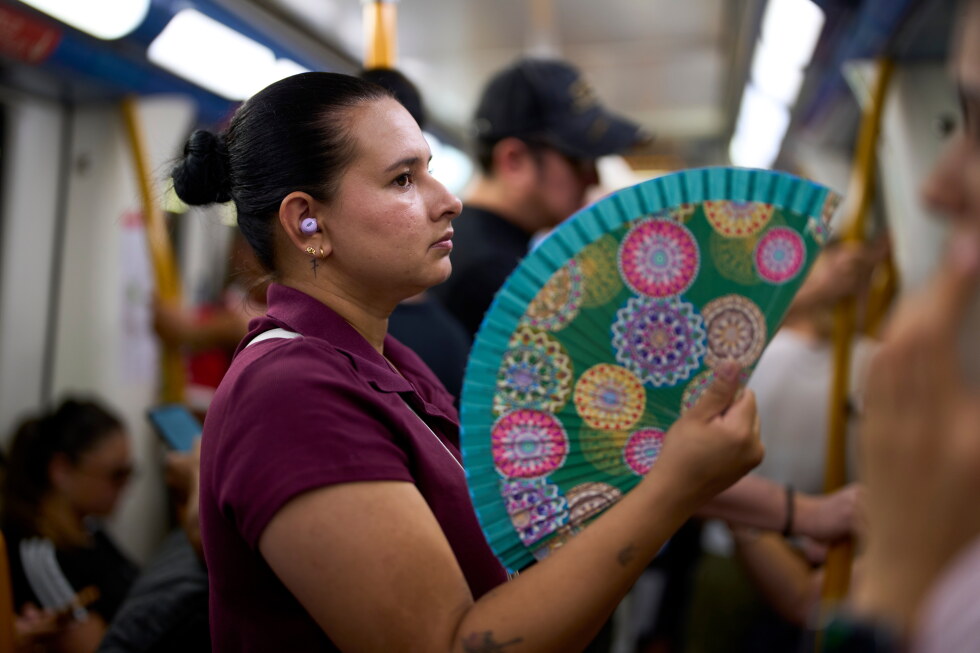
Across Spain’s packed metro carriages, sunbaked public squares, open-air festivals and crowded event venues, one iconic traditional accessory has made a striking resurgence this summer, driven by a string of record-breaking heat waves that have pushed temperatures across Western Europe to dangerous, sweltering highs. The abanico, Spain’s classic handheld folding fan, is compact enough to tuck into a purse or jacket pocket, and with a single flick of the wrist, it unfurls into a wide semicircle that generates a surprisingly cool, refreshing breeze without relying on batteries or electricity.
This summer, as successive heat domes sent temperatures climbing above 38 degrees Celsius (100 Fahrenheit) across much of the Iberian Peninsula, the abanico has cemented its status as an essential summer staple, embraced by people of all ages and genders both locally and among visiting tourists. Where once it was largely seen as a women’s accessory, more men are now carrying the fans, pulling them out to cool down on crowded public transit, at outdoor music concerts, and beneath the beating sun at summer festivals. During Madrid’s vibrant annual Pride celebrations in July, rainbow-patterned abanicos were ubiquitous across the city’s parade routes and gathering spaces.
On a sweltering August day in central Madrid’s Puerta del Sol, 20-year-old Ana Feliu spoke with the Associated Press while shielding herself from the sun with a lightweight paper abanico she received as a gift at a festival in Valencia. She carries one with her everywhere she goes during the summer months, noting that this particular fan is her favorite, but she maintains a large collection of different designs for different occasions. The Spanish capital had forecast highs of 39 degrees Celsius (102 Fahrenheit) for that Thursday and Friday, making constant cooling a daily necessity. Nearby, 53-year-old David González fanned himself with a vibrantly hued fan decorated in shades of pink, purple, and red. “At first, I felt a little self-conscious, because it’s something that’s mainly associated with women, but I have to admit it serves a purpose — and it brightens my day,” he explained.
The history of the folding fan in Spain stretches back hundreds of years, with deep global roots. Historians trace the accessory’s arrival in Europe to 15th and 16th-century Portuguese maritime trade routes connecting the continent to Asia, where handheld folding fans had been used for millennia. As folding fans grew fashionable among royal courts across Western Europe, Spain developed its own robust fan-making industry: Madrid emerged as an early production hub, and by the 18th century, Valencia had become the country’s undisputed fan-making capital. By the 1800s, the abanico was so deeply woven into Spanish aristocratic culture that women developed a subtle nonverbal “language of the fan,” using different movements and positions to discreetly communicate flirtation, romantic interest, or disapproval to others in social settings.
From Spain, the abanico traveled across the Atlantic to Latin America, and by the 19th century, it had become a core expressive prop for flamenco dance, shaped in part by Cuban musical and dance traditions like the guajira that influenced flamenco’s evolution. Over time, the fan’s close connection to flamenco turned it into one of the most recognizable quintessential symbols of Spanish culture. “The fan is a perfect element because, on the one hand, it evokes the heat and humidity of Cuba — that heavy, oppressive feeling,” explained Carmen Torres, a 44-year-old flamenco dancer based in southern Spain. “And at the same time, it gives us a way to bring out the seductive, coquettish quality that defines so much of the performance.”
For long-standing fan businesses across Spain, this summer’s heat waves have been a major boon, boosting sales to levels not seen in decades. At Casa de Diego, a wood-paneled fan shop in central Madrid that has been operated by the Llerandi family for more than 150 years, business has been booming this season. “We live from the heat,” said Javier Llerandi, the shop’s current owner. The store sells exclusively Spanish-made abanicos, ranging from simple two-tone wooden models priced around 30 euros ($35) to elaborate, hand-painted luxury pieces crafted from mother-of-pearl with intricate floral designs that can cost as much as 6,000 euros (nearly $7,000). Llerandi explains that prices shift dramatically based on the materials used, and even more so on the level of hand workmanship required for each piece. As Madrid has grown into a top global tourist destination, foreign visitors have become some of the shop’s most enthusiastic customers, drawn to the fan’s reliability compared to modern battery-powered portable coolers. “Battery-run items eventually run out of power, and always at the worst possible moment,” Llerandi said with a smile. “Without a doubt, heat waves are good for this business.”
For budget-focused shoppers and casual users, low-cost printed plastic or paper abanicos are available for just a few euros at street souvenir kiosks and market stalls across the country, and vendors across Madrid reported similarly strong sales this summer. Outside Madrid’s iconic Las Ventas bullring, for example, vendor Juani Duran sells wooden abanicos decorated with traditional floral patterns for five euros apiece ahead of bullfights, which take place in open-air stadiums where spectators often wear formal, layered attire. “You’ll usually find a hand fan in any woman’s pocket — and in some men’s, too,” Duran said ahead of a late-August bullfight. Acknowledging the more affordable quality of her stock, she added, “They’re not the best quality, but they’ll get you through the summer.”