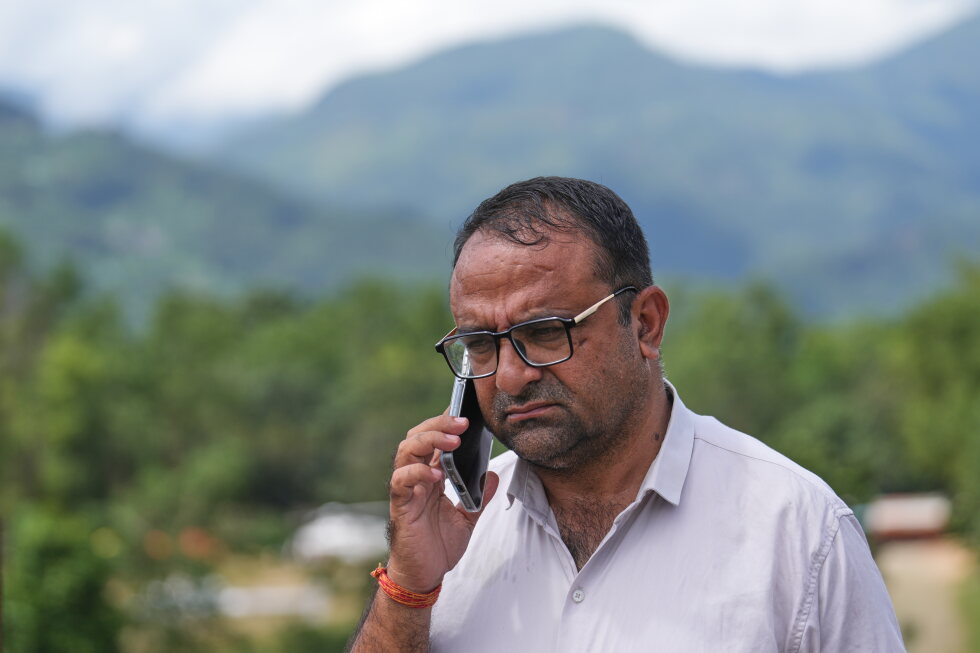
In the mountain-fringed Trishuli Valley of north-central Nepal, a routine school morning turned into a race against catastrophe last week, when warnings of an oncoming glacial outburst flood reached Tribhuvan Trishuli Secondary School. Rajendra Dawadi, a veteran teacher who had spent both his student and teaching career at the institution, was mid-lesson when the school’s accountant burst into his classroom with the first urgent alert of rising waters that were tearing through settlements downstream.
Successive warnings piled in quickly: a second alert from a teacher’s phone call, followed by a panicked parent arriving to collect their child. With no official confirmation of the danger and minutes to spare, Dawadi did not hesitate. He immediately sounded the school bell, ordered every student and staff member on campus to evacuate toward the elevated hills nearby, and coordinated with bus drivers to divert incoming student transports to safer ground.
One full bus of students had already reached the new bridge leading to the school when Dawadi ordered it to turn back. Barely moments after the bus cleared the span, the adjacent old bridge collapsed into the churning flood. As Dawadi followed the last of the evacuees up the nearby hillside, the murky, debris-choked waters rose rapidly behind him. From their vantage point on the safe slope, he watched the three-story school building—an institution that had shaped his entire life—get swallowed whole by a torrent of water, mud, and boulders. Tragically, two members of the school staff were caught in the flood and remain unaccounted for.
The disaster that unfolded across Nepal and southern China was triggered by a glacial lake collapse in the Himalayas, a catastrophic event that has now claimed more than 900 lives and left more than 4,700 people missing across both regions. At Tribhuvan Trishuli Secondary School, which enrolled 1,643 students total, at least 900 children were on campus when the first warning hit. Every single one of those students survived, a miracle directly credited to Dawadi’s split-second decision to evacuate.
The scale of the loss hits close to home for Dawadi, who earned his own education at the school before returning to teach there for years. “I have no words. I got education from that school. And I gave education at that school,” he told the Associated Press.
The destruction of Tribhuvan Trishuli is far from an isolated tragedy. Across northern Nepal, the flash floods have displaced thousands of children from their learning spaces, derailing their academic progress and raising alarms that thousands could miss months of school. International children’s charity Save the Children estimates that at least 69 schools across the region have been completely destroyed, putting nearly 19,000 students’ access to education at severe risk.
In the aftermath of the disaster, Dawadi’s fast, calm response has been widely celebrated as an act of extraordinary heroism. When he returned to the school’s riverfront site days after the flood, waiting parents wrapped him in hugs, tears in their eyes as they thanked him for saving their children’s lives. “Their parents hugged me, they cried with me. They were emotional,” he recalled.
Fourteen-year-old student Suvina Tamang, one of the evacuated children, confirmed that the entire school building was swept away just minutes after the evacuation was completed. “I will thank him when I see him for saving my life,” she said.
Despite the widespread praise, Dawadi rejects the label of hero. For the long-time educator, evacuating his students was simply a basic responsibility. Now, he says, the most pressing needs go beyond the immediate celebration of survival: displaced students require urgent psychological support to process the trauma of the disaster, and learning must resume as quickly as possible, even if classes have to be held in temporary facilities.
His clear message to the Nepalese government is straightforward: prioritize rebuilding destroyed schools, and get children back to the classroom as soon as possible.