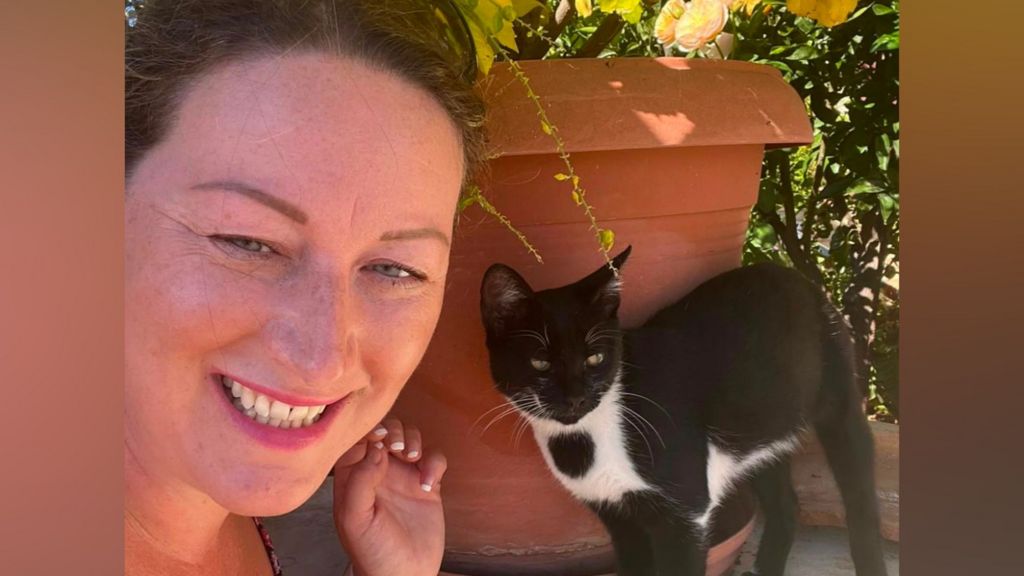
For most tourists, a Mediterranean holiday is all about sun, sea, and relaxation. For UK cat lover Eve Gaut, a 24-hour stop in the Cretan village of Sissi in September 2023 changed the lives of two tiny stray kittens – and transformed her own approach to animal welfare.
Gaut, a resident of Shropshire, had long made a habit of feeding stray cats during her travels, often pained by seeing them scavenge through garbage bins for leftover food to survive. But when two orphaned black-and-white kittens bounded up to greet her immediately after she stepped out of her rental car, the encounter struck a chord she never expected.
“It sounds crazy, I just felt this connection,” Gaut recalled. “Stavros was meowing nonstop, and I just got the feeling he was asking me for help. I knew right then that if we could get them back to the UK, we could give them a far better life than they could ever have on the streets.”
The two kittens, who would later be named Stavros and Nikos, were brothers whose mother had been killed by a passing car. Their situation reminded Gaut of the two cats she already had at home, and for the rest of her stay, the pair followed her everywhere around the village while she shared what food she could spare. But constant worry for their safety lingered: watching the tiny kittens dart across busy roads, dodging vans and motorbikes, left Gaut terrified that they would meet the same fate as their mother. By the end of her trip, she had made up her mind: “I love these cats, and I’m going to save them,” she told her husband.
Gaut immediately began coordinating the rescue, reaching out to local Greek animal rescue charities to get help. After she returned to the UK, a local volunteer used the photographs she had left behind to track down and capture the two brothers, kicking off the formal rehoming and relocation process. After months of veterinary care – totaling more than £1,500, which covered vaccinations, microchipping, and treatment for health issues – a period of foster care in Greece, and coordinated international transport, Gaut was finally reunited with Stavros and Nikos in January 2024.
Against all odds, the transition went smoothly. “They both adapted incredibly well,” Gaut said. “They’re super affectionate, and they eat nonstop – I think they still remember what it was like to never know where their next meal would come from. They’ve just been such wonderful additions to our home, and everyone adores them.”
Stavros and Nikos’ happy ending is far from the norm for the hundreds of thousands of stray cats living across Southern Europe, however. According to International Cat Care, an animal welfare nonprofit, uncontrolled breeding has left Mediterranean holiday destinations facing what the organization calls an overwhelming stray cat population crisis. On the island of Cyprus alone, estimates suggest there are as many as 2 million stray cats – more than the country’s entire human population of 1.2 million.
Harry Eckman, global advisor on cat population management for International Cat Care, says he understands the impulse animal lovers feel when they bond with a stray during a trip. “There is an enormous unmet need for help for these animals, and the scale of the problem is huge,” he explained. But he also cautions that bringing a stray cat home isn’t always the best choice for the animal, urging travelers to prioritize the cat’s needs over their own emotional impulse. “A cat that’s happy to sit on your hotel balcony and take food and scratches from you isn’t necessarily going to be happy living inside a home in another country,” he said. “Uprooting a cat from its familiar environment, especially if it’s never lived indoors, can cause incredible stress and distress.”
In many regions, well-managed community cat programs already provide the best long-term care for stray populations. In these managed colonies, cats are neutered (marked by a clipped ear to signal the procedure), provided with regular food and veterinary care by local volunteers, and allowed to live out their lives in the territory they know. For example, the Portuguese capital of Lisbon has more than 1,300 registered managed cat colonies, with local residents overseeing their ongoing care.
Eckman’s advice for travelers who want to help is simple: support local efforts rather than trying to rescue cats on your own. “In every destination you visit, there are already local people and organizations working as hard as they can to help these cats,” he said. “Seek out those local groups, and offer your support – that will make a massive difference not just for the one cat you met, but for hundreds and thousands of cats over months and years to come.”
Gaut agrees with that guidance, acknowledging that not every stray cat relocation works out well, and many cats are better off remaining in their native environment. “Mine is a happy story, but I’ve heard so many sad ones where people brought a cat home and it didn’t work out,” she said. “You have to be realistic about what’s best for the animal.”
Since bringing Stavros and Nikos home, Gaut has continued to help stray cats on her visits to Greece, spending hundreds of pounds of her own money on cat food and encouraging local residents to take more action to care for strays. On a recent trip to the Greek island of Andros, she tracked down the owner of a property where she spotted a severely ill kitten, convinced him to take the animal to a vet for treatment, and covered the cost of care herself.
“It breaks my heart every time I go back to Greece, because when I see the street cats, all I can think is that this was the life Stavros and Nikos were going to have,” she said. “Sometimes I wonder if I should even go back, because it doesn’t feel like a holiday when you see all that suffering. But if I don’t go, I’m just turning my back on the problem, and every small bit of help counts. Realistically, there aren’t enough homes in Greece for all these stray cats, or they wouldn’t be on the streets in the first place.”