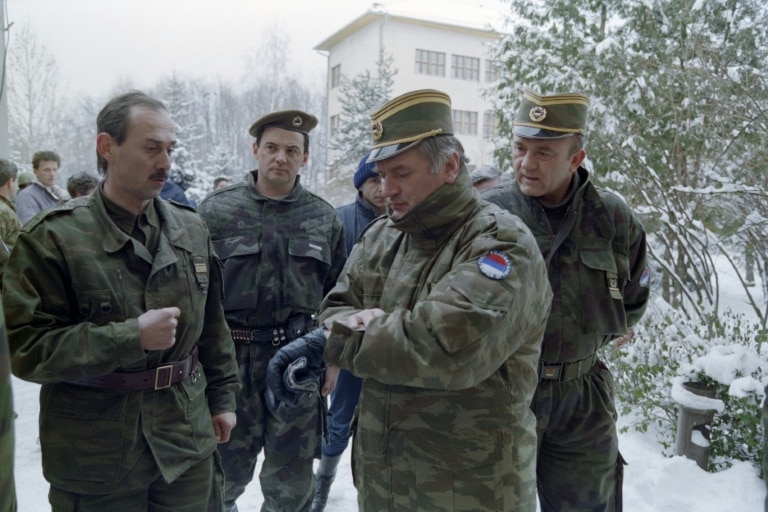
Ratko Mladic, the former top military commander of Bosnian Serb forces whose role in the 1995 Srebrenica massacre earned him the notorious moniker the “Butcher of Bosnia”, has passed away, Serbia’s state-owned public broadcaster RTS announced on Thursday. The 80-year-old had been serving a full life sentence at a United Nations detention facility in The Hague, Netherlands, after being convicted of genocide, multiple war crimes, and crimes against humanity for his central role in orchestrating the Srebrenica slaughter — the worst episode of mass killing Europe has witnessed since the conclusion of World War II.
In the months leading up to his death, Mladic had experienced multiple strokes that left his health in severe decline. Serbian government officials and members of Mladic’s family had repeatedly submitted formal requests to the international tribunal in The Hague, calling for his compassionate release on medical grounds. All of these appeals were ultimately rejected by judicial authorities, who ruled that Mladic should serve out his full sentence behind bars.
Mladic stood as one third of a brutal power bloc that drove ethnic violence through the Balkans during the breakup of the former Yugoslavia. The political wing of the faction was led by Slobodan Milosevic, the former president of Yugoslavia, and Radovan Karadzic, the founder and former leader of the unrecognized Bosnian Serb state. When communism collapsed across Eastern Europe, the former Yugoslavia fractured along ethnic lines, plunging the region into a devastating four-year war between 1992 and 1995. By the time the conflict ended, official casualty counts put the total death toll at roughly 100,000, with an additional 2.2 million people forced to flee their homes and become displaced persons.
No atrocity during the conflict gained more global infamy than the Srebrenica massacre. In July 1995, Mladic’s Serb forces swept into Srebrenica, a small town in eastern Bosnia that had been formally designated a UN-protected safe haven for vulnerable Bosnian Muslim civilians. Over the course of several days, Mladic’s troops systematically rounded up and executed more than 8,000 Bosnian Muslim men and boys, burying their remains in mass unmarked graves across the surrounding countryside. For decades after the massacre, forensic teams have continued to recover and identify remains from these mass graves, providing long-awaited closure to surviving family members.
Mladic evaded capture for more than 16 years after the end of the Bosnian war, living in hiding in Serbia before he was finally arrested by Serbian security forces in 2011. He was extradited immediately to The Hague to face trial before the International Criminal Tribunal for the former Yugoslavia, and was found guilty on all counts in 2017. His final appeal to overturn the conviction was rejected by the UN appeals court in 2021, which upheld his life sentence.