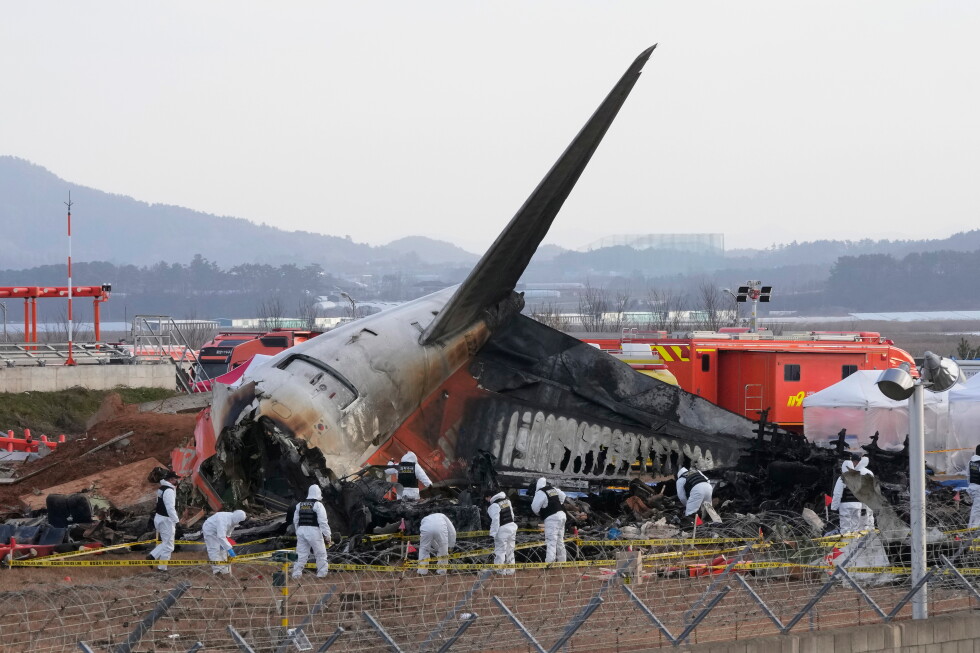
On Thursday, South Korean law enforcement announced a major development in the investigation into the country’s worst aviation disaster in nearly 30 years: authorities are pushing for criminal indictments against seven senior transport ministry officials linked to the December 2024 Jeju Air crash at Muan International Airport that claimed 179 lives.
The tragedy unfolded when a Boeing 737-800 operated by regional carrier Jeju Air attempted an emergency landing after its landing gear failed to deploy. The aircraft skidded off the runway before colliding with a concrete structure housing landing guidance equipment, triggering a catastrophic fire that left only two survivors among the 181 people on board.
Investigators have already recovered physical evidence of bird strike damage to both of the plane’s engines, a key detail that has factored into early probes. A further unusual finding has added complexity to the case: the jet’s two black boxes, which record flight data and cockpit audio, ceased recording approximately four minutes before the crash, leaving gaps in investigators’ full understanding of the final moments of the flight.
Many aviation safety experts have pointed to additional systemic failures that contributed to the high death toll, specifically calling out the design and construction of the concrete localizer structure the plane hit. Localizers are antenna arrays that guide aircraft during landing approaches, and global aviation safety standards require these structures to be built with frangible, easily breakable materials to minimize damage in the event of a collision. Experts argue the non-frangible concrete construction of the Muan airport localizer directly worsened the crash’s impact.
Police investigations have now uncovered that the seven indicted transport ministry officials knowingly falsified official records and public statements, falsely claiming the Muan localizer had been installed in full compliance with both South Korean domestic regulations and international aviation safety standards. Law enforcement has officially referred the case to state prosecutors, requesting the seven officials be charged with the criminal offense of falsifying official government documents. Conviction on this charge carries a maximum penalty of seven years’ imprisonment in South Korea. When contacted for comment following Thursday’s announcement, the South Korean Transport Ministry declined to issue any statement.
The probe remains ongoing: police confirmed they are still investigating roughly 70 other individuals connected to the crash, including personnel involved in the original installation of the Muan airport localizers and senior airport operations managers.
The crash marks South Korea’s deadliest aviation accident since 1997, and as of yet no formal final cause has been publicly released by investigators, and no prior criminal prosecutions have been filed in connection with the disaster. The investigation has already been marked by controversy earlier this year: the Aviation and Railway Accident Investigation Board initially planned to release an early probe finding that both engines sustained bird strike damage, and that pilots had shut down the less severely damaged engine moments before the emergency landing. That draft finding, widely interpreted as implying pilot error contributed to the crash, sparked fierce public pushback from bereaved families of the victims and active-duty South Korean pilots, who accused authorities of attempting to shift blame for the disaster onto the deceased pilots to deflect from institutional failures. In response to the outcry, the investigation board scrapped the planned announcement of the preliminary results.