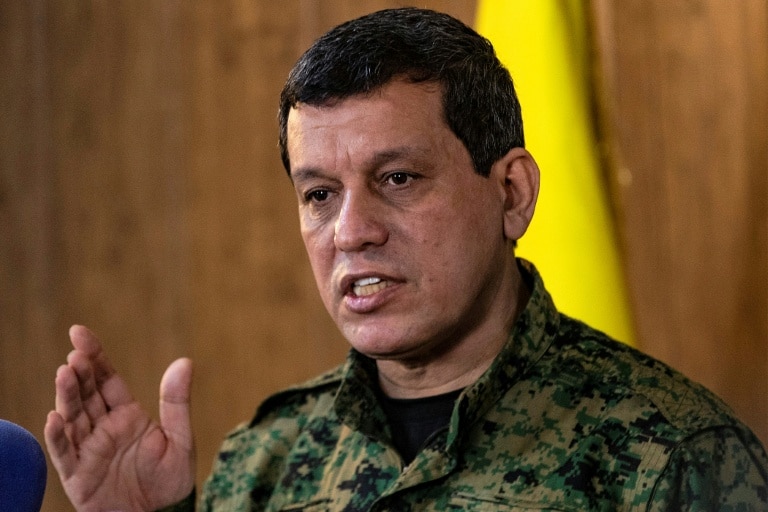
In a historic shift reshaping Syria’s political and military landscape following the ousting of long-time leader Bashar al-Assad late last year, Mazloum Abdi, commander-in-chief of the Kurdish-led Syrian Democratic Forces (SDF), has formally announced the dissolution of the group as an independent military force. The move comes as the final step in a broader agreement that integrates all former SDF fighters and institutions into the new Damascus government’s state structures.
Abdi made the declaration in a televised address from the presidential palace in Damascus on Tuesday, confirming that the integration of SDF personnel into Syrian army brigades has been fully completed. “We announce today the end of the mission of the Syrian Democratic Forces and declare, with full responsibility, their dissolution as an independent military force,” Abdi stated. He added that since the SDF’s founding, fighters had carried a heavy burden through one of Syria’s darkest periods, liberating dozens of cities and towns first from the former Baathist regime, then from the brutal occupation of the Islamic State (IS), also known by its Arabic acronym Daesh.
“Circumstances have changed today and the country has entered a new phase characterised by peace and participation,” Abdi explained, noting that the group’s original mandate had concluded with the transition to a new political order. For his part, US Special Envoy to Syria and Iraq Tom Barrack, who also serves as Washington’s ambassador to Turkey, praised the disbandment as a model for post-conflict reconciliation. “This is what real integration looks like: not winners and losers, but former counterparts with differing points of view crafting a diplomatic solution to strengthen the sovereign nation of Syria. One army, one government, one state,” Barrack said.
The SDF’s origin traces back to 2015, when the United States helped organize the group to leverage the combat experience of Kurdish fighters who had successfully defended the northern Syrian city of Kobane from IS occupation. For nearly a decade, the SDF served as Washington’s primary partner in the campaign against the jihadist group, ultimately driving IS out of all the territory it controlled in Syria by 2019. At its peak strength, the coalition of Kurdish and Arab fighters numbered roughly 100,000 members and controlled large, oil-rich swathes of northern and northeastern Syria.
But the geopolitical landscape shifted dramatically following Assad’s ouster in late 2024, when the US shifted its support to the new US-friendly administration in Damascus, abandoning its long-time partner. In January 2025, open clashes between SDF fighters and new government troops left the Kurdish force with major territorial losses, and a wave of mass defections from Arab members of the SDF cut the group’s personnel in half, according to Syria expert Fabrice Balanche. Those clashes preceded the landmark integration deal that set the stage for Tuesday’s announcement.
Under the terms of the agreement, new Syrian President Ahmed al-Sharaa issued a historic decree granting formal recognition of Kurdish national rights and enshrining Kurdish as an official national language — a first for Syria since it gained independence in 1946. The deal also requires the SDF to expel all leaders and members of the Kurdistan Workers’ Party (PKK) — a group that has waged a decades-long insurgency in Turkey and is labeled a terrorist organization by Ankara — from Syrian territory, a concession that addressed longstanding Turkish security concerns. Turkey had repeatedly launched cross-border military incursions into northern Syria between 2016 and 2019 to push SDF forces back from its border, due to Ankara’s view that the SDF is an extension of the PKK.
The dissolution of the SDF marks a major political win for al-Sharaa, who has moved quickly to consolidate central government control over all Syrian territory following Assad’s fall. For Syria’s Kurdish population, however, the deal effectively ends a decades-long push for regional autonomy, even as Abdi reaffirmed that advocacy for Kurdish rights would continue through political channels. Last week, Abdi confirmed the full integration of Kurdish civilian administrative bodies into the Syrian state, adding: “Our struggle will continue, to cement our people’s rights in the constitution.”