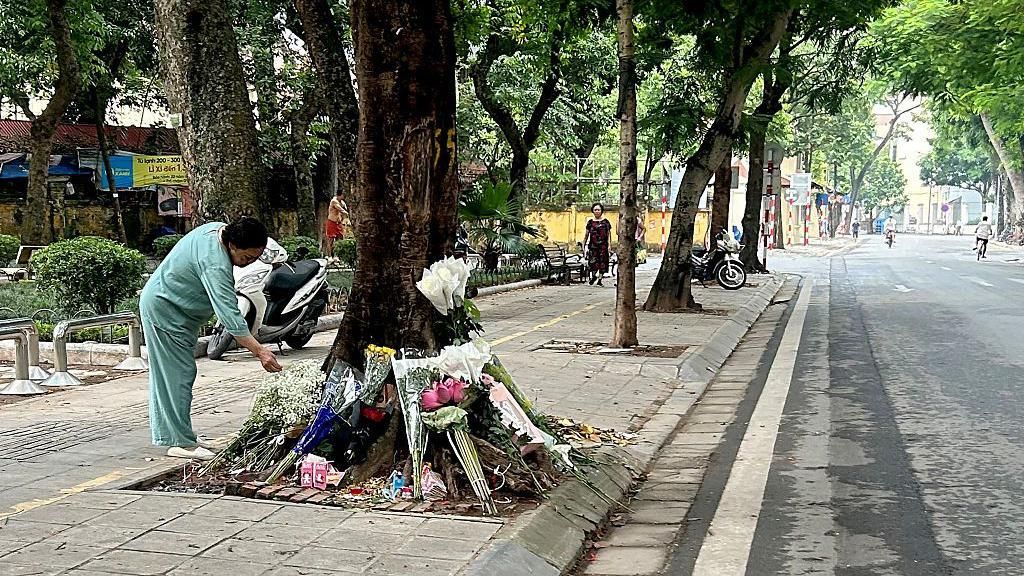
For months, an unassuming street tree along a busy Hanoi avenue blended in seamlessly with the hundreds of other greenery lining Vietnam’s capital. Today, it is widely known as the “Justice Tree,” a quiet gathering point for grief and anger that has grown into one of the most significant grassroots movements the country has seen in recent years.
The tragedy at the center of this movement dates back to May 2025, when former National Assembly deputy Nguyen Sy Cuong was driving his BMW along Nguyen Huy Tu Street. For reasons that remain undetermined, Cuong’s vehicle veered across the center line into oncoming traffic, slamming directly into a motorbike carrying 49-year-old Do Viet Hung and his 18-year-old daughter, Do Ngoc Phuong Thuy. Hung survived the crash with a broken leg, but Phuong Thuy – who had her right leg severed in the collision – died 10 days later in a local hospital.
For 15 months after the crash, almost no official information was released to the public, leaving a vacuum of transparency that fueled widespread speculation among Vietnamese citizens, particularly younger generations. In early August 2026, anonymous Gen Z social media users launched a coordinated campaign across major platforms including Facebook, Instagram, Threads and X, publishing millions of posts under the hashtags #NguyenSyCuong and #BMW to demand full accountability for the crash.
Early online discussion centered on two core questions: Was Nguyen Sy Cuong indeed the driver at fault, and why had authorities refused to release detailed information about the case? Multiple users shared reports matching the driver’s initials (NSC) and 1961 birth year to the former politician, leading to widespread rumors that the case had been covered up to protect a well-connected former public official. Many users also claimed their posts discussing the crash had been removed by social media platforms at the request of the Vietnamese government, sharing screenshot evidence of deletion notices – claims that have not yet been independently verified by outside outlets.
As calls for a full, transparent investigation grew louder, masked mourners began visiting the site of the crash to lay bouquets at the base of the Justice Tree. Local police quickly removed the flowers, prompting activists to create a virtual memorial of the Justice Tree online. The digital tribute quickly garnered hundreds of thousands of messages, condolences and tributes from across the country.
Faced with mounting public pressure and growing online attention that made the case impossible to ignore, Vietnamese authorities issued an unprecedented official confirmation in an August 2026 broadcast on state-run Vietnam Television (VTV). Officials confirmed that Nguyen Sy Cuong was indeed the driver of the BMW involved in the fatal collision. They added that because Cuong had “sincerely confessed and actively and fully remedied the consequences of his actions,” Phuong Thuy’s family had submitted a formal petition requesting that he be exempt from criminal prosecution. The statement did not disclose details of what “remedy” Cuong provided, and the former lawmaker was ultimately cleared of all criminal liability.
While the decision to drop charges is technically permitted under Vietnamese law, it has sparked sharp criticism from both legal experts and the public. Lawyers have questioned whether full due process was followed during the investigation, while social media users have pointed to Cuong’s decades of political connections as the core reason he avoided prosecution, renewing calls for a full independent probe.
This is not the first time that grassroots social media pressure in Vietnam has pushed authorities to revisit a high-profile crash involving a powerful connected individual. In March 2026, a retired police colonel named Nguyen Van Sau – a former deputy department head at the Ministry of Public Security – was involved in an alcohol-fueled chain-reaction crash that killed one woman and injured two others. After the victim’s family raised concerns the former official would avoid accountability, social media users amplified their calls for action. Three months later, Sau was formally charged with violating road traffic safety regulations.
Many Gen Z activists believe the same level of public pressure is the only path to securing justice for Phuong Thuy. But their movement has been met with swift pushback from Vietnamese authorities and state media.
In the same VTV broadcast that confirmed Cuong’s involvement, Phuong Thuy’s father Do Viet Hung thanked internet users for their sympathy, but stated his family was satisfied with the investigation’s outcome and asked the public to stop pressing the issue. He also warned citizens “not to be drawn into the influence of reactionary elements.” A senior Ministry of Public Security official went further, claiming that “hostile forces” were leveraging the accident to incite unrest and social disorder in the country ahead of Vietnam’s 2 September national holiday. Authorities have gone as far as to accuse the Gen Z-led movement of plotting a “colour revolution,” a common label used to describe nonviolent protest movements that the Vietnamese government frames as externally driven anti-government plots.
Movement organizers have rejected these accusations as baseless, insisting their only goal is to secure full transparency and accountability for a teenage crash victim. But the widespread outrage over the case has exposed growing, simmering discontent among Vietnamese youth even as the government tightens restrictions on online freedom of expression, using tools ranging from fines and intimidation to criminal prosecution to curb dissent.
On anonymous platforms like Threads and Reddit, young Vietnamese are increasingly speaking out about a range of grievances beyond the crash, from expanded police power and controversial land reclamation projects to high-profile exam cheating scandals and tighter restrictions on online communication. This youth discontent aligns with a broader wave of Gen Z-led anti-government movements across the Asia-Pacific over the past year, where young people have mobilized against corruption, nepotism, economic inequality and democratic backsliding. Collectively, these movements have been unofficially dubbed the “Asian Spring,” with visible uprisings taking place in Bangladesh, India, Nepal, Iran, Mongolia, the Maldives, the Philippines and Timor-Leste.
Unlike many of these countries, large-scale public protest has rarely reached a boiling point in Vietnam, where authorities have a long history of quickly stifling dissent before it can translate to offline action. For most Vietnamese civilians, anonymous social media posts, digital memorials and online organizing represent the most robust form of activism they can safely pursue.
At its core, the movement remains focused on a single goal: holding a former lawmaker accountable for a fatal crash that killed an 18-year-old girl, and ensuring that no connected public figure is granted special treatment under the law. Yet even the existence of this small, focused movement has sparked alarm among authorities, serving as a stark reminder of the entrenched political status quo in Vietnam’s one-party state. As one viral post framing the government’s perspective put it: “Are these Gen Z kids planning a colour revolution using this accident? Are they trying to emulate Bangladesh, India, and Nepal, and then create an Asian Spring? Remember, this is Vietnam! This is not Nepal, India, or Bangladesh!”